'Chainsaw massacre': Europe mulls culls for fish-guzzling cormorant / Photo: © AFP

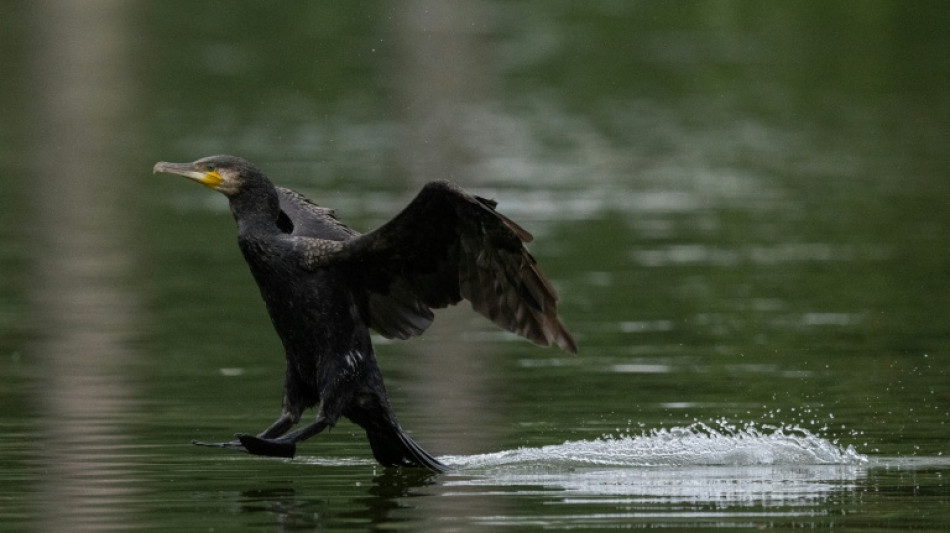
Europe's great cormorant has recovered from near-extinction to overabundance in half a century, stoking a long-running debate over population control between fishers troubled by its voracious appetite and conservationists.
The large black bird's relentless raids on the continent's waters have recently led nine European Union members to urge an easing of the culling rules that have protected the species since 1979.
In a note to Brussels in May, Croatia, the Czech Republic, Estonia, Finland, Latvia, Poland, Romania, Slovakia and Sweden asked for the bloc's cormorant population to be kept at "an ecologically and economically acceptable level".
"The situation is very bad and keeps worsening," Peter Bozik from the Slovak Fishing Club told AFP, calling the bird "a terrorist".
"When cormorants gather in wintering grounds, they can collect the entire fish population out of the unfrozen water in a moment, or damage it so that it will not survive," he added.
Pavel Vrana, an ichthyologist at the Czech Fishing Union, said cormorants not only eat fish, but also often injure them or stress them out so they will not reproduce.
"When you have 3,000 cormorants descending on a place, it's a chainsaw massacre," he told AFP.
Grigore Stefan, from the Murighiol Fishermen's Association in the Danube Delta, said Romania lost "millions of fish" to cormorants annually.
"It's a harmful animal," he said. "I don't know if there are any fish left in the delta this summer."
- 'Fish tubs' -
In the past, Europeans systematically destroyed some cormorant colonies with the help of fire brigades and the military, according to a European Parliament report.
Those efforts brought the species close to extinction. By the early 1960s, only a few thousand breeding pairs remained in the main breeding range of the Netherlands, Germany, Denmark, Sweden and Poland.
But since being granted protected status, its numbers have soared to an estimated two million birds in Europe in 2026.
Zdenek Vermouzek, head of the Czech Society for Ornithology, said cormorants benefited from overfishing in the Baltic Sea, which has wiped out large predatory fish feeding on smaller fry.
"The cormorants have simply replaced these predators," he told AFP.
In central Europe, fish lack hiding places asthe authorities are quick to clear natural shelters such as fallen trees, while ponds resemble "fish tubs" with steep banks, making them vulnerable to predators, Vermouzek added.
Cormorants also have "very few natural predators and so multiply uncontrollably", Romania's General Association of Hunters and Sport Fishermen told AFP.
Both fishers and conservationists agree that while local cormorant populations are relatively low and stable, the greatest damage is caused by large flocks of migrant birds.
But they propose very different methods to deal with the fast-flying, flexible cormorants.
Calling for a "pan-European solution", Vrana proposed oiling eggs in the nest to close the pores through which the embryo breathes as an efficient culling method.
"If we want to ecologically and efficiently curb the population, it must happen in the place where they reproduce, no matter how terrible that sounds," he said.
Conservationists disagree, though they accept the practice of shooting cormorants, allowed under an exception to the EU rules, to deter them from areas where fish winter.
Ornithologist Jozef Ridzon, from SOS/Birdlife Slovakia, said fishers should identify "sensitive" fish protection areas to continue deterrent shooting.
"A blanket solution will fail," he warned.
- 'Mankind has erred' -
Vermouzek was also sceptical of large-scale measures for which "we don't have the men and we don't have the guns".
"The birds are rather intelligent and when someone intervenes in a colony, they will start nesting separately and the costs of the intervention will rise," the ornithologist added.
He proposed reducing river-clearing operations to give fish better hiding places from the birds, and returning to nature-driven management on the region's exposed ponds.
Both conservationists and fishers agree humanity is to blame for the damage.
But while environmentalists favour letting nature run its course, fishers want greater human intervention.
"If mankind has erred, mankind must make amends. We cannot rely on natural mechanisms at a time when nature's hands are tied," said Vrana.
burs-frj/sbk/pdw
P.Grant--TFWP