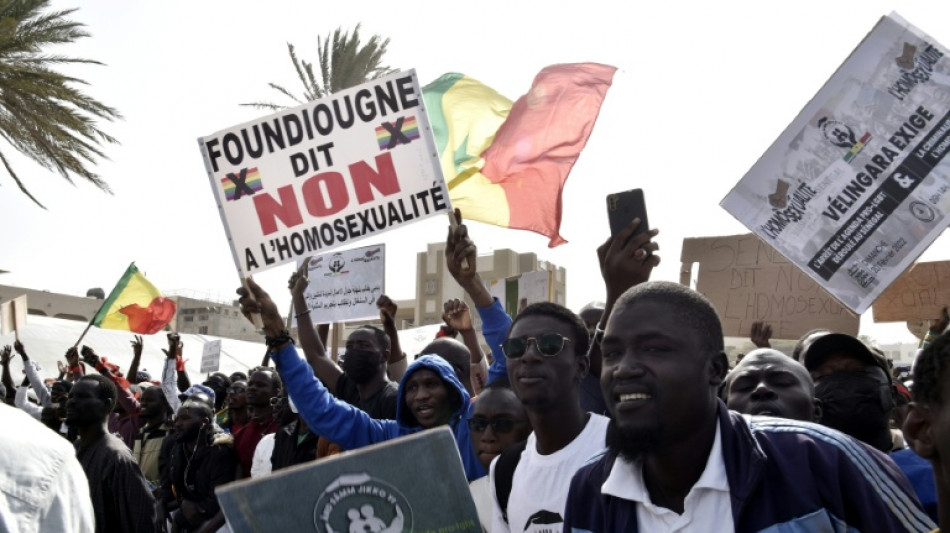
'Public lynching': Senegal cracks down on LGBTQ+ community / Photo: © AFP/File

From a rise in arrests to online attacks, Senegal has been under an intensified crackdown on same-sex relations in recent weeks, prompting outcry from human rights groups and driving some in the LGBTQ+ community to consider exile.
Amplifying the repression, Prime Minister Ousmane Sonko on Tuesday unveiled legislation that would double the maximum penalty for same-sex relations, making them punishable by up to 10 years in prison.
Homosexuality has long been a hot-button issue in the Muslim majority and deeply religious West African nation.
But in early February, a dozen men were arrested, including two local celebrities, accused of "acts against nature" -- a term used to describe same-sex relations.
That spurred a wave of arrests, at least 30 people according to local press, based on accusations and phone searches reported almost daily -- and the names of those detained have been made public.
"Even in Senegal, this is unprecedented. What they are doing is public lynching," a human rights defender told AFP on condition of anonymity.
Some of those detained have faced accusations of deliberately transmitting HIV, fuelling further fierce debate about same-sex relations.
The highly publicised arrests -- spawning headlines like "Big homo clean-up" and "Bisexuals, walking dangers" -- prompted Senegal's media ethics regulator CORED to call for respect for human dignity and individuals' privacy.
On social media, it has also stirred up already charged language and videos -- which AFP could not verify -- showing people being assaulted over suspicion of their sexual orientation are circulating.
The LGBTQ+ community has been "traumatised", the human rights defender said.
"People are hiding -- they are going into seclusion much more than before."
- 'Dramatic situation' -
It is within this context that Sonko's draft bill was developed.
In addition to doubling prison terms for those found guilty of same-sex relations, it would also punish those who advocate for LGBTQ+ people with prison sentences of three to seven years.
Making good on a longstanding promise by the ruling party, the repression of same-sex relations is politically advantageous in a country where it is widely regarded as deviant.
For years, influential religious groups have called for its "criminalisation".
The climate of regular discrimination has become unbearable for the LGBTQ+ community in the country, activists contacted by AFP said.
"We are still helping people get to Gambia", the neighbouring country, the rights activist said, denouncing the "dramatic situation".
The scale of departures is difficult to quantify given their secretive nature, but the association STOP Homophobia said it received 18 requests for help to leave Senegal in recent days.
The Paris-based group regularly supports Senegalese victims of discrimination and has noted an increase in requests for assistance.
"Some mention violence, threats and expulsion from their families. All are afraid of being arrested and many fear for privacy violations," said Terrence Khatchadourian, STOP's secretary general.
"Using details related to HIV status as evidence has serious consequences for public health by discouraging testing and access to care," he added.
- Defending 'norms' -
Few groups have denounced the situation in Senegal, where defending the rights of same-sex relations is viewed as a Western value incompatible with local ones.
The new president of Senegal's human rights league, Denis Ndour, said he supports harsher penalties and describes individuals practicing same-sex relations as "sick", in a recent interview with the Senegalese newspaper L'Observateur.
"Externalising homosexuality cannot be accepted" out of respect to local "norms", he said.
"Whatever a country's cultural or religious stance, protection from violence and humiliation is a universal principle," said Marame Kane, a French-Senegalese expert in advocacy on LGBTQ+ and feminist issues.
Since 2021, Senegal has no longer been considered a safe country by France's Office for the Protection of Refugees and Stateless Persons due to risks linked to sexual orientation.
Boubacar, using a pseudonym for his protection, said he was forced to flee Senegal five months ago when his family discovered his sexual orientation and threw him out of their home.
Some of his friends are now also trying to leave the country, he told AFP.
As for those who do not have the means, "the only thing they can do is see death coming and wait".
G.George--TFWP