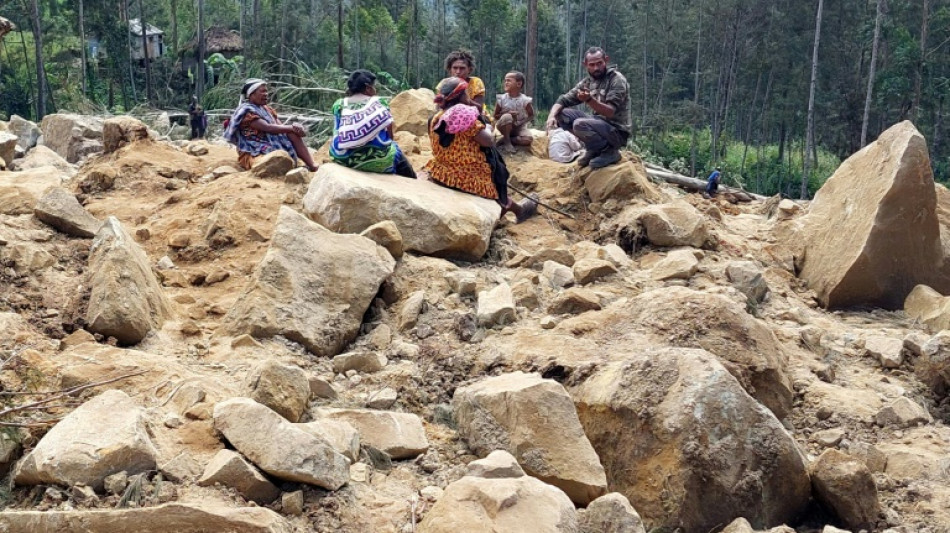
Rescuers fear new slips at deadly Papua New Guinea landslide / Photo: © AFP

Rescuers digging through mud and rocks at a Papua New Guinea landslide that killed an estimated 670 people say they are being obstructed by falling debris, dangerous terrain and tribal fighting along a key supply route.
A once-bustling remote hillside village in Enga province was almost wiped out when a chunk of Mount Mungalo collapsed in the early hours of Friday morning, burying scores of homes and the people sleeping inside them.
Locals have been using shovels and pieces of wood to find bodies under the landslide -- a mix of car-sized boulders, uprooted trees and churned-up earth that is thought to be up to eight metres (26 feet) deep.
"The landmass is still sliding, rocks are falling from the mountain," UN migration agency official Serhan Aktoprak told AFP.
Streams of water were flowing between the soil and debris while cracks were appearing in land adjacent to the landslip, Aktoprak said.
"This might trigger a further sliding," the UN official warned, posing a "serious risk" both to rescuers and people living in the area.
- 'Houses burning' -
Aktoprak said his colleagues had to flee falling rocks at the site at the weekend.
The estimated death toll climbed to 670 over the weekend after local leaders and disaster workers reassessed the size of the population lying beneath mud and rubble spanning almost four football fields in length.
Five bodies and the leg of a sixth had been pulled from the debris by Saturday night.
"It has been already three days and seven hours since this disaster hit so basically we are racing against time but to what extent we might be able to bring people to safety is another issue," Aktoprak said.
More than 1,000 people have been displaced by the catastrophe, aid agencies have estimated, with food gardens and water supplies destroyed.
An outbreak of tribal fighting unrelated to the disaster was blocking attempts to bring in humanitarian aid from the provincial capital Wabeg, the UN official said.
"Many houses are burning with others emitting smoke. Women and children have been displaced while all the youth and men in the area were carrying bush knifes," he said, quoting from a report from an aid convoy attempting to reach the disaster site.
The tribal battles had also delayed the delivery of heavy machinery and diggers.
- 'Nobody escaped' -
The area is located some 600 kilometres (370 miles) from Port Moresby, the capital of the South Pacific island nation.
A schoolteacher from a neighbouring village, Jacob Sowai, said more than 2,000 people lived in the disaster zone.
"People are very sad. Nobody escaped. It's very hard to collect information. Nobody escaped. We don't know who died because records are buried," he told AFP.
People from adjoining villages were helping to unearth bodies, said Nickson Pakea, president of the nearby Porgera Chamber of Commerce and Industry.
"Because of the hard rock and the clay, the stone, and the rocks that came in, it is quite messy. It needs excavators to remove the debris," Pakea told AFP.
A nearby mining joint venture, New Porgera Limited, had agreed to provide mechanical diggers to help the rescuers and clear roads, he said.
Located on the side of densely forested Mount Mungalo, the village was home to a transient population that could swell to more than 4,000 people.
It served as a trading post for miners who panned for gold in the highlands.
- Heavy rains -
Locals said the landslip may have been triggered by heavy rains that have saturated the region in recent weeks.
Papua New Guinea has one of the wettest climates in the world, according to the World Bank, with the heaviest downpours concentrated in the humid highland interior.
Research has found shifting rainfall patterns linked to climate change could exacerbate the risk of landslides.
Since the start of the year, the country has experienced multiple earthquakes, floods and landslides, stretching the resources of emergency services.
T.Harrison--TFWP