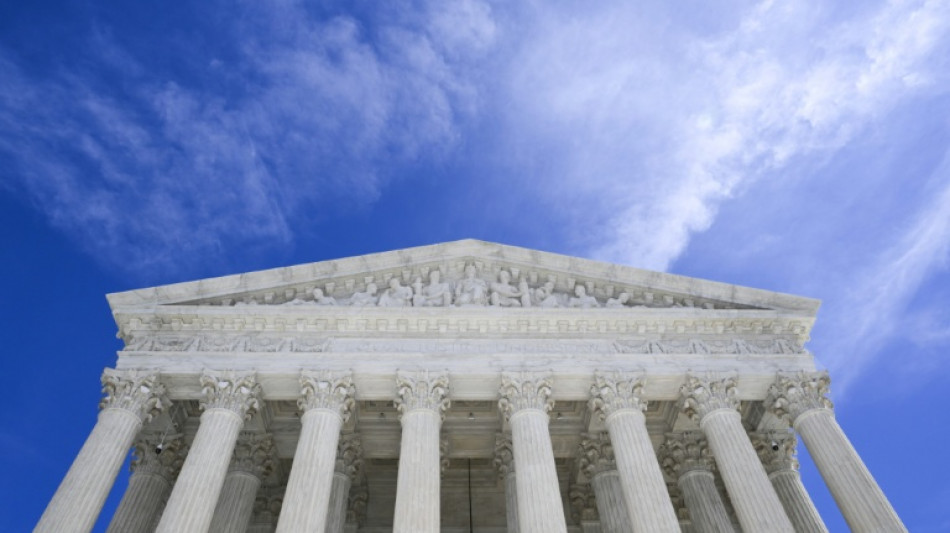
US Supreme Court hears bid to shut the door on climate suits / Photo: © AFP/File

Dozens of climate lawsuits could live or die by a Supreme Court case to be heard Monday seeking damages from oil companies for their role in global warming and for concealing the dangers of fossil fuels.
Known as Suncor v Boulder, the dispute began in 2018 when the city and county of Boulder, Colorado, sued ExxonMobil and Suncor Energy, claiming they "knowingly caused and contributed to the alteration of the climate" while "concealing and/or misrepresenting the dangers" of their products.
Suncor operates a refinery in Colorado, while ExxonMobil has deep ties to the Rocky Mountain State. The plaintiffs say they have suffered hundreds of millions of dollars in losses from wildfires, flooding and other weather extremes stemming from climate change linked to the burning of fossil fuels.
It is one of around 40 similar suits brought by cities, states, tribes and other local jurisdictions, modeled on successful litigation against tobacco and opioid producers.
The companies contend such suits aim to impose an enormous "carbon tax" that could bankrupt the energy industry -- that they are an illegitimate attempt to regulate greenhouse gas emissions, and are essentially asking the court to make them all go away.
After failing to move the case to federal court, the companies lost bids to have it dismissed in state court and at Colorado's Supreme Court.
President Donald Trump's administration filed a brief urging the US Supreme Court to take up the case, and the justices agreed.
The court will consider whether federal law -- specifically the Clean Air Act -- preempts Boulder's claims, whether the Constitution itself bars such suits, and whether it can review the case before a trial has taken place.
If the justices focus on the last question, "that essentially just kicks the can down the road" since the wider questions would likely be raised later, Katrina Kuh, a professor of environmental law at Pace University, told AFP.
A ruling on the federal law questions, however, would matter for many pending suits.
"It could extinguish them entirely," said Kuh. Or the justices could narrow them -- allowing Colorado, for example, to apply its state law only to emissions within the state.
The questions also bear on so-called "climate superfunds" -- laws in New York and Vermont that would make polluters pay for climate resilience projects.
New York's was struck down by a federal judge last month, and an adverse Supreme Court ruling could shut the door to it being revived on appeal.
Conservative legal scholar Jonathan Adler, a William & Mary law professor who filed a brief supporting Boulder, told AFP he disagreed with the oil companies' legal theories and believed such cases are "viable" -- without offering a view on the underlying merits.
He added that Justices Amy Coney Barrett, Neil Gorsuch and Clarence Thomas bear the most watching because "all three of them have shown some skepticism towards broad preemption arguments," though he said they are also likely to be skeptical of suits of this nature.
Ahead of the hearing, ultraconservative Justice Samuel Alito recused himself after critics called on him to step aside over his oil and gas stock holdings.
Conservatives still hold a 5-3 majority without Alito, but a 4-4 split is now possible -- which would leave the Colorado ruling in place and let the case proceed to trial.
A.Nunez--TFWP