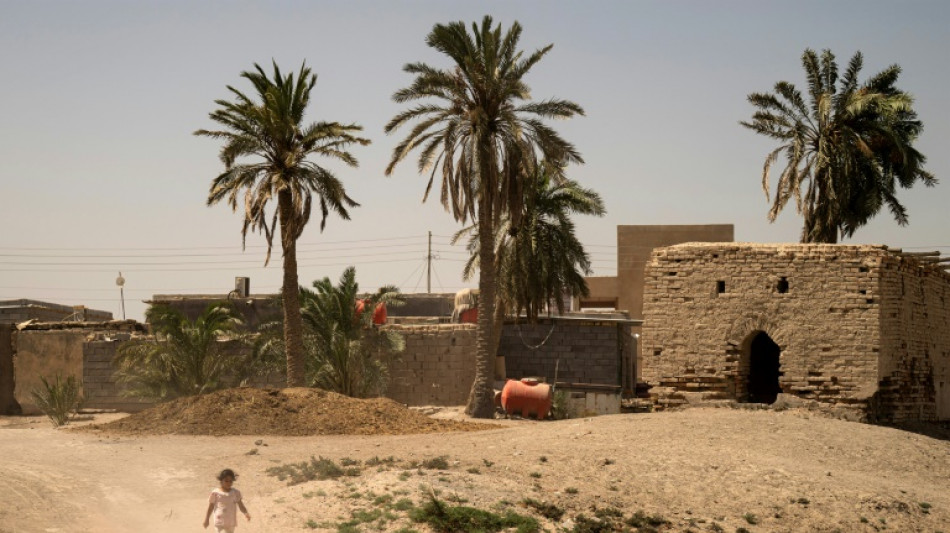
Water salinity hurting farmers, livestock in Iraq / Photo: © AFP

Iraqi farmer Umm Ali has watched her poultry die as salinity levels in the country's south hit record highs, rendering already scarce water unfit for human consumption and killing livestock.
"We used to drink, wash and cook with water from the river, but now it's hurting us," said Umm Ali, 40, who lives in the once watery Al-Mashab marshes of southern Iraq's Basra province.
This season alone, she said brackish water has killed dozens of her ducks and 15 chickens.
"I cried and grieved, I felt as if all my hard work had been wasted," said the widowed mother of three.
Iraq, a country heavily impacted by climate change, has been ravaged for years by drought and low rainfall.
Declining freshwater flows have raised salt and pollution levels, particularly further south where the Tigris and Euphrates rivers converge before spilling into the Gulf.
"We haven't seen such high levels of salinity in 89 years," Iraq's water ministry spokesman Khaled Shamal said.
Last month, salinity levels recorded in central Basra province soared to around 29,000 parts per million compared to 2,600 ppm last year, according to a report from the ministry.
Freshwater should contain less than 1,000 ppm of dissolved salts, while ocean water salinity levels are around 35,000 ppm, according to the US Geological Survey.
- Dead buffalo -
The Tigris and Euphrates converge at Basra's Shatt al-Arab waterway "laden with pollutants accumulated along their course", said Hasan al-Khateeb, an expert from Iraq's University of Kufa.
In recent weeks, the Euphrates has seen its lowest water levels in decades, and Iraq's artificial lake reserves are at their lowest in recent history.
Khateeb warned that the Shatt al-Arab's water levels had plummeted and it was failing to hold back the seawater from the Gulf.
Farmer Zulaykha Hashem, 60, said the water in the area had become very brackish this year, adding that she has to wait for the situation to improve in order to irrigate her crop of pomegranate trees, figs and berries.
According to the United Nations, almost a quarter of women in Basra and nearby provinces work in agriculture.
"We cannot even leave. Where would we go?" Hashem said, in a country where farmers facing drought and rising salinity often find themselves trapped in a cycle of water crisis.
The UN's International Organization for Migration, which documents climate-induced displacement in Iraq, has warned that increased water salinity is destroying palm groves, citrus trees and other crops.
As of October last year, some 170,000 people were displaced in central and southern Iraq due to climate-related factors, according to the agency.
Water scarcity pushed Maryam Salman, who is in her 30s, to leave nearby Missan province for Basra several years ago, hoping her buffalo could enjoy the Shatt al-Arab.
Near her house, AFP saw three buffalo skeletons on the parched land, with locals saying the animals had died due to lack of water.
Rising salinity is not the only problem now, said Salman, a mother of three children.=
"Water is not available... neither summer nor winter," she said.
- Fewer fish -
The Tigris and Euphrates originate in Turkey, and Iraqi authorities have repeatedly blamed dams across the border for significantly reducing their flows.
Iraq receives less than 35 percent of its allocated share of water from the two rivers, according to authorities, in a country with inefficient water management systems after decades of war and neglect.
Khateeb from the University of Kufa said that in addition to claiming its share of the rivers, Iraq must pursue desalination projects in the Shatt al-Arab.
In July, the government announced a desalination project in Basra with a capacity of one million cubic meters per day.
Local residents said the brackish water was also impacting fish stocks.
Hamdiyah Mehdi said her husband, who is a fisherman, returns home empty-handed more frequently.
She blamed the Shatt al-Arab's "murky and salty water" for his short temper after long days without a catch, and for her children's persistent rash.
"It has been tough," said Mehdi, 52, noting the emotional toll on the family as well as on their health and livelihood.
"We take our frustrations out on each other."
M.McCoy--TFWP