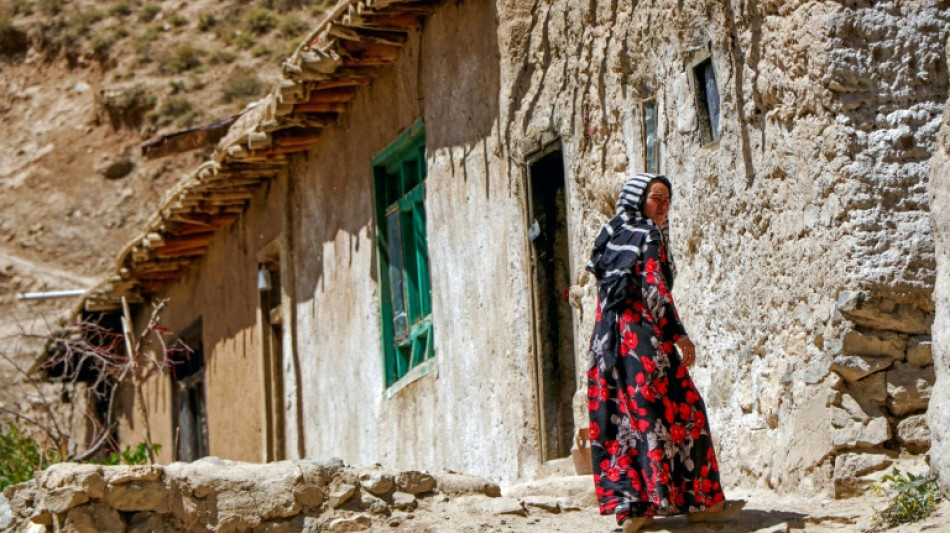
Women bear brunt of Afghanistan's water scarcity / Photo: © AFP

In a remote Afghan village, women strap yellow plastic jerry cans to donkeys and travel every day down a dusty canyon to collect as much water as they can.
The containers hold barely enough for drinking, let alone for the hygiene needs of the roughly 30 people living in Qavriyak, central Bamiyan province.
"There is not enough water to clean or take a shower daily and we don't have hygienic toilets," said 26-year-old Masooma Darweshi.
It's a struggle faced by parched settlements across much of the country.
Afghans are experiencing the climate crisis through water, international organisations warn, emphasising that women are particularly at risk.
Women and girls traditionally make the increasingly long trips to collect water, made more difficult since the Taliban government came to power and imposed restrictions on women's movement, education and work.
Women are the primary caregivers in Afghan households, tending to children, the sick and elderly as well as domestic chores.
"Water is women's business," Shukria Attaye, a school teacher in a village above Darweshi's, told AFP.
"Cooking, cleaning dishes, fetching water, washing clothes, taking care of the kids, bathing them -- it's all on women."
- 'Unaware of proper hygiene' -
At the top of the canyon with sides stained by a now-dry stream, Attaye's village's fortunes changed when non-governmental organisation Solidarites International provided toilets and a clean water source.
"Women used to carry big gallons on their backs, causing back problems" as they hiked thirty minutes each way to collect water or take dishes and clothes for washing, said Attaye.
The children used to get sick often from water contaminated by human and animal waste, contributing to one of the highest rates of malnutrition in the world, particularly among children and mothers.
The UN children's agency UNICEF said in May approximately 31 percent of Afghans do not have access to basic drinking water and 42 percent do not have access to basic hygiene services, with the burden weighing "most heavily on girls and women".
The Taliban authorities dispute the UN figures but have implemented their own projects on water management and hygiene, water ministry spokesman Motiullah Abid told AFP.
Improving hygiene awareness and disease rates "won't be solved in just five or six months, addressing them requires sustained effort", said Aziza Shuja, who has worked on women's health issues across her native Bamiyan for years, carrying out hundreds of hygiene training sessions with Solidarites International.
"Many women said they had previously been unaware of proper hygiene," with diarrhoea and skin conditions rife, said Shuja, who trained in gynaecology.
But a cultural reluctance to publicly address women's health and a ban on girls' education beyond primary school have contributed to a lack of knowledge and poor access to women healthcare providers.
- 'More problems than men' -
Darweshi said the women in her village get ill often, but it is a long and bumpy ride to the nearest clinic -- a journey often taken by donkey or motorcycle.
"Sometimes, when women get their periods, they complain of pain in their kidneys or abdomen," Darweshi said, blaming infections from lack of water for hygiene.
Disposable pads are out of reach for the poor family, which did not have enough water this year to grow crops.
The fine line many families walk between getting by and desperation in a country facing one of the world's worst humanitarian crises after decades of war, is stark in the face of increasing climate risks, like droughts and floods.
In neighbouring Maidan Wardak province, Gol Babo and her daughter said they would have to cut dirty clothes into strips to use when they menstruated after a flash flood clogged the Chinzai village's already limited water source.
"Women have more problems than men, of course," she told AFP. "There is only enough water for drinking... Everything is laying outside dirty, there is no water to clean anything."
S.Jones--TFWP