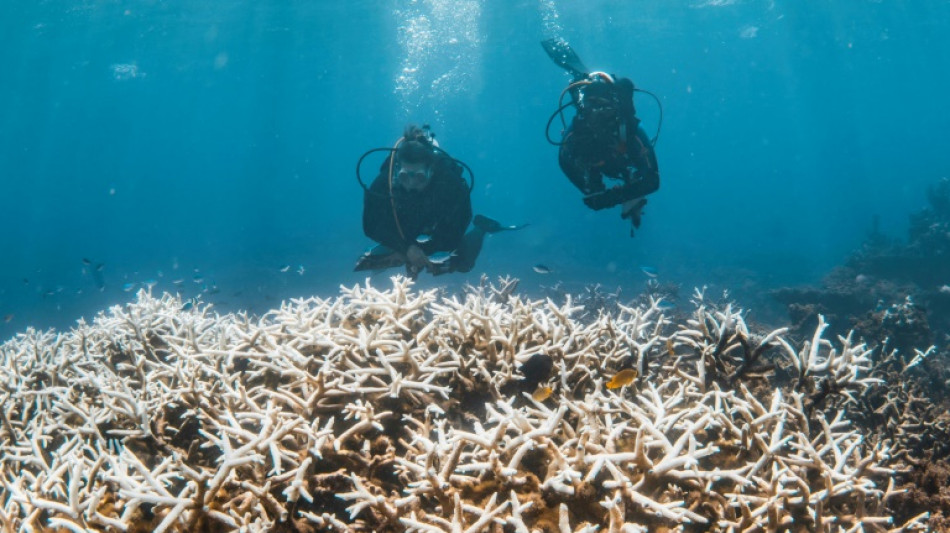
Great Barrier Reef suffers most widespread bleaching on record / Photo: © Minderoo Foundation/AFP/File

Australia's famed Great Barrier Reef has suffered its most widespread coral bleaching on record, according to a government report released Wednesday that warns the natural wonder is in dire health.
Scientists documented the "most spatially extensive" bleaching since records began almost 40 years ago, driven by sweltering ocean temperatures in 2024 that triggered "unprecedented levels of heat stress".
The Australian Institute of Marine Science surveyed the health of 124 coral reefs between August 2024 and May 2025.
Northern and southern branches of the sprawling reef had seen the "largest annual decline in coral cover" ever recorded, the government agency found.
Reefs had been battered by tropical cyclones and infestations of crown-of-thorns starfish that feast on coral.
But the "number one cause is climate change," said the institute's research lead Mike Emslie.
"There is no doubt about that," he told AFP.
Often dubbed the world's largest living structure, the Great Barrier Reef is a 2,300 kilometre (1,400-mile) expanse of tropical corals that houses a stunning array of biodiversity.
But repeated bleaching events have threatened to rob the tourist drawcard of its wonder, turning banks of once-vibrant coral a sickly white.
Unusually warm tropical waters triggered widespread coral bleaching on the Great Barrier Reef in 2024 and in the first few months of 2025 -- the sixth such event in the past nine years.
"The (Great Barrier Reef) experienced unprecedented levels of heat stress, which caused the most spatially extensive and severe bleaching recorded to date," the report found.
Over the past two years a mass global bleaching event has drained the life from more than 80 percent of the world's coral reefs.
Bleaching occurs when water temperatures rise forcing coral to expel the colourful microscopic algae, known as zooxanthellae, embedded in their tissues.
If high temperatures persist, the coral can eventually turn white and die.
Emslie said past coral growth would help cushion the record losses and that the Great Barrier Reef was still an "amazing place".
- 'Worth fighting for' -
"It is still worth fighting for. We can't throw our arms up and give up," he said.
The report found a rapidly growing type of coral -- known as acropora -- had suffered the most.
This coral is quick to grow, but is also one of the first to bleach.
The report found that any recovery of the reef could take years and was dependent on future coral reproduction and minimal environmental disturbance.
Richard Leck from the World Wildlife Fund compared the fluctuating health of the Great Barrier Reef to a "rollercoaster".
"That is a sign of an ecosystem under incredible stress and what reef scientists are hugely concerned about is when the reef does not keep bouncing back the way it has," he told AFP.
Leck said some coral reefs around the world were already beyond recovery, warning the Great Barrier Reef could suffer the same fate without ambitious and rapid climate action.
The average sea surface temperature around Australia was the "highest on record" in 2024, according to Australian National University.
Australia is currently developing its next round of emissions reduction targets, a key obligation under the landmark Paris climate agreement.
The mining superpower remains one of the world's biggest coal exporters and continues to heavily subsidise its fossil fuel sectors.
M.Delgado--TFWP