Rubber tappers forge sustainable future in Amazon / Photo: © AFP

As the sun rises over the Amazonian island of Marajo, Renato Cordeiro laces up his boots, grabs his knife, and heads out to tap his rubber trees.
Drop by drop, he collects the milky white sap, known as latex, that sustains him.
The recent revival of the rubber tapper trade in this impoverished northern Brazilian region has created jobs for families who once thrived during the Amazonian rubber boom, which collapsed in the late 20th century.
A local company called Seringo has enabled Cordeiro and more than 1,500 other rubber tappers to resume their craft. The company produces goods such as footwear while also protecting the forest, increasingly threatened by deforestation.
For Cordeiro, a wiry 57-year-old, the Amazon is his backyard.
Behind his stilt house on the Anajas River, dozens of natural rubber trees blend with centuries-old trees and palms typical of this island, surrounded by rivers on one side and the sea on the other.
- 'Family heritage' -
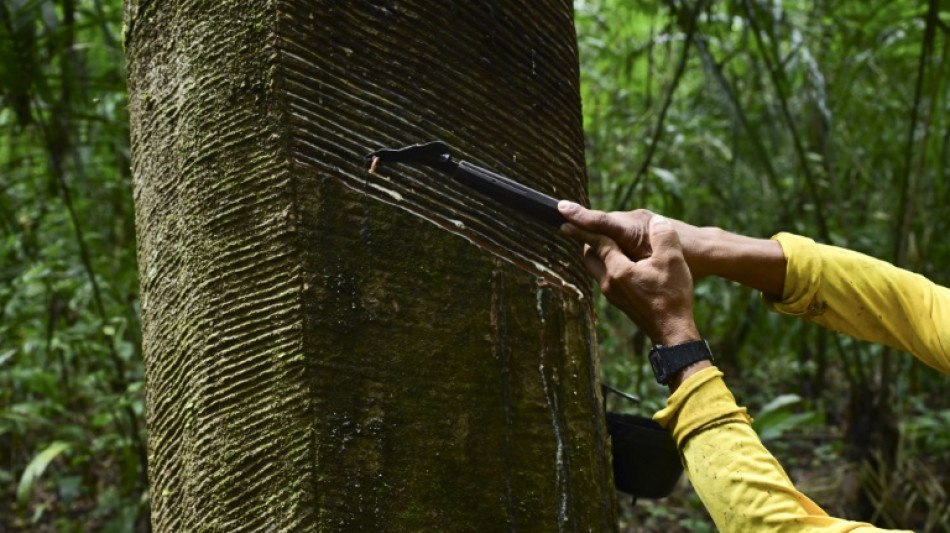
"I started tapping trees at age seven with my mother, deep in the forest," said Cordeiro, holding his knife, which has a protruding metal piece for making precise cuts in the bark.
With each incision made carefully to avoid harming the trunk, the native Amazonian tree begins to drip its latex into a container placed underneath. As it fills, Renato moves on to the next tree.
Each day, he collects about 18 liters (4.8 gallons), mixing it with vinegar to produce white rubber sheets. These hang on a rope for 10 days to dry before being sold to Seringo, which picks them up from his riverside home.
Cordeiro, a married father of three, beams with pride. After nearly two decades of scraping by through hunting and acai harvesting, he returned to rubber tapping in 2017 to protect what he calls his family heritage — the forest.
"I longed for this work to return," says Valcir Rodrigues, another rubber tapper and father of five, from a stilt house along the river north of Anajas.
"We want to leave a better world for our children, so we don't deforest," he says.
Rodrigues frequently confronts loggers who invade his land to cut down trees.
"They need to understand how much they harm the forest — and themselves — since many end up in debt to their employers," he explains.
Deforestation surged in Marajo when global demand for Amazonian rubber plummeted as countries like Malaysia began large-scale rubber tree plantations.
Today, however, rubber sustains Rodrigues's entire family. His wife and mother-in-law skillfully craft colorful artisanal goods sold primarily in Belem, the capital of Para state, to Marajo's east.
"I was a civil servant, but the local government never gave me a job. This is my first real trade, and I love it," said his mother-in-law Vanda Lima, a smiling 60-year-old.
- Expansion -
With one of Brazil's worst Human Development Index rankings, "it was necessary to create income in Marajo," says Zelia Damasceno, who co-founded Seringo with her husband to boost the region's bio-economy.
Initially focused on promoting artisanal work, the couple realized that rubber tappers were "unsatisfied," extracting latex sporadically for their spouses to use in making crafts.
"That's why we envisioned a second purpose — footwear — so they could also earn a living," says Damasceno, 59, from Para.
At its factory in Castanhal, about 300 kilometers (200 miles) east of Marajo, Seringo produces 200 pairs of biodegradable shoes daily, made from 70 percent rubber and 30 percent acai powder.
The company recently received support from the Para government to expand the number of rubber tappers it calls on in Marajo to 10,000.
That is part of a sustainable development program launched ahead of COP30, a UN climate conference scheduled for November in Belem.
Still, challenges remain, Damasceno admits: "Some young people don't want to follow this path. We must raise awareness about the importance of this work to preserve the forest and their future."
T.Mason--TFWP