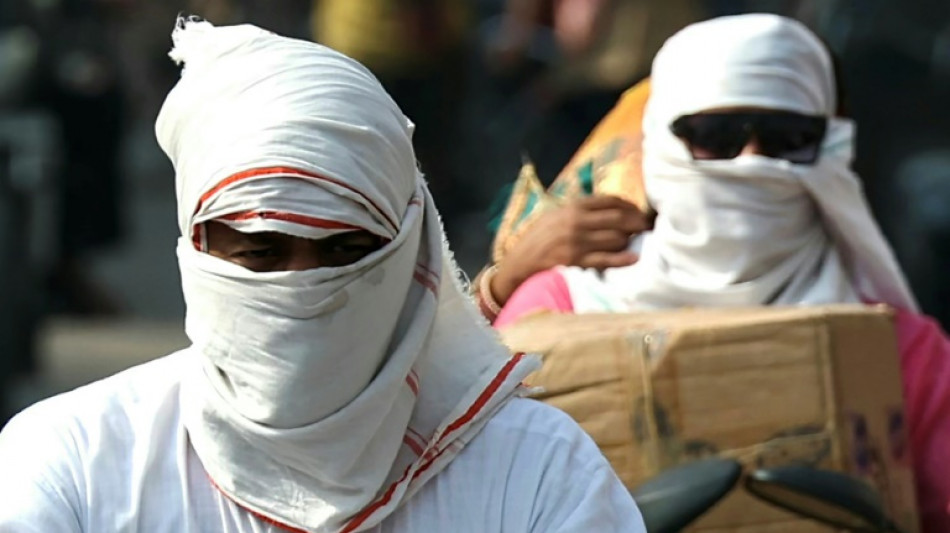
Experts warn of heat risks as India's temperatures climb again / Photo: © AFP

Extreme temperatures across India are having their worst impact in the country's teeming megacities, experts said Thursday, warning that the heat is fast becoming a public health crisis.
India is enduring a crushing heatwave with temperatures in several cities sizzling well above 45 degrees Celsius (104 degrees Fahrenheit).
Temperature readings in the capital New Delhi rose into the high 40s Celsius this week, with power usage in the city -- where the population is estimated at more than 30 million -- surging to a record high on Wednesday.
"Cities are more vulnerable to the compounding effects of urbanisation and climate change," said Aarti Khosla, director at research institute Climate Trends.
"Expect a greater number of hotter days, prolonged dry spells and less rainy days as weather patterns continue to change due to increased human emissions," she told AFP.
- Heat ward and ice baths -
In Delhi's Ram Manohar Lohia hospital, a specialised unit is busy treating patients with heat-related illnesses.
Equipped with immersion ice baths, the unit has treated eight heat-struck patients in the past week.
One person died Wednesday, medics said, with a body temperature that had surged to a fatal 41.5C (106.7F).
Among those admitted to the unit were manual labourers, most aged between 40 and 50, who work under the blazing sun.
"Treatment depends upon very quick, very rapid intervention and very rapid cooling," hospital director Ajay Shukla said, warning that the mortality rate for severe cases is around "60-80 percent".
The rising temperatures hit the vulnerable the hardest, including those on the economic margins, experts said.
"When the individual is dehydrated, extreme heat exposure will thicken their blood and cause organs to shut down, resulting in death within hours, popularly called 'heat stroke’," said Vidhya Venugopal, director at Sri Ram Institute of Higher Education and Research in Chennai.
"We urgently need... action to protect exposed populations."
- 'About survivability' -
India is no stranger to searing summer temperatures but years of scientific research have found climate change is causing heatwaves to become longer, more frequent and more intense.
The highest confirmed temperature ever recorded in India was 51C (123.8F), in Phalodi on the edge of Rajasthan's Thar Desert in 2016.
Khosla, from Climate Trends, described heatwaves as "the single largest threat to India's well-being today", adding that recent high temperatures were "proof that the issue is now about survivability".
No relief comes at night.
A study published by New Delhi's Centre for Science and Environment (CSE) this month said Indian cities were not cooling down after sunset as much as they had in the decade of 2001-2010.
It found temperatures then had dropped after dusk nearly 2C more than today.
"Hot nights are as dangerous as midday peak temperatures," it said.
"People get little chance to recover from daytime heat... exerting prolonged stress on the body."
- 'Caused by burning coal' -
Researchers say human-induced climate change has driven the devastating heat impact in India and should be taken as a warning.
"The suffering India is facing this week is worse because of climate change, caused by burning coal, oil and gas and deforestation," said Friederike Otto, a climatologist at the Imperial College London and director of World Weather Attribution.
The world's most populous nation is the third-biggest emitter of greenhouse gases but has committed to achieve a net zero emissions economy by 2070 -- two decades after most of the industrialised West.
For now, it is overwhelmingly reliant on coal for power generation.
The government under Prime Minister Narendra Modi, who is seeking a third term in ongoing elections, says the fossil fuel remains central to meeting India's rising energy needs and lifting millions out of poverty.
"What we are seeing in India is exactly what scientists said would happen if we didn't stop heating the planet," Otto said.
W.Lane--TFWP