The Fort Worth Press - Climate change worsened Chinese extreme heat and flooding event in 2020: study

USD -
AED 3.672498
AFN 65.000017
ALL 81.804344
AMD 360.28014
ANG 1.790403
AOA 918.000384
ARS 1600.365202
AUD 1.506943
AWG 1.8025
AZN 1.697564
BAM 1.782651
BBD 2.0138
BDT 125.381678
BGN 1.77347
BHD 0.377075
BIF 3004.201872
BMD 1
BND 1.290549
BOB 11.852743
BRL 5.730899
BSD 0.999882
BTN 92.381942
BWP 14.293657
BYN 3.00329
BYR 19600
BZD 2.010883
CAD 1.424245
CDF 2280.000027
CHF 0.833655
CLF 0.026348
CLP 1036.970305
CNY 6.664497
CNH 6.66049
COP 3531.25
CRC 443.887433
CUC 1
CUP 23.996245
CVE 100.503131
CZK 22.269869
DJF 178.046357
DKK 6.80684
DOP 59.828826
DZD 137.147593
EGP 54.797199
ERN 15
ETB 163.442618
EUR 0.91073
FJD 2.296801
FKP 0.763219
GBP 0.762675
GEL 2.589784
GGP 0.763219
GHS 11.793498
GIP 0.763219
GMD 74.000126
GNF 8867.682043
GTQ 7.644491
GYD 209.14568
HKD 7.837251
HNL 26.87831
HRK 6.831965
HTG 131.178621
HUF 338.775009
IDR 18380.75
ILS 3.30927
IMP 0.763219
INR 92.52685
IQD 1515.772971
IRR 1952357.999882
ISK 124.760115
JEP 0.763219
JMD 158.240136
JOD 0.709019
JPY 159.213985
KES 130.310217
KGS 87.450453
KHR 4067.067418
KMF 449.000289
KPW 900.00035
KRW 1343.739918
KWD 0.31263
KYD 0.833265
KZT 457.903804
LAK 22548.831952
LBP 89536.335712
LKR 332.950516
LRD 163.973276
LSL 17.600011
LTL 2.95274
LVL 0.60489
LYD 6.472341
MAD 10.003464
MDL 18.397091
MGA 4524.532189
MKD 56.062807
MMK 2099.909429
MNT 3609.881017
MOP 8.07197
MRU 40.734462
MUR 46.890111
MVR 15.381055
MWK 1733.705213
MXN 19.669011
MYR 4.115396
MZN 63.40502
NAD 17.600011
NGN 1362.479719
NIO 36.796004
NOK 9.75034
NPR 147.811107
NZD 1.825875
OMR 0.384504
PAB 0.999882
PEN 3.465952
PGK 4.506303
PHP 63.75401
PKR 276.407809
PLN 4.078985
PYG 6400.335421
QAR 3.644782
RON 4.862704
RSD 107.156983
RUB 82.148149
RWF 1477.673566
SAR 3.752403
SBD 8.177162
SCR 13.788835
SDG 601.505187
SEK 10.20733
SGD 1.290305
SHP 0.763854
SLE 23.000227
SLL 20969.503664
SOS 571.399925
SRD 37.374981
STD 20697.981008
STN 22.330991
SVC 8.74828
SYP 13002.000337
SZL 17.594998
THB 34.031504
TJS 9.248585
TMT 3.5
TND 3.032457
TOP 2.40776
TRY 50.67739
TTD 6.784975
TWD 32.970213
TZS 2690.018024
UAH 45.081166
UGX 4303.956687
UYU 40.514798
UZS 11995.843701
VES 921.380502
VND 25832.5
VUV 122.059278
WST 2.818491
XAF 597.399915
XAG 0.023959
XAU 0.00027948106
XCD 2.70255
XCG 1.801974
XDR 0.707052
XOF 597.399915
XPF 108.701795
YER 236.594249
ZAR 17.51608
ZMK 9001.200301
ZMW 20.821598
ZWL 321.999592
SSP 5775.447104
MXV 2.201173
  • RIO

    -0.3300

    97.04

    -0.34%

  • CMSC

    -0.0400

    20.67

    -0.19%

  • RELX

    0.0000

    33.41

    0%

  • RBGPF

    0.0000

    67.95

    0%

  • BCE

    -0.0700

    21.99

    -0.32%

  • BCC

    -0.0300

    75.66

    -0.04%

  • GSK

    0.8600

    51.08

    +1.68%

  • JRI

    -0.0300

    11.52

    -0.26%

  • NGG

    -0.1200

    76.68

    -0.16%

  • CMSD

    0.0900

    20.54

    +0.44%

  • BTI

    -0.0800

    55.75

    -0.14%

  • AZN

    2.0200

    168.1

    +1.2%

  • BP

    -1.4200

    43.16

    -3.29%

  • RYCEF

    0.4600

    19.7

    +2.34%

  • VOD

    0.0700

    17.02

    +0.41%

Climate change worsened Chinese extreme heat and flooding event in 2020: study
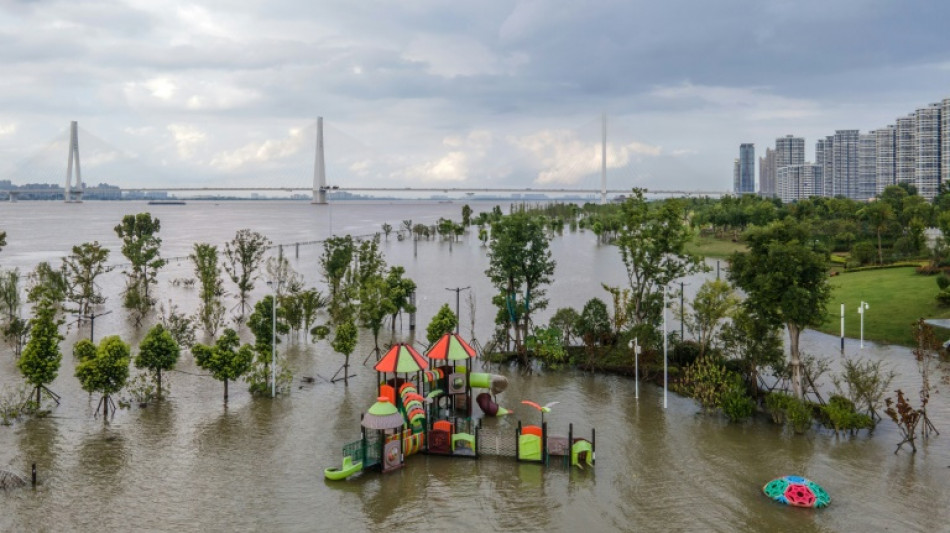
Climate change worsened Chinese extreme heat and flooding event in 2020: study / Photo: © AFP

Climate change worsened Chinese extreme heat and flooding event in 2020: study

Man-made global warming exacerbated an incident of extreme flooding and heat in eastern China in 2020, according to a study released Wednesday, which highlighted the need to prepare for increasingly intense episodes of such weather in the country.

Text size:

Researchers said that warming created by human activity caused an increase in rain that summer by around 6.5 percent, and increased heat by around one degree Celsius (33.8 degrees Fahrenheit).

Record rains fell in June and July around the lower part of the Yangtze River during the monsoon, causing the deaths of more than 100 people and billions of dollars in damage, said the study published in the journal Science Advances.

At the same time, extreme heat hit the south of the country, putting pressure on health care and energy systems, as well as on agriculture and infrastructure.

These simultaneous heat and precipitation phenomena are physically interconnected, and commonly occur at the same time in that part of the world, but in 2020 they were exceptional, the researchers said.

To determine the impact of warming linked to human activity, scientists modeled the weather conditions leading up to and during the events, based on measurements in the real world.

They then constructed a scenario simulating conditions as they might have been without human-caused warming, by adjusting humidity levels, air and ocean temperatures. They finally compared the two models to determine the role of human influence.

The researchers also warned about future weather events, noting that by the end of the century, precipitation in the region could increase by 14 percent compared to 2020, and that the season could be 2.1 degrees Celsius warmer.

The results of the study "underscore the necessity of preparing for more intense spatially compounding flood-heat hazards over eastern China," the researcher said, since they "could lead to increased economic damage and loss of life."

S.Jones--TFWP