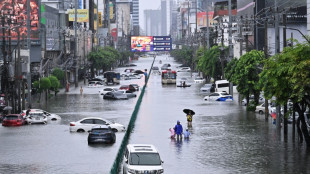
The temperature the human body cannot survive / Photo: © AFP/File

Scientists have identified the maximum mix of heat and humidity a human body can survive.
Even a healthy young person will die after enduring six hours of 35-degree Celsius (95 Fahrenheit) warmth when coupled with 100 percent humidity, but new research shows that threshold could be significantly lower.
At this point sweat -- the body's main tool for bringing down its core temperature -- no longer evaporates off the skin, eventually leading to heatstroke, organ failure and death.
This critical limit, which occurs at 35 degrees of what is known "wet bulb temperature", has only been breached around a dozen times, mostly in South Asia and the Persian Gulf, Colin Raymond of NASA's Jet Propulsion Laboratory told AFP.
None of those instances lasted more than two hours, meaning there have never been any "mass mortality events" linked to this limit of human survival, said Raymond, who led a major study on the subject.
But extreme heat does not need to be anywhere near that level to kill people, and everyone has a different threshold depending on their age, health and other social and economic factors, experts say.
For example, more than 61,000 people are estimated to have died due to the heat last summer in Europe, where there is rarely enough humidity to create dangerous wet bulb temperatures.
But as global temperatures rise -- last month was confirmed on Tuesday as the hottest in recorded history -- scientists warn that dangerous wet bulb events will also become more common.
The frequency of such events has at least doubled over the last 40 years, Raymond said, calling the increase a serious hazard of human-caused climate change.
Raymond's research projected that wet bulb temperatures will "regularly exceed" 35C at several points around the world in the coming decades if the world warms 2.5C degrees above preindustrial levels.
- 'Really, really dangerous' -
Though now mostly calculated using heat and humidity readings, wet bulb temperature was originally measured by putting a wet cloth over a thermometer and exposing it to the air.
This allowed it to measure how quickly the water evaporated off the cloth, representing sweat off of skin.
The theorised human survival limit of 35C wet bulb temperature represents 35C of dry heat as well as 100 percent humidity -- or 46C at 50 percent humidity.
To test this limit, researchers at Pennsylvania State University in the United States measured the core temperatures of young, healthy people inside a heat chamber.
They found that participants reached their "critical environmental limit" -- when their body could not stop their core temperature from continuing to rise -- at 30.6C wet bulb temperature, well below the previously theorised 35C.
The team estimated that it would take between five to seven hours before such conditions would reach "really, really dangerous core temperatures," Daniel Vecellio, who worked on the research, told AFP.
- The most vulnerable -
Joy Monteiro, a researcher in India who last month published a study in Nature looking at wet bulb temperatures in South Asia, said that most deadly heatwaves in the region were well below the 35C wet bulb threshold.
Any such limits on human endurance are "wildly different for different people," he told AFP.
"We don't live in a vacuum -- especially children," said Ayesha Kadir, a paediatrician in the UK and health advisor at Save the Children.
Small children are less able to regulate their body temperature, putting them at greater risk, she said.
Older people, who have fewer sweat glands, are the most vulnerable. Nearly 90 percent of the heat-related deaths in Europe last summer were among people aged over 65.
People who have to work outside in soaring temperatures are also more at risk.
Whether or not people can occasionally cool their bodies down -- for example in air conditioned spaces -- is also a major factor.
Monteiro pointed out that people without access to toilets often drink less water, leading to dehydration.
"Like a lot of impacts of climate change, it is the people who are least able to insulate themselves from these extremes who will be suffering the most," Raymond said.
His research has shown that El Nino weather phenomena have pushed up wet bulb temperatures in the past. The first El Nino event in four years is expected to peak towards the end of this year.
Wet bulb temperatures are also closely linked to ocean surface temperatures, Raymond said.
The world's oceans hit an all-time high temperature last month, beating the previous 2016 record, according to the European Union's climate observatory.
H.M.Hernandez--TFWP