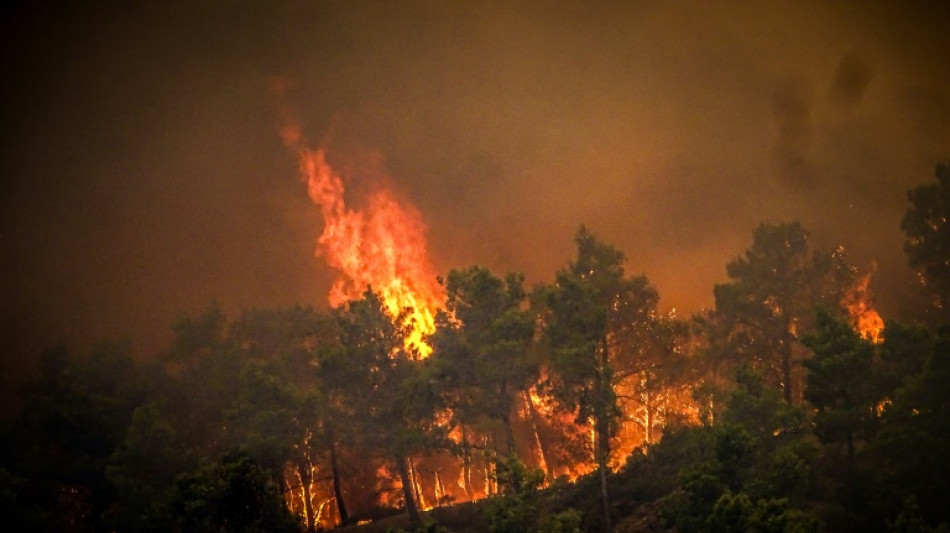
Thousands flee Greek island fires as Northern hemisphere swelters / Photo: © Eurokinissi/AFP

Around 30,000 people were moved to safety on the Greek island of Rhodes island where a wildfire burned on Saturday, while people in the southern United States struggled under a record-breaking heatwave.
Tens of millions of people have been suffering through intense heat this summer and the world looks set for its hottest July on record.
As temperature records tumble, experts have pointed to climate change driven by the burning of fossil fuels, arguing that global warming is playing a key role in the devastating heat.
On the Mediterranean island of Rhodes, where a wildfire has been blazing for days, boats carried 2,000 people to safety from beaches in the east of the popular tourist island.
Three coastguard ships led more than 30 private vessels in the emergency evacuation, while a Greek navy boat was heading to the area.
Elsewhere dozens of buses took people to safety, while others had to walk where fires had cut off road access.
From the moment the evacuation alert sounded early in the afternoon, tourists had headed for the beach, pulling their suitcases behind them.
People were being taken to gyms, schools and hotel conference centres on the island where they will stay overnight, while firefighters battle the blaze.
The battle to extinguish the fire continues in the area of Laermon and Lardos, where it is raging out of control.
Greece is fighting dozens of forest fires 11 days into a heatwave that has seen temperatures soaring above 40 Celsius (104 Fahrenheit). It could be the longest hot spell the country has ever seen.
- 80 million Americans sweltering -
Across the southern United States, about 80 million Americans will swelter in temperatures of 41C and above this weekend, the National Weather Service (NWS) said.
The country's worst heat of up to 46C is forecast for Phoenix, Arizona, which has seen a record-breaking three weeks in a row of highs above 43C.
Tourists have been flocking to Death Valley National Park, which straddles the border between California and Nevada, to post selfies with a temperature display outside the visitor centre.
Many are hoping to see it break a world record of 56.7C, which was set in July 1913 but was likely the result of a faulty measurement, according to several meteorologists.
Further north, in Canada, which has been suffering wildfires that left Montreal blanketed in smog, torrential rain hit the eastern province of Nova Scotia, cutting off roads and threatening to burst a dam.
Four people were reported missing, including two children who had been in a car engulfed by flood waters.
- Hottest month -
July 2023 is on track to be the hottest month -- not only since records began, but also in "hundreds, if not thousands, of years", said leading NASA climatologist Gavin Schmidt.
The effects cannot be attributed solely to the El Nino weather pattern, which "has really only just emerged" and isn't expected to strengthen until later in the year, he added.
El Nino is associated with the warming of ocean surface temperatures in the central and eastern Pacific Ocean.
Schmidt said the trend of extreme heat was expected to persist, "and the reason why we think that's going to continue, is because we continue to put greenhouse gases into the atmosphere".
The exceptional temperatures in Greece also meant key tourist sites such as the Acropolis closed during the hottest part of the day.
Emergency health officials told the state broadcaster they had admitted at least 38 heatstroke patients in the last three days, while hospitals were also seeing cases of fainting and other heat-related conditions.
Greece is just one of many countries battling a prolonged spell of extreme heat around the globe in recent days.
burs/pvh-lcm/jj
C.M.Harper--TFWP