Zimbabwe's carbon credit takeover spooks locals, investors / Photo: © AFP

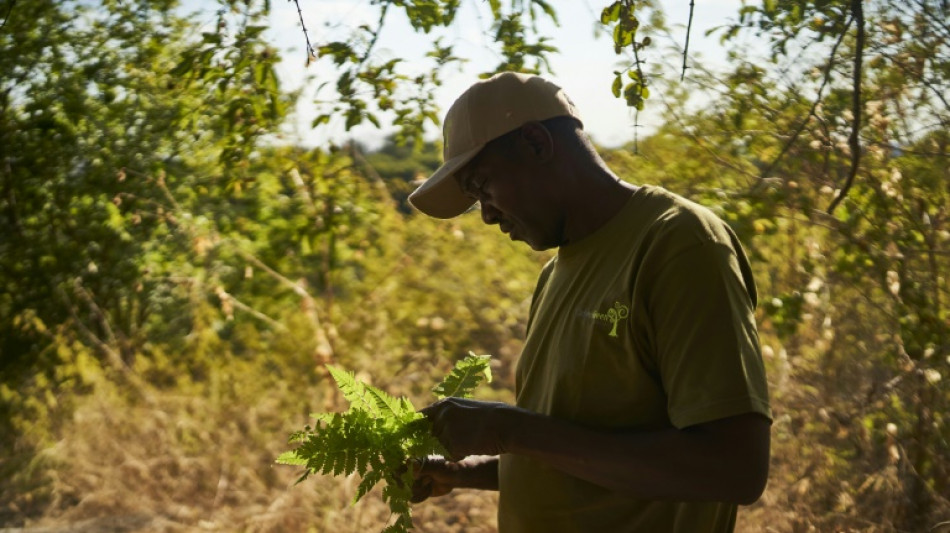
It is shortly after sunrise, and Peter Mudenda looks for elephant tracks on a dirt road surrounded by mopane trees.
Once a farmer, the 49-year-old gave up the plough several years ago when a massive forest protection project was launched in Binga, a remote semi-arid district in northern Zimbabwe.
He now makes a living digging fireguards, taking care of trees and keeping tabs on wildlife.
"I was getting a good yield... but I was quick to appreciate that we could benefit more as a community from a conservancy," Mudenda told AFP.
The conservancy is part of a wider project that makes money selling carbon credits, a financial tool aimed at tackling climate change.
But in Zimbabwe, the model has been upended by a shock announcement that the government intends to claim half of all revenues.
As more countries look to regulate the sector, the move has created uncertainty in a $2 billion global market, stoking fears that other governments may follow suit, analysts say.
"The approach they've taken is quite radical and a bit blunt," said Gilles Dufrasne of Carbon Market Watch, an advocacy group.
The scheme in Binga is part of Kariba REDD+, the largest carbon credit initiative of its kind.
Carbon credits aim at providing an important funding source for conservation.
Companies or individuals buy credits from entities that remove or reduce greenhouse gas emissions, such as investing in renewable energy, planting trees or nurturing old forests.
Each credit is worth the equivalent of one tonne of carbon dioxide -- a useful badge of honour for those keen on proving their green credentials.
A partnership between Zimbabwean firm Carbon Green Investments and South Pole, a Swiss-based carbon offsets developer, Kariba REDD+ was launched 2011.
It now covers 785,000 hectares (1.9 million acres) of forest, fostering a series of community-led activities from beekeeping to ecotourism.
Since its inception it has generated more than 100 million euros ($110 million) from the sale of carbon credits, according to South Pole -- a figure that is expected to mushroom.
- Carbon credit boom -
The global market is forecast to grow at least five-fold to $10 billion by 2030, according to a 2023 estimate by oil giant Shell and the Boston Consulting Group (BCG).
Much of the trade happens between companies in a so-called voluntary market.
But countries are also negotiating an international carbon offset trading system to reach their climate targets under the umbrella of United Nations-led climate talks.
South Pole says most of Kariba's income was produced over the past two years. Gucci and Nestle are among firms that have bought into it.
Last month, Zimbabwe, which is cash strapped and in desperate need of foreign currency, said it wants a slice of the pie.
Francis Vorhies, a conservation economist at South Africa's Stellenbosch University, said there was a logic behind Zimbabwe's move, given that the national market was based largely on government-controlled resources.
But the new policy has spooked investors and locals alike.
"This is business, not charity work. There are investors putting in their money," said Elmon Mudenda, a local councillor in Binga, who shares the same surname as the former farmer but is not related to him.
"Government must be careful to come up with friendly policies, so that we don't have communities going back to a mindset where they don't value the conservation of forests."
Under the new policy, 50 percent of all revenue from carbon offset projects should go to the national treasury.
- 'Devil in the details' -
At least another 20 percent should go to local investors, while and foreign partners would be allowed to pocket no more than 30 percent.
All carbon credit deals are to be subjected to central approval and all agreements previously entered would be declared "null and void", Harare declared last month.
"(It) does raise the question of what they're going to do with the money," said Dufrasne of Carbon Market Watch.
South Pole says it initially took a 25 percent commission on Kariba sales, before it started to buy the credits for itself at a time of low prices to later resell them.
About 20 percent of revenue currently goes to fund environmental protection activities, with the rest split between local councils, communities and leaseholders, according to the firm's website.
Stephen Wentzel, director of Carbon Green Investments, said Kariba would remain viable if the government was to put its cut back into the project.
But due to Zimbabwe's "historical reputation," foreign firms might shy away from buying credits directly, and harbour suspicions about how the funds will be used, he said.
"The devil is in the details," said South Pole's spokeswoman Nadia Kahkonen, explaining no concrete regulation has yet followed the announcement.
"Speculation and political discourse currently creates even more uncertainty... and will slow down if not halt investments in local projects."
T.Gilbert--TFWP