The Fort Worth Press - Asia heatwaves made 30 times more likely by climate change: study

USD -
AED 3.6725
AFN 65.498831
ALL 81.910095
AMD 378.010177
ANG 1.79008
AOA 917.000095
ARS 1442.232097
AUD 1.447974
AWG 1.8
AZN 1.679026
BAM 1.658807
BBD 2.01469
BDT 122.336816
BGN 1.67937
BHD 0.376968
BIF 2960
BMD 1
BND 1.274003
BOB 6.911584
BRL 5.272703
BSD 1.000305
BTN 90.399817
BWP 13.243033
BYN 2.865297
BYR 19600
BZD 2.011721
CAD 1.37165
CDF 2230.000045
CHF 0.777555
CLF 0.02195
CLP 866.710083
CNY 6.93805
CNH 6.939685
COP 3700.85
CRC 495.911928
CUC 1
CUP 26.5
CVE 93.825019
CZK 20.603404
DJF 177.71986
DKK 6.34081
DOP 62.995021
DZD 130.060373
EGP 46.856399
ERN 15
ETB 155.150026
EUR 0.849125
FJD 2.216898
FKP 0.732184
GBP 0.739795
GEL 2.69498
GGP 0.732184
GHS 10.974974
GIP 0.732184
GMD 72.999956
GNF 8760.500761
GTQ 7.672344
GYD 209.27195
HKD 7.81303
HNL 26.454967
HRK 6.3973
HTG 131.225404
HUF 322.782007
IDR 16886.95
ILS 3.119945
IMP 0.732184
INR 90.321502
IQD 1310.5
IRR 42125.000158
ISK 122.900592
JEP 0.732184
JMD 156.449315
JOD 0.708997
JPY 156.633502
KES 129.000438
KGS 87.449771
KHR 4033.000063
KMF 419.000058
KPW 900.030004
KRW 1471.989986
KWD 0.30744
KYD 0.833598
KZT 493.342041
LAK 21500.000573
LBP 85550.000319
LKR 309.548446
LRD 186.150152
LSL 16.260081
LTL 2.95274
LVL 0.60489
LYD 6.324959
MAD 9.185022
MDL 16.999495
MGA 4440.000275
MKD 52.338218
MMK 2099.783213
MNT 3569.156954
MOP 8.049755
MRU 39.849936
MUR 46.050157
MVR 15.450164
MWK 1737.000329
MXN 17.55195
MYR 3.951299
MZN 63.749722
NAD 16.285115
NGN 1367.09822
NIO 36.701015
NOK 9.81742
NPR 144.639707
NZD 1.684896
OMR 0.384507
PAB 1.000314
PEN 3.367497
PGK 4.265974
PHP 58.815021
PKR 279.737212
PLN 3.587406
PYG 6605.373863
QAR 3.641349
RON 4.3236
RSD 99.675965
RUB 76.750999
RWF 1453
SAR 3.750175
SBD 8.058149
SCR 14.65365
SDG 601.502308
SEK 9.06708
SGD 1.27589
SHP 0.750259
SLE 24.450569
SLL 20969.499267
SOS 571.484438
SRD 37.870144
STD 20697.981008
STN 21.05
SVC 8.752036
SYP 11059.574895
SZL 16.305262
THB 31.850216
TJS 9.362532
TMT 3.505
TND 2.847496
TOP 2.40776
TRY 43.61304
TTD 6.773307
TWD 31.665034
TZS 2584.999947
UAH 43.163845
UGX 3570.701588
UYU 38.599199
UZS 12275.000276
VES 377.985125
VND 25955
VUV 119.687673
WST 2.726344
XAF 556.374339
XAG 0.015352
XAU 0.000213
XCD 2.70255
XCG 1.802745
XDR 0.691101
XOF 554.499549
XPF 101.697491
YER 238.401353
ZAR 16.34654
ZMK 9001.196933
ZMW 18.580528
ZWL 321.999592
  • SCS

    0.0200

    16.14

    +0.12%

  • JRI

    -0.1500

    13

    -1.15%

  • AZN

    -0.2900

    187.16

    -0.15%

  • CMSC

    0.0300

    23.55

    +0.13%

  • NGG

    -0.9000

    86.89

    -1.04%

  • RIO

    -5.3600

    91.12

    -5.88%

  • BTI

    0.3300

    61.96

    +0.53%

  • BCC

    -1.0700

    89.16

    -1.2%

  • RBGPF

    0.1000

    82.5

    +0.12%

  • BCE

    -0.7700

    25.57

    -3.01%

  • BP

    -1.0300

    38.17

    -2.7%

  • GSK

    1.9400

    59.17

    +3.28%

  • CMSD

    0.0200

    23.89

    +0.08%

  • RYCEF

    -0.0600

    16.62

    -0.36%

  • VOD

    -1.0900

    14.62

    -7.46%

  • RELX

    0.3100

    30.09

    +1.03%

Asia heatwaves made 30 times more likely by climate change: study
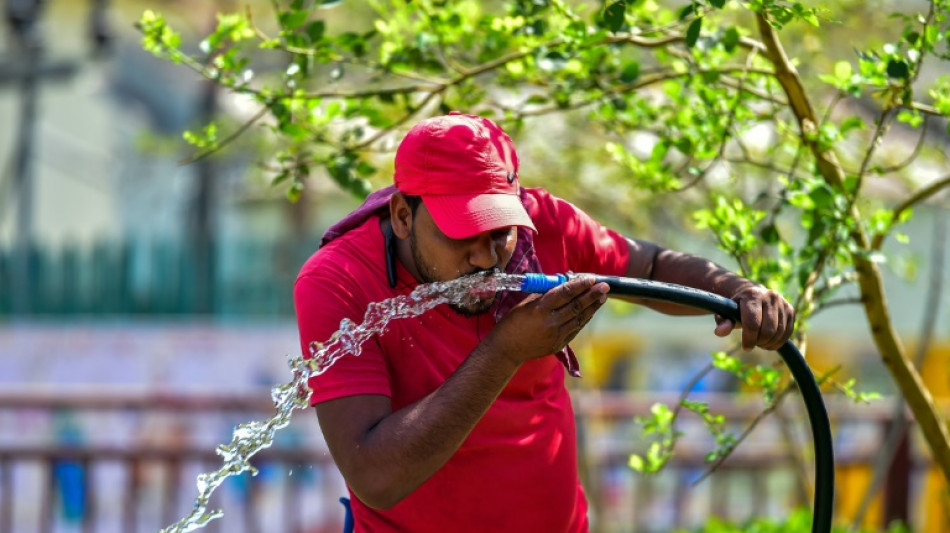
Asia heatwaves made 30 times more likely by climate change: study / Photo: © AFP/File

Asia heatwaves made 30 times more likely by climate change: study

Climate change made record-breaking deadly heatwaves in Bangladesh, India, Laos and Thailand last month at least 30 times more likely, according to a study published Wednesday.

Text size:

Parts of India saw temperatures above 44 degrees Celsius (111 Fahrenheit) in mid-April, with at least 11 deaths near Mumbai attributed to heat stroke on a single day. In Bangladesh, Dhaka suffered its hottest day in almost 60 years.

The city of Tak in Thailand saw its highest-ever temperature of 45.4 Celsius, while Sainyabuli province in Laos hit 42.9 Celsius, an all-time national temperature record, the study by the World Weather Attribution group said.

Two deaths were reported in Thailand, but the real toll was likely higher as the extreme heat caused widespread hospitalisations, with the poor and vulnerable the worst affected.

The new study by international climate scientists looked at the average maximum temperature and the maximum heat index, which includes humidity.

"In both regions, the researchers found that climate change made the humid heatwave at least 30 times more likely, with temperatures at least 2 degrees Celsius hotter than they would have been without climate change," WWA said in a statement.

"Until overall greenhouse gas emissions are halted, global temperatures will continue to increase and events like this will become more frequent and severe," it added.

The analysis also found that such events in India and Bangladesh, previously once-a-century, can now be expected around once every five years because of human-caused climate change.

For Laos and Thailand, if global temperatures rise by two degrees Celsius -- as will happen within around 30 years if emissions are not cut rapidly -- such extreme events could happen every 20 years, compared to every two centuries now, the study said.

"We see again and again that climate change dramatically increases the frequency and intensity of heatwaves, one of the deadliest weather events there are," said Friederike Otto of the Grantham Institute for Climate Change and the Environment, who was involved in the study.

"Still, heat action plans are only being introduced very slowly across the globe. They need to be an absolute priority adaptation action everywhere, but in particular in places where high humidity enhances the impacts of heatwaves," she added.

Scientists were previously reluctant to directly link a particular event to climate change, but in recent years a new field of "attribution science", like that done by the WWA, has emerged.

Some weather events have a more complicated relationship to global warming than others, with the relationship to heatwaves and increased rainfall relatively easy to study.

Other phenomena such as droughts, snowstorms, tropical storms and wildfires are more complicated however, according to the WWA.

F.Garcia--TFWP