'Perfect storm' of heat, dryness fuel western Canada's extreme wildfires / Photo: © AFP

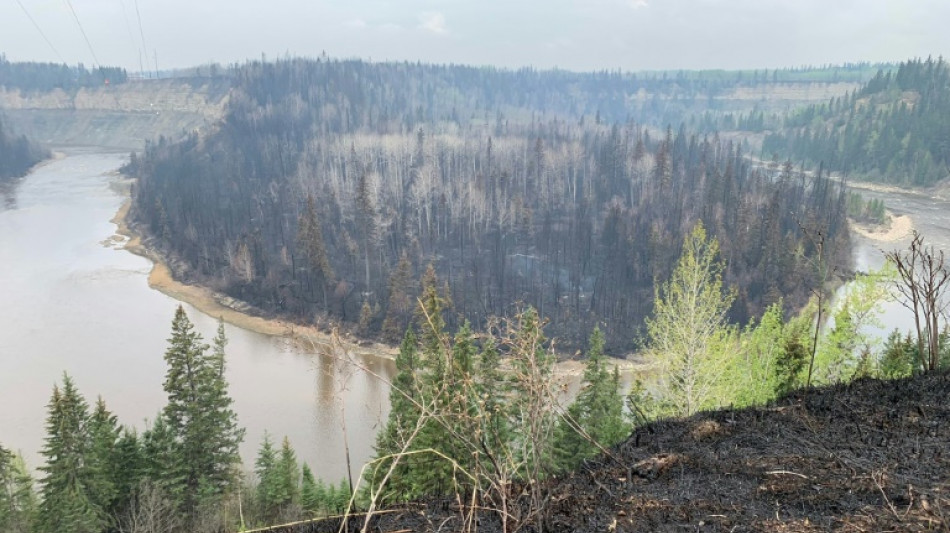
Dry vegetation, record temperatures and powerful winds: this "perfect storm" of weather phenomena fueled the massive forest fires in western Canada's Alberta province this year, according to researchers.
The extent of the fires and their appearance so early in the year illustrate the impacts of climate change, scientists say.
"We've already had 390,000 hectares (963,710 acres) burned. So it's already 10 times the typical fire year and we're really just getting started," said Danielle Smith, premier of Alberta province where a state of emergency was declared.
"It's an extraordinary (and) unprecedented event, which is I think what we have to be prepared for in future," she told reporters on Tuesday.
Around 30,000 people have been ordered to evacuate their homes while hundreds of firefighters work to control the flames.
"It is an exceptional year insofar as the accumulation of burned areas is very rapid, as is the number of very large fires at the same time," Yan Boulanger, a specialist in forest fires at the Canadian ministry for natural resources, told AFP.
The vast majority of fires are of human origin, including cigarette butts, campfires that weren't properly snuffed out or sometimes malicious acts, he said.
- 'Dangerous' month of May -
Spring is a risky time for fires in the area, as no snow remains on the ground and it's before plants turn green.
"We end up with very dry undergrowth and trees that are also very flammable, because they have no leaves," said Boulanger, who noted that the conditions in recent weeks "have been very dry."
Terri Lang, a meteorologist for Environment Canada, said that dry conditions make spring a "dangerous time."
In early May, a weather phenomenon set in that "brought really unseasonably hot and dry conditions to the province," Lang told AFP.
A ridge of high pressure pushed aside the precipitation and kept the heat in place, breaking several temperature records in the region.
In the provincial capital of Edmonton, the mercury reached 28.9 degrees Celsius (84 degrees Fahrenheit) on May 1, beating the previous all-time high of 26.7C (80F) set almost a century ago. Farther north, it reached 32.2C (89.9F) in Fort McMurray on Thursday.
Added to this were strong winds fueled by the typical temperature differential between the cold north and the warmer south.
"It was a perfect storm," said Lang.
Boulanger added that "if the conditions remain extreme, it could last for weeks or months."
A previous major fire in 2016 disrupted production in the oil sands region near Fort McMurray, pummelling the nation's economy.
That fire took almost a year to be put out, Boulanger said.
- More common with global warming -
Diana Stralberg, a researcher in Edmonton for the Canadian Forest Service, explained that human-caused climate change is making the fire season longer and causing "extreme fire weather conditions" to occur more often.
"Although fire is a natural, forest-renewing process, more frequent fires, as well as fires followed by droughts, can interrupt regeneration of conifer trees" and lead to a withdrawal of wooded areas in favor of grasslands, the climate specialist told AFP.
Little by little, the forest is being nibbled away, with direct consequences for dozens of species of migratory birds and caribou.
"Modeling of future fire and vegetation conditions has shown that, in Alberta, up to 50 percent of upland boreal forests could be at risk of conversion to grassland systems by the end of the 21st century under high-end warming scenarios," said Stralberg.
More and more fires also lead to the massive emissions of greenhouse gases, further exacerbating climate change, in a mechanism researchers call the "fire-climate feedback loop."
C.Rojas--TFWP