The Fort Worth Press - Long lost Madagascar songbird seen again in wild

USD -
AED 3.6725
AFN 65.510149
ALL 82.012423
AMD 377.773158
ANG 1.79008
AOA 916.999992
ARS 1442.27598
AUD 1.441005
AWG 1.8
AZN 1.698893
BAM 1.659595
BBD 2.015639
BDT 122.394949
BGN 1.67937
BHD 0.377008
BIF 2965.596535
BMD 1
BND 1.27457
BOB 6.91481
BRL 5.271098
BSD 1.000776
BTN 90.44239
BWP 13.24927
BYN 2.866659
BYR 19600
BZD 2.012669
CAD 1.36981
CDF 2229.999778
CHF 0.77703
CLF 0.021932
CLP 865.999877
CNY 6.93805
CNH 6.93905
COP 3698
CRC 496.14758
CUC 1
CUP 26.5
CVE 93.565043
CZK 20.585699
DJF 178.211857
DKK 6.33416
DOP 63.157627
DZD 129.904445
EGP 46.857397
ERN 15
ETB 155.932472
EUR 0.84825
FJD 2.21245
FKP 0.732184
GBP 0.73817
GEL 2.695007
GGP 0.732184
GHS 10.987836
GIP 0.732184
GMD 72.999886
GNF 8783.310776
GTQ 7.675957
GYD 209.370505
HKD 7.811475
HNL 26.434899
HRK 6.391397
HTG 131.283861
HUF 322.674025
IDR 16889.3
ILS 3.119945
IMP 0.732184
INR 90.260601
IQD 1311.010794
IRR 42125.000158
ISK 122.830248
JEP 0.732184
JMD 156.523658
JOD 0.709027
JPY 156.707504
KES 129.103496
KGS 87.450276
KHR 4038.98126
KMF 418.999634
KPW 900.030004
KRW 1467.888904
KWD 0.30738
KYD 0.833956
KZT 493.576471
LAK 21509.911072
LBP 89638.030929
LKR 309.69554
LRD 186.137286
LSL 16.167606
LTL 2.95274
LVL 0.60489
LYD 6.339495
MAD 9.185352
MDL 17.007501
MGA 4427.737424
MKD 52.281345
MMK 2099.783213
MNT 3569.156954
MOP 8.05317
MRU 39.920067
MUR 46.039811
MVR 15.450073
MWK 1735.286131
MXN 17.46585
MYR 3.954501
MZN 63.749662
NAD 16.167606
NGN 1367.609773
NIO 36.826006
NOK 9.79659
NPR 144.708438
NZD 1.677297
OMR 0.384499
PAB 1.000776
PEN 3.36398
PGK 4.350519
PHP 58.544495
PKR 280.209677
PLN 3.584725
PYG 6608.484622
QAR 3.647395
RON 4.321018
RSD 99.569011
RUB 76.750966
RWF 1460.610278
SAR 3.750069
SBD 8.058149
SCR 14.112804
SDG 601.481055
SEK 9.050735
SGD 1.273865
SHP 0.750259
SLE 24.450496
SLL 20969.499267
SOS 570.904894
SRD 37.870036
STD 20697.981008
STN 20.789492
SVC 8.756194
SYP 11059.574895
SZL 16.159799
THB 31.6935
TJS 9.366941
TMT 3.505
TND 2.899825
TOP 2.40776
TRY 43.6153
TTD 6.776526
TWD 31.643973
TZS 2585.000597
UAH 43.184356
UGX 3572.383187
UYU 38.617377
UZS 12275.134071
VES 377.985125
VND 25959
VUV 119.687673
WST 2.726344
XAF 556.612755
XAG 0.013831
XAU 0.000207
XCD 2.70255
XCG 1.803594
XDR 0.692248
XOF 556.610394
XPF 101.198154
YER 238.405018
ZAR 16.251495
ZMK 9001.20654
ZMW 18.589121
ZWL 321.999592
  • SCS

    0.0200

    16.14

    +0.12%

  • CMSC

    0.0300

    23.55

    +0.13%

  • CMSD

    0.0200

    23.89

    +0.08%

  • RBGPF

    0.1000

    82.5

    +0.12%

  • RYCEF

    -0.2000

    16.42

    -1.22%

  • BCE

    -0.7700

    25.57

    -3.01%

  • AZN

    -0.2900

    187.16

    -0.15%

  • BTI

    0.3300

    61.96

    +0.53%

  • GSK

    1.9400

    59.17

    +3.28%

  • RIO

    -5.3600

    91.12

    -5.88%

  • NGG

    -0.9000

    86.89

    -1.04%

  • VOD

    -1.0900

    14.62

    -7.46%

  • BCC

    -1.0700

    89.16

    -1.2%

  • JRI

    -0.1500

    13

    -1.15%

  • BP

    -1.0300

    38.17

    -2.7%

  • RELX

    0.3100

    30.09

    +1.03%

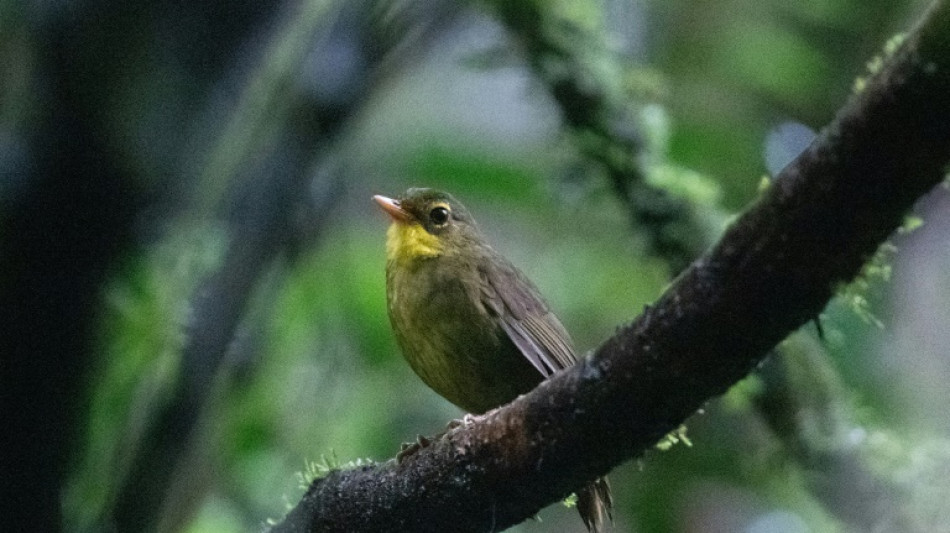
Long lost Madagascar songbird seen again in wild
Long lost Madagascar songbird seen again in wild / Photo: © American Bird Conservancy/AFP

Long lost Madagascar songbird seen again in wild

Conservationists were celebrating Wednesday the first sightings in 24 years of the dusky tetraka, a yellow-throated songbird native to Madagascar for which ornithologists had feared the worst.

Text size:

A expedition to remote regions of the island nation confirmed two recent sightings of the bird.

Scientists also learned something about the petite bird's behaviour that could help explain how it escaped notice for so long, even if it remains extremely rare.

The last documented sighting of dusky tetraka, in 1999, was in the rainforests of northeastern Madagascar, one of the world's most diverse biodiversity hotspots with hundreds of unique vertebrate species.

In December, an international team of researchers led by the US-based Peregrine Fund drove for 40 hours and hiked for half-a-day to the last spot the warbler-like bird had been seen.

Much of the forest, they discovered, had been destroyed and converted to farms for vanilla production, even though the area is officially protected.

After eight days, team member John Mittermeier, director of the lost birds program at American Bird Conservancy, finally spotted one hopping through dense undergrowth on the ground near a rocky river and snapped a photo.

"If dusky tetraka always prefer areas close to rivers, this might help to explain why the species has been overlooked for so long," he said.

- 'Data insufficient' -

"Birding in tropical forests is all about listening for bird calls, and so you naturally tend to avoid spending time next to rushing rivers where you can't hear anything."

Another dusky tetraka located by a second team also spent most of its time in dense vegetation close to a river, presumably looking for insects and other prey in the damp undergrowth.

"Now that we've found the dusky tetraka and better understand the habitat it lives in, we can look for it in other parts of Madagascar," said Lily-Arison Rene de Roland, Madagascar Program director for The Peregrine Fund.

The bird is on the Top Ten Most Wanted Lost Birds list, a collaboration between Re:wild, American Bird Conservancy and BirdLife International, all partners on the expedition.

More than half of Madagascar's birds -- some 115 species -- are endemic, meaning they are found nowhere else.

More than 40 of the island's bird species are classified as threatened with extinction on the Red List of the International Union for the Conservation of Nature (IUCN).

The dusty tetraka -- aka Crossleyia tenebrosa -- is not classified for lack of data.

The main drivers of biodiversity loss on Madagascar are forest destruction to make way for agriculture, habitat degradation, invasive species, climate change and hunting.

About 40 percent of the island's original forest cover was lost between the 1950s and 2000, according to earlier research.

K.Ibarra--TFWP