The Fort Worth Press - Treating wounds with insects: the strange habits of Gabon chimps

USD -
AED 3.67295
AFN 66.00018
ALL 80.066009
AMD 365.249926
ANG 1.789783
AOA 917.999667
ARS 1494.994298
AUD 1.411353
AWG 1.8
AZN 1.713532
BAM 1.689844
BBD 2.014455
BDT 122.025082
BGN 1.696366
BHD 0.377025
BIF 2987.5
BMD 1
BND 1.278101
BOB 11.57661
BRL 5.215298
BSD 1.000186
BTN 95.649807
BWP 13.500717
BYN 3.042111
BYR 19600
BZD 2.011569
CAD 1.39041
CDF 2270.000582
CHF 0.812175
CLF 0.023452
CLP 923.070272
CNY 6.743298
CNH 6.74695
COP 3115
CRC 449.280935
CUC 1
CUP 26.5
CVE 95.270804
CZK 20.90175
DJF 177.71974
DKK 6.457785
DOP 58.739626
DZD 132.910036
EGP 50.530501
ERN 15
ETB 161.79626
EUR 0.86381
FJD 2.208964
FKP 0.73738
GBP 0.738805
GEL 2.597447
GGP 0.73738
GHS 11.084996
GIP 0.73738
GMD 73.495518
GNF 8786.186101
GTQ 7.629268
GYD 209.249883
HKD 7.843885
HNL 26.817351
HRK 6.5088
HTG 130.825457
HUF 316.033501
IDR 17879
ILS 2.994501
IMP 0.73738
INR 95.78175
IQD 1310.281367
IRR 1374574.999375
ISK 122.830168
JEP 0.73738
JMD 158.0373
JOD 0.708972
JPY 159.589498
KES 129.440318
KGS 87.450282
KHR 4043.000285
KMF 424.99973
KPW 900.000294
KRW 1412.889818
KWD 0.30877
KYD 0.833492
KZT 461.941214
LAK 22540.942885
LBP 89566.055097
LKR 331.989787
LRD 181.533065
LSL 16.225889
LTL 2.95274
LVL 0.60489
LYD 6.372987
MAD 9.293278
MDL 17.253028
MGA 4307.91296
MKD 53.154037
MMK 2099.801401
MNT 3596.870401
MOP 8.080213
MRU 40.113705
MUR 47.000387
MVR 15.449939
MWK 1734.288331
MXN 17.071398
MYR 4.059898
MZN 63.90505
NAD 16.225889
NGN 1350.07937
NIO 36.807113
NOK 9.41944
NPR 153.044147
NZD 1.702455
OMR 0.384477
PAB 1.000168
PEN 3.368628
PGK 4.494615
PHP 61.854958
PKR 277.579544
PLN 3.73572
PYG 6034.292824
QAR 3.656087
RON 4.530701
RSD 101.410313
RUB 84.900741
RWF 1473.708766
SAR 3.746587
SBD 8.032258
SCR 13.871434
SDG 601.495489
SEK 9.539055
SGD 1.278475
SHP 0.740866
SLE 24.575006
SLL 20969.499227
SOS 571.633467
SRD 37.967015
STD 20697.981008
STN 21.16841
SVC 8.751625
SYP 13001.999906
SZL 16.214138
THB 33.10203
TJS 9.241503
TMT 3.51
TND 2.92919
TOP 2.40776
TRY 47.914301
TTD 6.782414
TWD 31.9439
TZS 2649.998035
UAH 44.804538
UGX 3730.824229
UYU 40.349581
UZS 11822.340881
VES 771.57685
VND 26177
VUV 118.338592
WST 2.726312
XAF 566.740682
XAG 0.015674
XAU 0.00023
XCD 2.70255
XCG 1.802598
XDR 0.707052
XOF 566.75782
XPF 103.042635
YER 237.125047
ZAR 16.266201
ZMK 9001.202368
ZMW 18.677991
ZWL 321.999592
  • JRI

    -0.0400

    12.44

    -0.32%

  • CMSC

    -0.1200

    21.24

    -0.56%

  • CMSD

    -0.0900

    21.09

    -0.43%

  • BCC

    -1.7600

    80.18

    -2.2%

  • BCE

    0.0100

    23.36

    +0.04%

  • RBGPF

    -2.6900

    68.65

    -3.92%

  • RIO

    -0.5200

    96.69

    -0.54%

  • NGG

    0.8600

    82.15

    +1.05%

  • RYCEF

    0.2200

    21.06

    +1.04%

  • RELX

    0.9500

    34.51

    +2.75%

  • BP

    0.5600

    43.41

    +1.29%

  • GSK

    0.8700

    51.15

    +1.7%

  • VOD

    -0.0700

    16.13

    -0.43%

  • AZN

    3.2100

    160.1

    +2%

  • BTI

    0.6500

    56.38

    +1.15%

Treating wounds with insects: the strange habits of Gabon chimps


Treating wounds with insects: the strange habits of Gabon chimps

How to treat a wound?

Text size:

For humans, the first instinct would be to disinfect it and then cover it with a bandage.

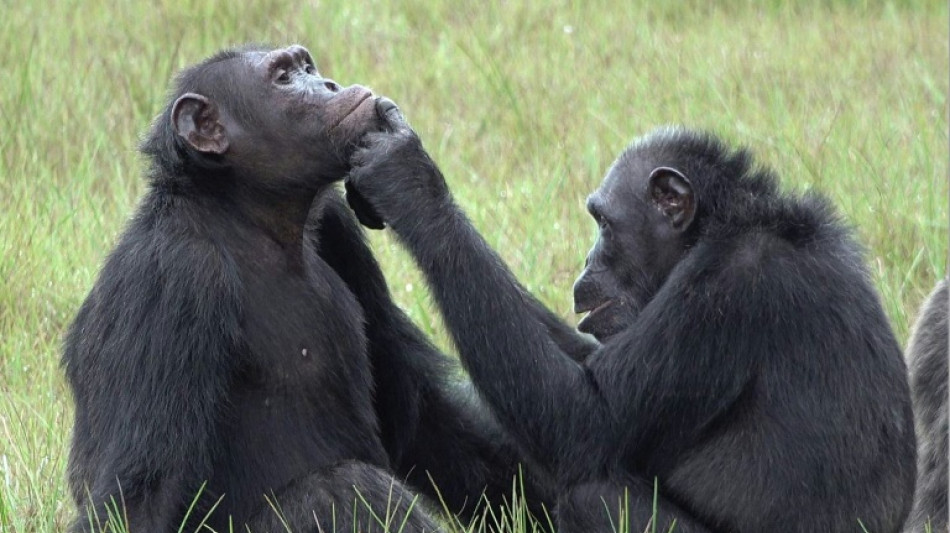
But chimpanzees have invented a more creative method: catching insects and applying them directly to the open wound.

Scientists observed this behavior in chimpanzees in the West African nation of Gabon, noticing that the apes not only use insects to treat their own wounds, but also those of their peers.

The research, published Monday in the journal Current Biology, marks an important contribution to ongoing scientific debate about the ability of chimpanzees -- and of animals in general -- to selflessly help others.

"When you're going to school and you read in your biology books about the amazing things that animals can do," Simone Pika, a biologist at the University of Osnabruck in Germany and a co-author of the study, told AFP. "I think it could really be something like that that will end up in those books."

The project began in 2019, when an adult female chimpanzee named Suzee was observed inspecting a wound on the foot of her adolescent son.

Suzee then suddenly caught an insect out of the air, put it in her mouth, apparently squeezed it, and then applied it to her son's wound.

After extracting the insect from the wound, she applied it two more times.

The scene unfolded in Loango National Park on Gabon's Atlantic coast, where researchers are studying a group of 45 central chimpanzees, an endangered species.

Over the following 15 months, scientists saw chimpanzees administer the same treatment on themselves at least 19 times.

And on two other occasions they observed injured chimpanzees being treated in the same way by one or several fellow apes.

The wounds, sometimes several centimeters wide, can come from conflicts between members of same or an opposing group.

Far from protesting the treatment, the bruised chimpanzees were happy to be tended to.

"It takes lot of trust to put an insect in an open wound," said Pika. "They seem to understand that if you do this to me with this insect, then my wound gets better. It's amazing."

- Soothing properties? -

Researchers have not been able to identify what bug was used on the wounds, but they believe it to be a flying insect given the chimpanzees' rapid movement to catch it.

Pika says the insect could contain anti-inflammatory substances that have a soothing effect.

Insects are known to have various medical properties and researches will need to conduct more work to detect and study the insect in question.

Birds, bears, elephants and other animals have already been observed self-medicating, for example by eating plants.

But what is unique about chimpanzees is that they will treat not just themselves, but also help others.

Some scientists, however, still doubt the ability of animal species to exhibit prosocial behaviors, such as selflessly caring for others, Pika said.

But here the chimpanzees have nothing to gain, she stressed. So why do they do it?

In humans, prosocial behavior is generally linked to empathy.

Could the same feeling be at play in chimpanzees, Pika wondered.

"It is a hypothesis that we must study," she said.

D.Ford--TFWP