Colosseum Geophysics Points to Large Intact Carbonatite Targets

SAN BERNARDINO, CALIFORNIA / ACCESS Newswire / February 25, 2026 / Dateline Resources Limited (ASX:DTR)(OTCQB:DTREF)(FSE:YE1) (Dateline or the Company) is pleased to report on the interpretation of the Company's high-resolution geophysical datasets collected across the Colosseum Project. Gravity, high-resolution airborne magnetics and radiometrics, induced polarization (IP) and magneto-tellurics (MT) were interpreted with geological mapping and surface geochemistry data to identify carbonatite rare earth targets. Three distinct targets demonstrate coincident anomalies that would be expected from a carbonatite source. Two of the targets are defined sufficiently for a diamond drill program.
In addition, drilling in late 2025 (RC25-038) delivered the first drill-based confirmation of mantle-derived anomalous rare earth elements (REE) at the project. This drill hole was completed before the new infill geophysics surveys, with the hole interpreted to have intersected the margin of Target 1. Assaying shows a geochemical fingerprint that points clearly to a mantle-sourced carbonatite system.
Highlights
Converged Geophysical and Geological Datasets: Multiple high-resolution datasets have been collected, processed and interpreted together for the first time, providing a comprehensive view of the project.
Rare Earth Elements (REE) halo intersected in drilling: Drillhole RC25-038, on the margin of Target 1, intersected anomalous rare earth elements, representing the first drill-based confirmation of sub surface REE at the project.
Mantle-Derived REE System Confirmed: The REE signature in RC25-038 is mantle-derived and is directly comparable to the Mountain Pass carbonatite system.
Carbonatite-Style Geochemical Signature Identified: RC25-038 returned elevated Ba, Sr, Ca, P, Th and U with associated potassic alteration, confirming proximity to an alkaline-carbonatite source.
Carbonatite Diamond Drilling: Twelve drillhole locations have been finalized to test the Clark Mountain Fault Zone (Target 1) and Eastern Gravity (Target 2) anomalies.
Dateline's Managing Director, Stephen Baghdadi, commented:
"The completion of the integrated high-resolution datasets has given us a level of confidence in our targeting that we have not had before. Two well-defined targets, twelve holes, and a third zone in the 2200N anomaly that we are continuing to work on. We are advancing this project methodically and the technical foundations are strong.
"Importantly, RC25-038 is an important result, being the first drill-based confirmation of rare earth elements at Colosseum. It carries additional weight, given where it sits on the margin of what is now our highest-priority carbonatite target."
Combined Datasets Provide a Clearer Picture Than Ever Before
The full suite of geophysical surveys carried out at the Colosseum Project, together with the geochemistry data collected in 2025, has now been brought together and interpreted as a collective dataset for the first time.
Previous announcements described each survey's result individually. Combining them has identified where signals from completely different techniques, each measuring something unique about the ground beneath the surface, all converge at the same location. When multiple independent methods coincide, the confidence in a target increases significantly. No single survey could provide this level of granularity and clarity on its own.
Importantly, the geochemical results from drill hole RC25-038 (see further in this announcement) and historical surface sampling have also been brought into this combined analysis, allowing the geophysical models to be ground-truthed against real geochemistry.
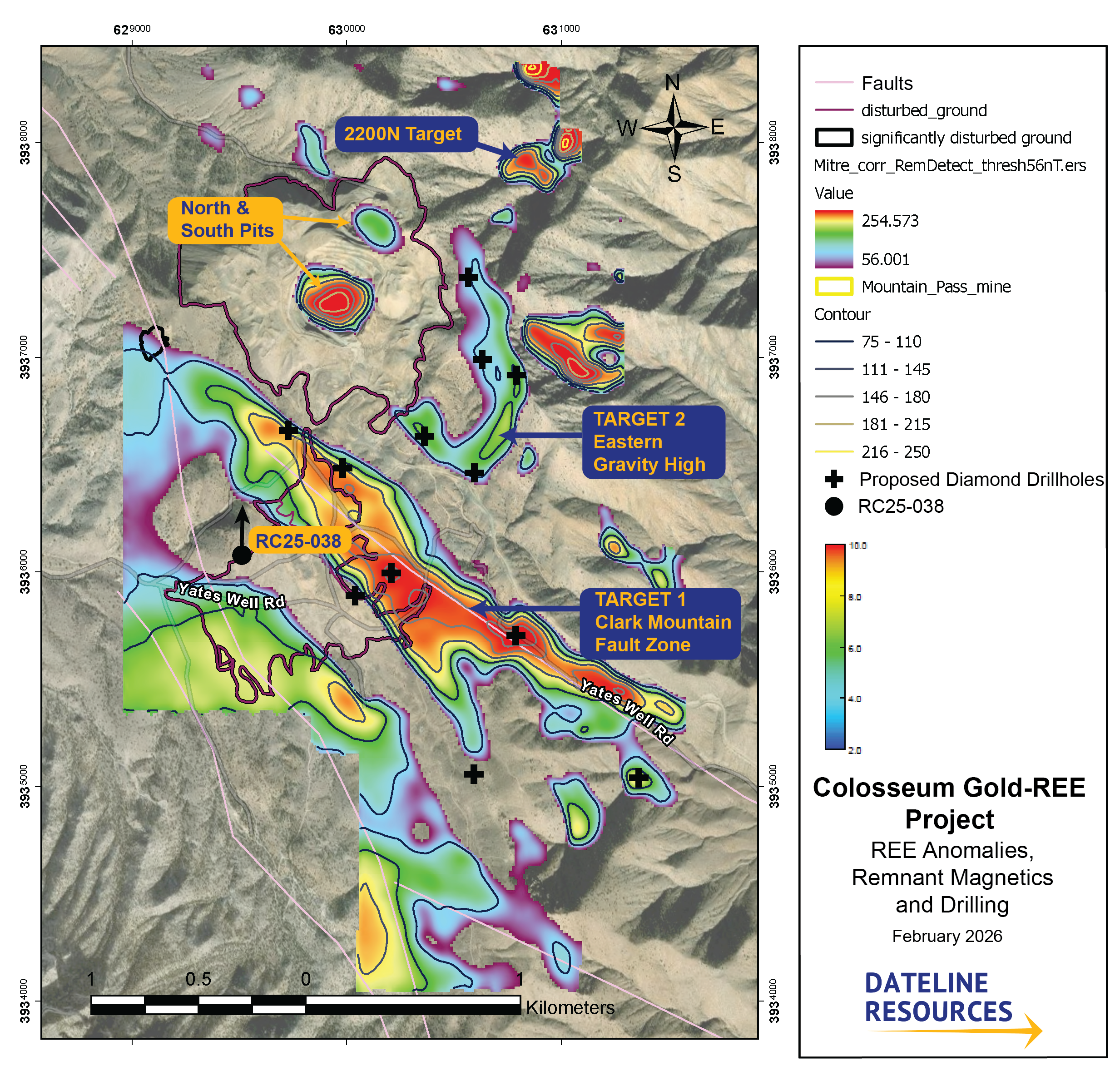
Figure 1: Carbonatite Targets at Colosseum highlighted by remnant magnetics image. Drillhole RC25-038, drilled in the tailings dam area is shown as a circle, with the 12 planned diamond drillholes shown as crosses in the figure.
Target Areas Combined and Refined
The combined interpretation has refined three distinct areas of REE-carbonatite interest at Colosseum. Two, the Clark Mountain Fault corridor and the Eastern Gravity High, are defined clearly enough to progress drilling immediately. The 2200N anomaly, identified in earlier MT survey work, is being further assessed for drilling after this program.
Target 1: Clark Mountain Fault Zone (Primary REE-Carbonatite Target)
Target 1 is interpreted as a NW bearing structure that is approximately 1.2km long and between 150-200 meters wide and follows the Clark Mountain Fault. The scale and converging datasets make this the highest-priority REE-carbonatite target. It stands out because every survey type has anomalies that coincide:
The electrical surveys (IP and MT) indicate conductive and chargeable material at depth along the fault;
The radiometricsshow elevated potassium and thorium, elements commonly enriched around carbonatite bodies;
The gravitysurvey shows a high-density body of rock at depth consistent with a carbonatite intrusion and
Surface and subsurface geochemistryshows elevated levels of rare earths, barium, strontium, calcium and phosphorus, all of which are hallmarks of carbonatite-related mineralization.
The IP, MT and gravity responses are similar to that seen at Mountain Pass, 10km to the south.
Target 1 is further strengthened by drill hole RC25-038 (described below), which sits on the eastern edge of this target area and confirmed rare earth elements downhole at around 40 meters depth. The REE-bearing rock unit intersected in RC25-038 appears to get wider as it goes deeper. With the benefit of all the merged data, new drill holes at Target 1 are positioned deeper and closer to the center of the anomaly than RC25-038.
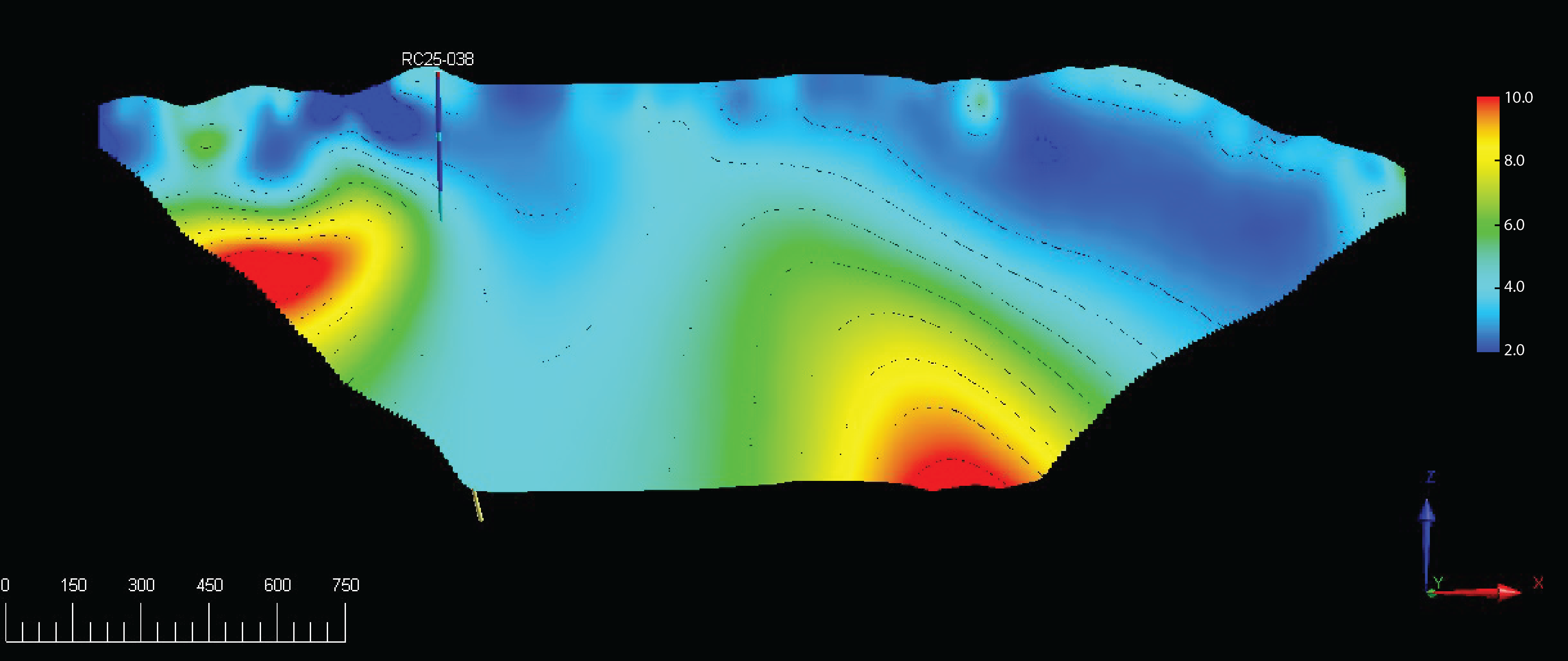
Figure 2: East-West IP chargeability cross section showing hole RC25-038, drilled true north into the section.
Target 2: Eastern Gravity High
Target 2 is defined by a strong gravity anomaly on the eastern side of the Colosseum claim area, running roughly north-south in a ring-like structure. The gravity and electrical survey data both suggest a dense resistive body of rock buried at depth, the same kind of signal associated with carbonatite intrusions. The drill target sits west of extensive mantle derived outcrops at surface and a geochemistry carbonate anomaly at surface.
Target 3: 2200N Anomaly
The 2200N anomaly remains a high-priority target. The MT resistivity and IP chargeability responses are both exceptionally broad in lateral extent, and additional modelling is required to identify the optimal drill entry points before committing capital. A dedicated drill program will follow once additional targeting refinement work is complete.
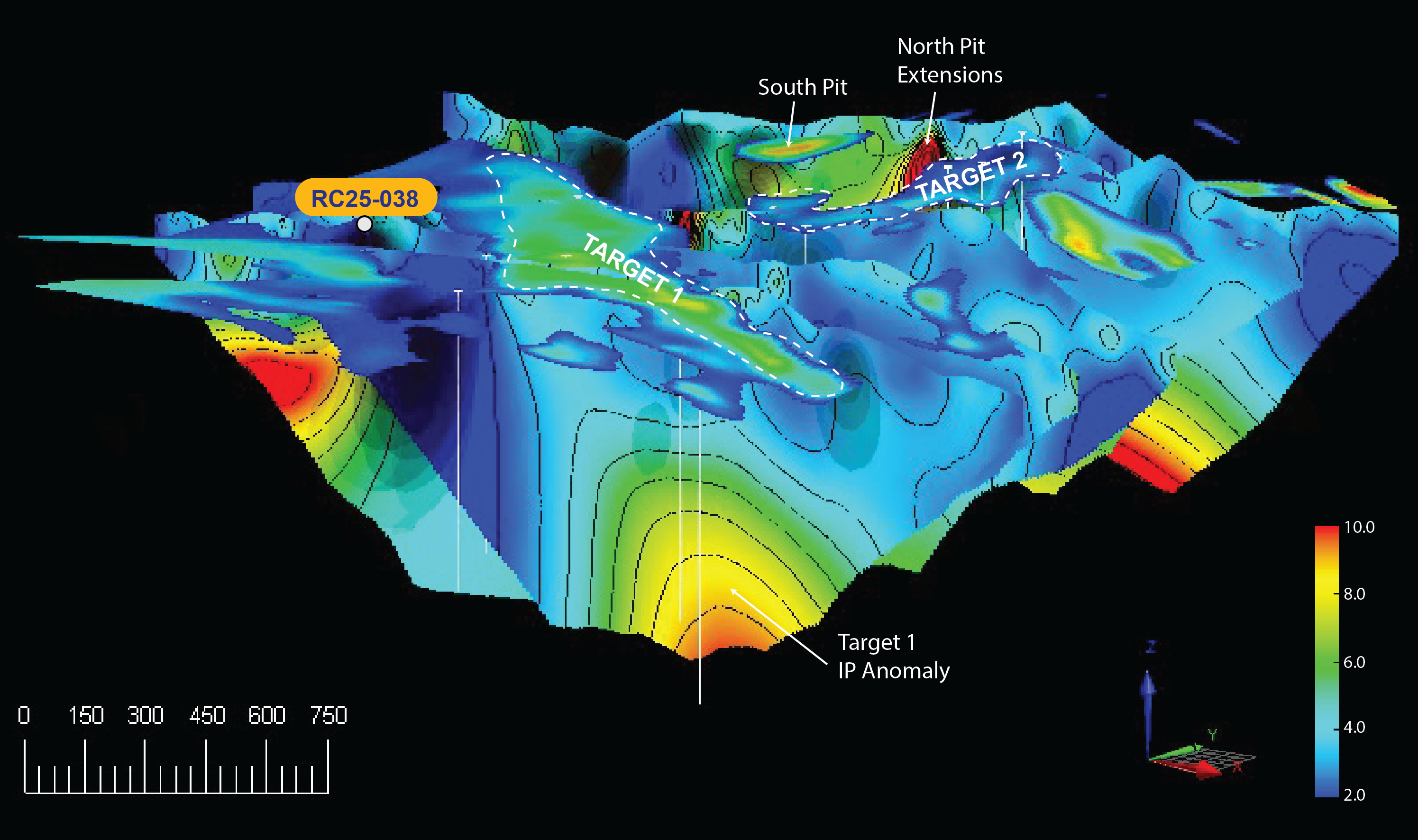
Figure 3: Oblique view looking NW with magnetics (2D plan) and IP section lines. Main focus is Target 1, looking down the plunge of where there is a coincident remnant magnetic and IP chargeability anomaly.
Drilling Confirms Mantle-Derived REE System and Advances Targeting Model
Drill hole RC25-038 represents the first drill intersection of anomalous rare earth element at the Colosseum Project and was specifically designed to test early indications of REE prospectivity using broad-based geophysical (MT) targeting. The hole was collared at the contact of the Clark Mountain Fault in an area with no exposed fenite alteration at surface, demonstrating that anomalous REE is present in the subsurface beyond previously mapped alteration zones.
Laboratory analysis of the samples shows a geochemical fingerprint that points clearly to a deep, mantle-sourced carbonatite system. Chondrite-normalized REE plots show a smooth lanthanide distribution profile with no negative europium anomaly. This pattern is characteristic of mantle-derived alkaline magmatic systems and matches the REE signature of the Mountain Pass carbonatite. The absence of a negative europium anomaly is consistent with a deep mantle-derived REE system. This profile is exactly the profile that would be expected on the margins of a carbonatite body.
Alongside the rare earths, the samples returned elevated levels of barium, strontium, calcium, phosphorus, thorium and uranium, with associated potassium-rich alteration in the surrounding rock (see Appendix 2). This combination of elements is a well-recognized geochemical fingerprint of carbonatite systems worldwide, and mirrors the signatures documented at Mountain Pass and other major carbonatite-hosted REE deposits.
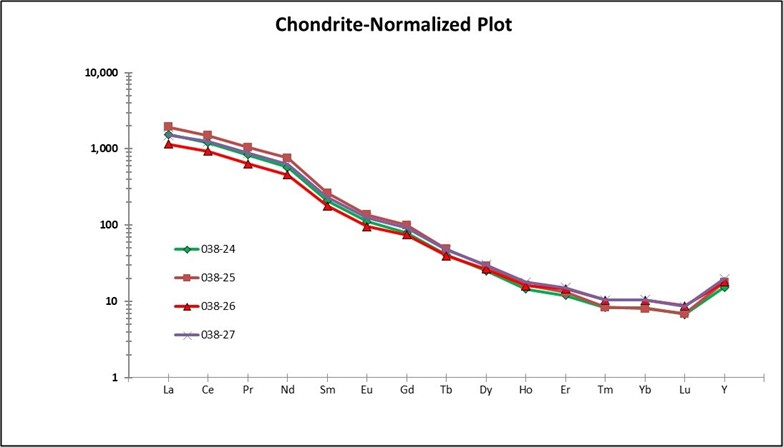
Figure 4: Chondrite Normalised Plot of the four samples collected in RC25-038 showing a smooth, lanthanide distribution profile with no negative europium anomaly, characteristic of mantle-derived alkaline magmatic systems.
RC25-038 sits on the eastern edge of Target 1, on the outer margin of the geophysical anomaly. Now that the complete combined dataset is available, it is clear that rather than testing the center of the carbonatite system, the hole grazed its edge. The main carbonatite body is believed to sit deeper and further to the east and will be drill tested accordingly.
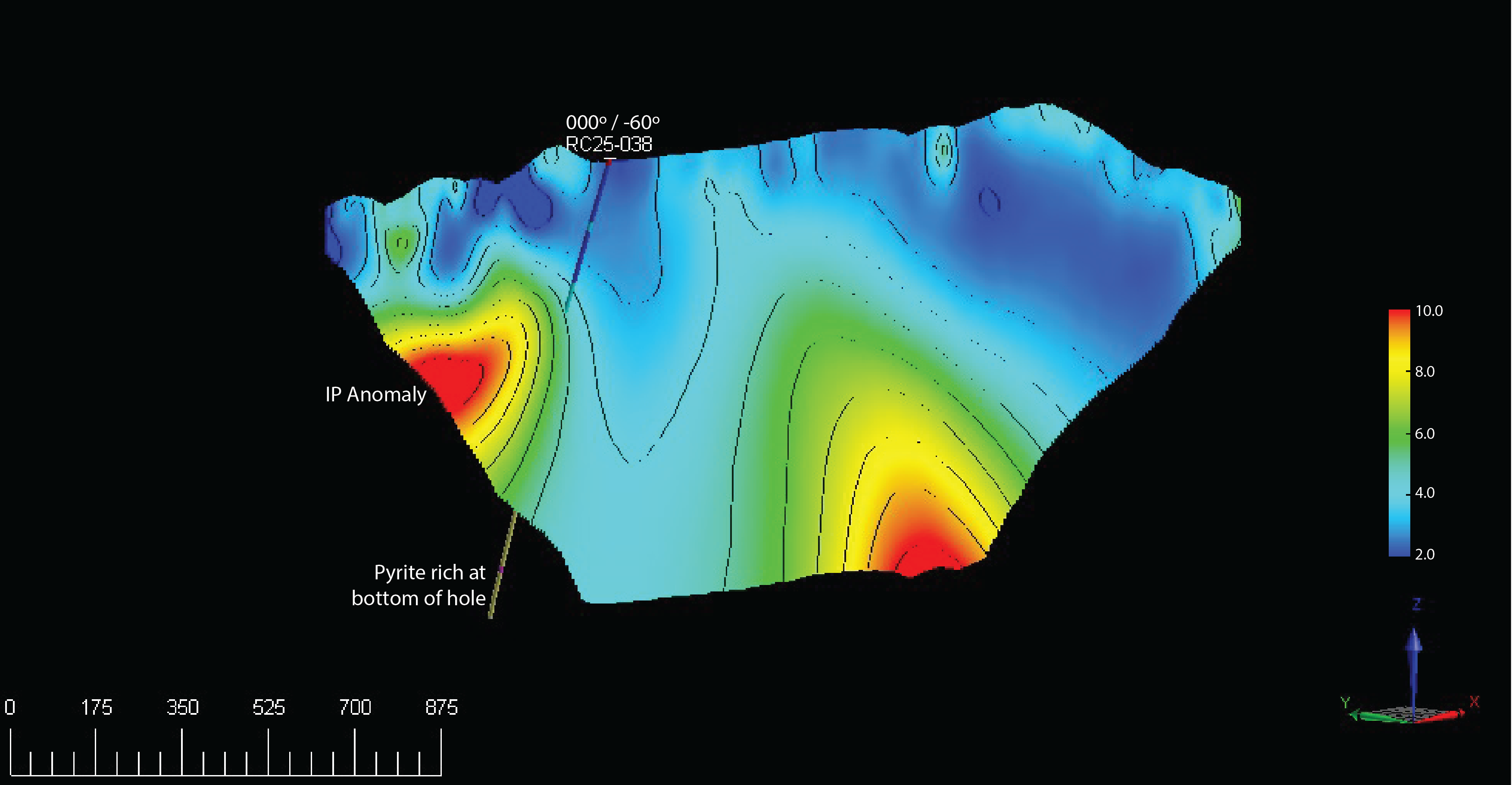
Figure 5: REE drill hole RC25-038 in relation to IP chargeability anomaly. The hole was drilled true north and just grazed the edge of Target 1. There were pyrite rich zones at the bottom of hole, proximal to Target 1.
Lack of Oxidized Sulphur at Surface Points to Intact System That Hasn't Leaked
At Colosseum, detailed surface sampling and review of historical data have not identified elevated sulphate or related oxyanions above Target 1. This lack of oxidized sulfur leakage is consistent with a sulfide system that remains largely intact at depth.
In practical terms, it suggests that the primary sulfide assemblage associated with the carbonatite system has not been extensively weathered nor chemically depleted over geological time. The data supports a model in which the core of the hydrothermal system remains preserved beneath cover.
For an alkaline-carbonatite setting, this is a constructive outcome. Primary rare earth mineralization in these systems is commonly associated with sulfide-bearing intrusive phases. If significant oxidation and dispersion had occurred, one would expect a broad supergene geochemical footprint at surface. The absence of such a signature reduces the likelihood that the system has been substantially "bled off" and increases the probability that the intrusion and associated sulfide-hosted REE mineralization remain preserved at depth.
When considered alongside the coincident gravity, magnetic, electrical and radiometric anomalies, and the mantle-derived REE signature in RC25-038, the geochemical stability at surface adds another line of evidence supporting the interpretation of a coherent, preserved carbonatite system. This interpretation further underpins the rationale for the planned deeper diamond drilling program targeting the interpreted core of Target 1.
Lack of Sodium Indicates Carbonate Minerals - Increases Support for Carbonatite
Additional insight has been provided from major element geochemistry, including plotting samples on a Ca-K-Na ternary diagram. The samples display negligible sodium and are strongly enriched in calcium. In the absence of sodium, the calcium is unlikely to be hosted in plagioclase or other sodic silicate minerals. Instead, the geochemical signature indicates that calcium is predominantly present within carbonate minerals. This interpretation is supported by the position of the most calcium-rich samples, which plot compositionally between dolomite and ankerite, suggesting a Mg-Fe-bearing carbonate assemblage rather than simple calcite.
This distinction is important. Carbonate minerals such as dolomite and ankerite are commonly developed in hydrothermal systems associated with alkaline and carbonatite intrusions. The identification of a dolomite-ankerite compositional trend provides geochemical support for the field observation that the rocks may represent a carbonate-rich intrusive or carbonate-dominant alteration phase.
When considered together with the absence of surface oxyanion leakage and the coincident geophysical anomalies, the carbonate-dominant chemistry is consistent with a coherent and potentially preserved intrusive system at depth, rather than superficial or surficial carbonate development.
Carbonatite Drill Program Designed
A 12-hole diamond drill program has been approved across Targets 1 and 2. The holes are designed to test both targets from multiple angles and at a range of depths, with several planned to go beyond 750 meters to reach the bodies of rock generating the geophysical signals.
At Target 1, the holes are positioned deeper and closer to the center of the system than RC25-038, following the indication from that hole that the REE-bearing rock gets wider as it goes deeper.
At Target 2, the holes are designed to test the buried body of rock identified by the gravity and electrical surveys on the eastern side of the claim, a zone that has never previously been drilled.
This press release has been authorized for release by the Board of Dateline Resources Limited.
For more information, please contact:
Stephen Baghdadi
Managing Director
+61 2 9375 2353
Andrew Rowell
Corporate & Investor Relations Manager
+61 400 466 226
[email protected]
www.datelineresources.com.au
Follow Dateline on socials:
X - @Dateline_DTR
Truth Social - @dateline_resources
LinkedIn - dateline-resources
YouTube - @dateline.resources
About Dateline Resources Limited
Dateline Resources Limited (ASX:DTR)(OTCQB:DTREF)(FSE:YE1) is an Australian company focused on mining and exploration in North America. The Company owns 100% of the Colosseum Gold-REE Project in California.
The Colosseum Gold Mine is located in the Walker Lane Trend in East San Bernardino County, California. On 6 June 2024, the Company announced to the ASX that the Colosseum Gold mine has a JORC-2012 compliant Mineral Resource estimate of 27.1Mt @ 1.26g/t Au for 1.1Moz. Of the total Mineral Resource, 455koz @ 1.47/t Au (41%) are classified as Measured, 281koz @1.21g/t Au (26%) as Indicated and 364koz @ 1.10g/t Au (33%) as Inferred.
On 23 May 2025, Dateline announced that updated economics for the Colosseum Gold Project generated an NPV6.5 of US$550 million and an IRR of 61% using a gold price of US$2,900/oz.
The Colosseum is located less than 10km north of the Mountain Pass Rare Earth mine. Planning has commenced on drill testing the REE potential at Colosseum.
Dateline also owns 100% of the high-grade Argos Strontium Project, also located in San Bernardino County, California. Argos is reportedly the largest strontium deposit in the U.S. with previous celestite production grading 95%+ SrSO4.
Forward-Looking Statements
This announcement may contain "forward-looking statements" concerning Dateline Resources that are subject to risks and uncertainties. Generally, the words "will", "may", "should", "continue", "believes", "expects", "intends", "anticipates" or similar expressions identify forward-looking statements. These forward-looking statements involve risks and uncertainties that could cause actual results to differ materially from those expressed in the forward-looking statements. Many of these risks and uncertainties relate to factors that are beyond Dateline Resources' ability to control or estimate precisely, such as future market conditions, changes in regulatory environment and the behavior of other market participants. Dateline Resources cannot give any assurance that such forward-looking statements will prove to have been correct. The reader is cautioned not to place undue reliance on these forward-looking statements. Dateline Resources assumes no obligation and does not undertake any obligation to update or revise publicly any of the forward-looking statements set out herein, whether as a result of new information, future events or otherwise, except to the extent legally required.
Competent Person Statement
Sample preparation and any exploration information in this announcement is based upon work reviewed by Mr. Greg Hall who is a Chartered Professional of the Australasian Institute of Mining and Metallurgy (CP-IMM). Mr. Hall has sufficient experience that is relevant to the style of mineralization and type of deposit under consideration and to the activity which he is undertaking to qualify as a Competent Person as defined in the 2012 Edition of the "Australasian Code for Reporting Exploration Results, Mineral Resources and Ore Reserves" (JORC Code). Mr. Hall is a Non-Executive Director of Dateline Resources Limited and consents to the inclusion in the report of the matters based on this information in the form and context in which it appears.
Company Confirmations
The Company confirms it is not aware of any new information or data that materially affects the information included in the announcements dated 23 October 2024 with regard to the Colosseum MRE and 23 May 2025 with regard to Colosseum Project Economics. Similarly, the Company confirms that all material assumptions and technical parameters underpinning the estimates and the forecast financial information referred to in those previous announcements continue to apply and have not materially changed.
SOURCE: Dateline Resources Limited
View the original press release on ACCESS Newswire
M.Delgado--TFWP