The Fort Worth Press - 'In her prime': Rare blooming of palm trees in Rio

USD -
AED 3.672504
AFN 64.000368
ALL 82.099008
AMD 367.63228
ANG 1.790403
AOA 917.503981
ARS 1492.901385
AUD 1.443002
AWG 1.8025
AZN 1.70397
BAM 1.709092
BBD 2.014681
BDT 123.336392
BGN 1.69088
BHD 0.377157
BIF 2975.313497
BMD 1
BND 1.290864
BOB 6.927077
BRL 5.170399
BSD 1.000306
BTN 95.296893
BWP 13.491502
BYN 2.902259
BYR 19600
BZD 2.011797
CAD 1.41995
CDF 2246.000362
CHF 0.801016
CLF 0.023518
CLP 925.617163
CNY 6.789104
CNH 6.785505
COP 3363.656224
CRC 455.717219
CUC 1
CUP 26.5
CVE 96.35601
CZK 21.144704
DJF 178.127321
DKK 6.535604
DOP 59.256346
DZD 133.361297
EGP 49.283873
ERN 15
ETB 160.4018
EUR 0.873904
FJD 2.26045
FKP 0.748895
GBP 0.746798
GEL 2.63504
GGP 0.748895
GHS 11.363656
GIP 0.748895
GMD 72.503851
GNF 8772.665705
GTQ 7.634028
GYD 209.236685
HKD 7.84465
HNL 26.773277
HRK 6.587504
HTG 130.834098
HUF 308.910388
IDR 17994.4
ILS 2.99865
IMP 0.748895
INR 95.215504
IQD 1310.350854
IRR 1375950.000352
ISK 125.920386
JEP 0.748895
JMD 158.351903
JOD 0.70904
JPY 161.36504
KES 129.3398
KGS 87.447704
KHR 4005.767466
KMF 431.00035
KPW 900.00035
KRW 1528.775039
KWD 0.31029
KYD 0.833661
KZT 473.045834
LAK 22586.621226
LBP 89575.392144
LKR 335.046096
LRD 181.552847
LSL 16.224931
LTL 2.95274
LVL 0.60489
LYD 6.4115
MAD 9.354393
MDL 17.595141
MGA 4240.835409
MKD 53.86027
MMK 2099.883338
MNT 3582.147735
MOP 8.08057
MRU 39.921353
MUR 47.050378
MVR 15.460378
MWK 1734.609167
MXN 17.469104
MYR 4.071039
MZN 63.910377
NAD 16.224931
NGN 1370.080377
NIO 36.806921
NOK 9.841039
NPR 152.475204
NZD 1.75116
OMR 0.385704
PAB 1.000306
PEN 3.403766
PGK 4.394635
PHP 61.501038
PKR 278.103989
PLN 3.75205
PYG 6082.055315
QAR 3.656661
RON 4.568038
RSD 102.570892
RUB 76.986936
RWF 1464.412112
SAR 3.755774
SBD 8.058541
SCR 13.46616
SDG 600.503676
SEK 9.65806
SGD 1.291404
SHP 0.746601
SLE 24.350371
SLL 20969.503664
SOS 571.678245
SRD 37.566038
STD 20697.981008
STN 21.409534
SVC 8.752567
SYP 110.532098
SZL 16.22231
THB 33.325038
TJS 9.2726
TMT 3.51
TND 2.952244
TOP 2.40776
TRY 46.767504
TTD 6.779394
TWD 31.938038
TZS 2626.818718
UAH 44.550181
UGX 3650.980906
UYU 40.232446
UZS 11983.221916
VES 638.90327
VND 26296
VUV 118.93159
WST 2.77318
XAF 573.213615
XAG 0.016021
XAU 0.00024
XCD 2.70255
XCG 1.80277
XDR 0.712894
XOF 573.213615
XPF 104.216367
YER 237.050363
ZAR 16.231504
ZMK 9001.203584
ZMW 18.379866
ZWL 321.999592
  • CMSC

    0.0400

    21.99

    +0.18%

  • VOD

    0.1400

    13.15

    +1.06%

  • NGG

    2.6700

    82.85

    +3.22%

  • RBGPF

    2.5400

    68.15

    +3.73%

  • RELX

    0.5500

    31.93

    +1.72%

  • RIO

    1.0700

    94.42

    +1.13%

  • GSK

    2.3600

    53.66

    +4.4%

  • BTI

    1.2100

    61.77

    +1.96%

  • RYCEF

    0.5400

    19.68

    +2.74%

  • BCE

    0.4000

    21.42

    +1.87%

  • CMSD

    -0.0300

    22.15

    -0.14%

  • BCC

    0.4500

    75.93

    +0.59%

  • AZN

    11.2900

    195.15

    +5.79%

  • JRI

    0.0600

    13

    +0.46%

  • BP

    1.2500

    37.4

    +3.34%

'In her prime': Rare blooming of palm trees in Rio
'In her prime': Rare blooming of palm trees in Rio / Photo: © AFP

'In her prime': Rare blooming of palm trees in Rio

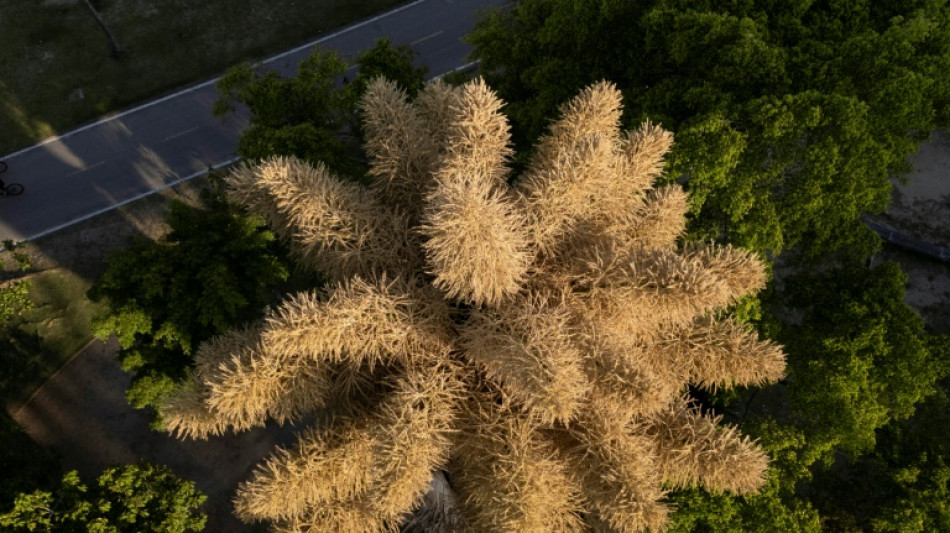
An extraordinary botanical spectacle is drawing crowds in Rio de Janeiro: several talipot palm trees, planted more than six decades ago, are blooming for the first -- and last -- time in their lives.

Text size:

The trees, growing in Rio's Aterro do Flamengo park and the Botanical Garden, were planted in the 1960s by the legendary landscape architect Roberto Burle Marx.

Now, some six decades later, these giants have reached the peak of their existence in the Brazilian seaside city.

The talipot palm (Corypha umbraculifera), native to southern India and Sri Lanka, is one of the largest palm species on the planet, some reaching more than 30 meters (98 feet) tall.

It flowers only once in its entire life, if it reaches between 40 and 70 years of age.

"The talipot palm only fruits once in its lifetime, and can produce up to five million fruits," Marcus Nadruz, from the Research Institute of the Rio de Janeiro Botanical Garden, told AFP.

The inflorescences, or flower clusters on stems, began to unfurl in October, forming enormous crowns atop the palm trees that teem with millions of tiny yellowish blossoms.

The entire process, from the opening of the first flowers to the ripening of the fruit, will take about a year, explained Nadruz.

But this splendor has an inevitable end. Once the fruit falls, the palm trees will slowly begin to die.

"I was born in 1961, so she's my age and in her prime," said Deborah Faride, who traveled to see the trees from Sao Paulo and was taking pictures of them with a friend.

"We're the same age and we're blooming together. Just one detail: the talipot is going to die. And I'm going to continue, God willing."

The Botanical Garden plans to collect the seeds to cultivate new seedlings to replace these older plants, and will also distribute them for landscaping projects in public spaces.

K.Ibarra--TFWP