'Roasted alive': Greek wildlife suffers as climate changes / Photo: © AFP

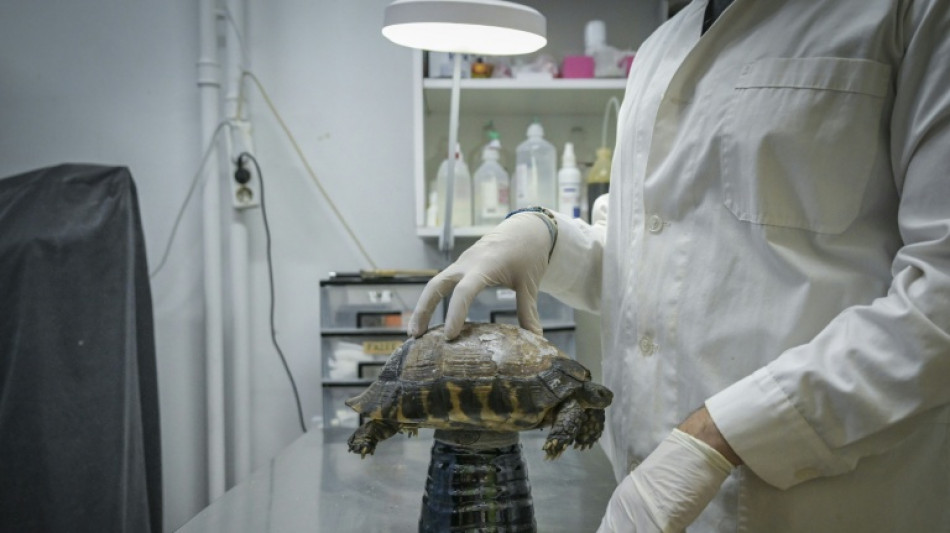
A badly burned tortoise that survived a Greek wildfire wriggles in an Athens animal clinic despite lots of painkillers, one of the latest victims of climate change that is playing havoc with the country's wildlife.
Most of the scorched scales on its back had to be removed with forceps.
"It was really depressed and had its mouth open trying to breathe because of the smoke" when volunteers brought it in, said vet Grigorios Markakis.
Even though "it's much better" now, the prognosis is not good, he told AFP. "If the whole shell is burned, imagine what happened inside... All the internal organs will be dysfunctional."
Markakis, 28, cares for orphaned, injured or sick creatures, from hedgehogs to snakes to storks, from a first aid station of the Greek wildlife protection group Anima.
The NGO has seen a surge in animal admissions -- largely because of climate change, which scientists say is driving longer, more intense and more frequent heatwaves worldwide, fuelling wildfires and generating other dangers for wildlife.
Greece suffered several major forest fires this summer amid high temperatures, especially around Athens and in the western Peloponnese.
The government said around 45,000 hectares (111,200 acres) have burned this year.
"These fires are now harder to suppress and often wipe out vast areas of critical habitat, killing animals directly and displacing many more," said Nikos Georgiadis, from the World Wildlife Fund Greece.
"Prolonged droughts, rising temperatures, and forest dieback all degrade habitats, reduce food and water availability, and make survival more difficult for many species," he told AFP.
- Thirsty vultures -
Anima staffer Anna Manta said "more and more animals" are being brought to them because of the prolonged heat.
"Most get exhausted or they are forced to leave the nests really, really early," she told AFP. Birds "just jump off the nests... because they get roasted alive", she told AFP.
In July, when Greece suffered a searing heatwave with temperatures above 40C, Anima admitted 1,586 animals. In June it was 2,125 -- nearly 300 more than during the same period last year.
"Last year we thought that it was the worst year we had ever seen... And then we had June," Manta said.
The centre has received many young emaciated and exhausted vultures.
"Down in Crete, they can't find water. Most of them go to the sea to drink water. They get poisoned because their body cannot process salt," said Manta.
The team treats them with medicine and fluids for a few days, before taking them to outdoor cages to socialise. They are released back into the wild after six months.
One such juvenile griffon vulture had just received IV fluids into a vein. Afterwards an employee carried it out -- with a pained look on her face because lice from the weak bird were crawling onto her.
"Climate change affects also the microorganisms, the parasites, the diseases, by affecting their transmission," said Markakis.
"The transmission is probably easier because these microorganisms can live for longer periods," he said.
- 'It was magic' -
Perched on a computer monitor was a long-eared owl. When Anima president Maria Ganoti began typing, the bird turned and looked down at the keyboard with its big orange eyes.
Later, it turned again to stare when people brought in a shoebox with a quail attacked by cats, followed by a fox hit by a car -- an increasing phenomenon.
Georgiadis said the root cause of such incidents was habitat degradation and "the expansion of urban areas close to or into forests, (which) pushes foxes and other animals to venture into cities".
Before Markakis took the injured fox to the operating table, he told how one of his "best life moments" was treating and releasing a cub that had severe head injuries back into the wild.
"I just gave it a last look, I opened the door (of its cage) and it immediately disappeared -- without even a thank you!" he laughed. "But it was magic."
M.Cunningham--TFWP