'Absolute madness': Thailand's pet lion problem / Photo: © AFP

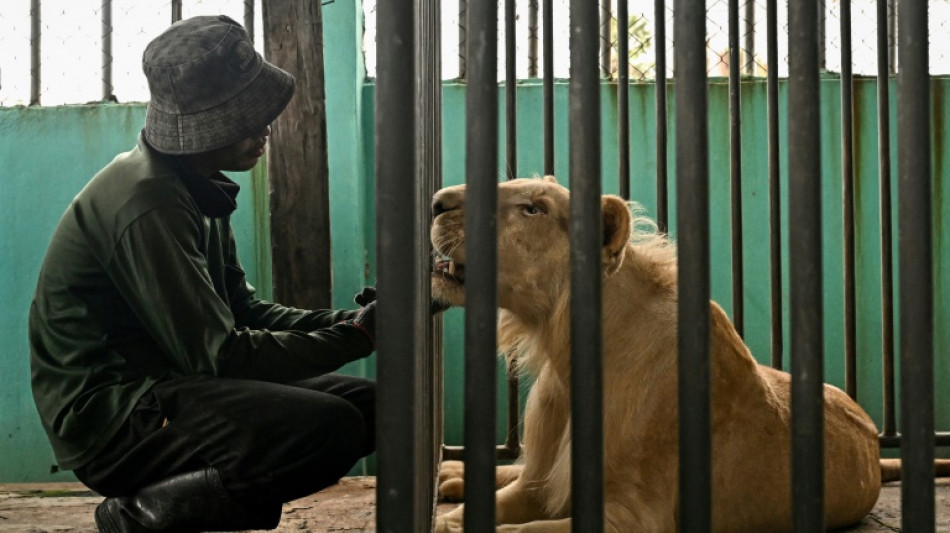
Behind a car repair business on a nondescript Thai street are the cherished pets of a rising TikTok animal influencer: two lions and a 200-kilogram lion-tiger hybrid called "Big George."
Lion ownership is legal in Thailand, and Tharnuwarht Plengkemratch is an enthusiastic advocate, posting updates on his feline companions to nearly three million followers.
"They're playful and affectionate, just like dogs or cats," he told AFP from inside their cage complex at his home in the northern city of Chiang Mai.
Thailand's captive lion population has exploded in recent years, with nearly 500 registered in zoos, breeding farms, petting cafes and homes.
Experts warn the trend endangers animals and humans, stretches authorities and likely fuels illicit trade domestically and abroad.
"It's absolute madness," said Tom Taylor, chief operating officer of conservation group Wildlife Friends Foundation Thailand.
"It's terrifying to imagine, if the laws aren't changed, what the situation is going to be in 10 years."
The boom is fueled by social media, where owners like Tharnuwarht post light-hearted content and glamour shots with lions.
"I wanted to show people... that lions can actually bond well with humans," he said, insisting he plays regularly with his pets.
He entered Big George's enclosure tentatively though, spending just a few minutes being batted by the tawny striped liger's hefty paws before retreating behind a fence.
Since 2022, Thai law has required owners to register and microchip lions, and inform authorities before moving them.
But there are no breeding caps, few enclosure or welfare requirements, and no controls on liger or tigon hybrids.
Births of protected native species like tigers must be reported within 24 hours. Lion owners have 60 days.
"That is a huge window," said Taylor. "What could be done with a litter of cubs in those 60 days? Anything."
- Illicit trade -
Taylor and his colleagues have tracked the rise in lion ownership with on-site visits and by trawling social media.
They recorded around 130 in 2018, and nearly 450 by 2024.
But nearly 350 more lions they encountered were "lost to follow-up" after their whereabouts could not be confirmed for a year.
That could indicate unreported deaths, an animal removed from display or "worst-case scenarios", said Taylor.
"We have interviewed traders (in the region) who have given us prices for live and dead lions and have told us they can take them over the border."
As a vulnerable species, lions and their parts can only be sold internationally with so-called CITES permits.
But there is circumstantial evidence of illicit trade, several experts told AFP, speaking on condition of anonymity to avoid angering authorities.
Media reports and social media have documented lions, including cubs, in Cambodia multiple times in recent years, though CITES shows no registered imports since 2003.
There is also growing evidence that captive lion numbers in Laos exceed CITES import licences.
In Thailand, meanwhile, imports of lion parts like bones, skins and teeth have dropped in recent years, though demand remains, raising questions about how parts are now being sourced.
Thai trader Pathamawadee Janpithak started in the crocodile business, but pivoted to lions as prices for the reptiles declined.
"It gradually became a full-fledged business that I couldn't step away from," the gregarious 32-year-old told AFP in front of a row of caged cubs.
She sells one-month-olds for around 500,000 baht ($15,500), down from a peak of 800,000 baht as breeding operations like hers increase supply.
Captive lions are generally fed around two kilograms (4.4 pounds) of chicken carcasses a day, and can produce litters of two to six cubs, once or twice a year.
Pathamawadee's three facilities house around 80 lions, from a stately full-maned nine-year-old to a sickly pair of eight-day-olds being bottle-fed around the clock.
They are white because of a genetic mutation, and the smaller pool of white lions means inbreeding and sickness are common.
Sometimes wrongly considered a "threatened" subspecies, they are popular in Thailand, but a month-old white cub being reared alongside the newborns has been sick almost since birth.
It has attracted no buyers so far and will be unbreedable, Pathamawadee said.
She lamented the increasing difficulty of finding buyers willing to comply with ownership rules.
"In the past, people could just put down money and walk away with a lion... Everything has become more complicated."
- Legal review -
Pathamawadee sells around half of the 90 cubs she breeds each year, often to other breeders, who are increasingly opening "lion cafes" where customers pose with and pet young lions.
Outside Chiang Mai, a handler roused a cub from a nap to play with a group of squealing Chinese tourists.
Staff let AFP film the interaction, but like all lion cafes contacted, declined interviews.
Pathamawadee no longer sells to cafes, which tend to offload cubs within weeks as they grow.
She said several were returned to her traumatised and no longer suitable for breeding.
The growing lion population is a problem for Thailand's Department of National Parks, Wildlife and Plant Conservation (DNP), admitted wildlife protection director Sadudee Punpugdee.
"But private ownership has existed for a long time... so we're taking a gradual approach," he told AFP.
That includes limiting lion imports so breeders are forced to rely on the domestic population.
"With inbreeding on the rise, the quality of the lions is also declining and we believe that demand will decrease as a result," Sadudee said.
Already stretched authorities face difficult choices on enforcing regulations, as confiscated animals become their responsibility, said Penthai Siriwat, illegal wildlife trade specialist at WWF Thailand.
"There is a great deal of deliberation before intervening... considering the substantial costs," she told AFP.
Owners like Tharnuwarht often evoke conservation to justify their pets, but Thailand's captive lions will never live in the wild.
Two-year-olds Khanom and Khanun live in a DNP sanctuary after being confiscated from a cafe and private owner over improper paperwork.
They could survive another decade or more, and require specialised keepers, food and care.
Sanctuary chief vet Natanon Panpeth treads carefully while discussing the lion trade, warning only that the "well-being of the animals should always come first".
Big cat ownership has been banned in the United States and United Arab Emirates in recent years, and Thailand's wildlife rules are soon up for review.
Sadudee is hopeful some provisions may be tightened, though a ban is unlikely for now.
He has his own advice for would-be owners: "Wild animals belong in the wild. There are plenty of other animals we can keep as pets."
D.Ford--TFWP