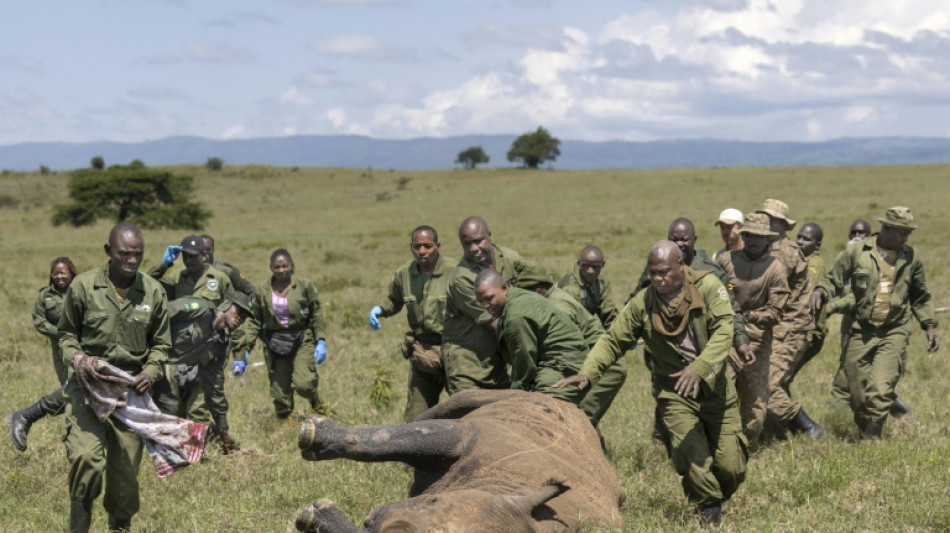
How to move a rhino / Photo: © AFP

Barely feeling the tranquiliser shot, the panic-stricken female rhinoceros ran to take shelter in a wooded area, eluding the low-flying helicopter trying to prevent her escape.
The rhino was supposed to be transferred to another park in Kenya on Saturday, but outsmarted the humans.
A few minutes later, rangers in 4x4 vehicles searched through thickets too dense for the crane truck that was meant to carry her away.
A decision was quickly made to administer the antidote to the tranquilise to prevent her from collapsing. If she fell the wrong way, she could suffocate.
The young female will therefore remain where she was born.
"The rhino is the worst one to translocate," said Taru Sheldrick, who was piloting the helicopter in Nakuru National Park in northwest Kenya, an oasis of greenery surrounding a deep blue lake.
"When you dart them, if you don't have long enough, they're running straight for thick bush, which is their security," he said.
"Whenever you're darting a rhino, you have a little bit of fear. Because it's a species in danger. Every animal is just so important."
Rhinos, which can weigh up to two tonnes, were once abundant in sub-Saharan Africa. But hunting by European colonisers and later large-scale poaching pushed them to the brink of extinction.
- Race against time -
The International Rhino Foundation (IRF) says there are about 28,000 left in the world, nearly 24,000 in Africa.
Kenya is home to more than 2,000 of them.
Rhinos reproduce less efficiently if too many of its kin live in the same location, according to the Kenya Wildlife Service (KWS), which manages the country's parks.
Moving them is therefore important, but rhinos are vulnerable to tranquilisers that slow their breathing, increase their body temperature and affect their heart rate, said Dr Dominic Mijele from KWS.
So it is a race against time as soon as a veterinarian, aboard a helicopter, administers the drug using a dart gun.
Five to seven minutes after injection, the rhino begins to feel groggy.
Then it collapses, as AFP observed on Saturday: after the first female retreated into the bush, three other black rhinos were anaesthetised within the span of a few hours in Nakuru.
A rescue team arrived on-site within two minutes of each shot, moving like a well-oiled machine.
About a dozen caregivers surrounded the animals, spraying them with water to cool their body temperature, rolling them onto their sides to ensure their respiration was not obstructed, administering oxygen and monitoring their vital signs.
Simultaneously, several other rangers secured the animals with straps threaded through the transport cage and attached to the front bumper of a jeep.
Fifteen minutes after the rescue team's arrival, the antidote was administered.
The animal then jolted to its feet and was promptly guided into a cage, which a crane loaded onto the flatbed of a truck.
- 'Number one' -
Mijele boasted of Kenya's unmatched expertise.
"We are number one in the world. We have done so many rhino translocations successfully," he said.
Jochen Zeitz, the owner of the private Segera Reserve, where about 20 rhinos have been relocated in the past two weeks, could not hide his relief after the latest operation.
On his 200 square kilometres of land, elephants, buffalos, lions, leopards, cheetahs and more roam freely, said the former Puma CEO and current Harley-Davidson executive.
But the reserve lacked "this iconic species" which were present up until 60 years ago in Segera, but have since disappeared.
Welcoming rhinos back is "completing the conservation work that we've done as a foundation over the last 22 years" since acquiring the land, he told AFP.
Due to the high risk of poaching for their horns, security measures had to be significantly enhanced with 100-150 new security staff, Zeitz said.
Late Saturday, a small group witnessed the release of the three rhinos from Nakuru, who had arrived in Segera after a six-hour drive.
In the dense night darkness, they listened as the metal bars of the transport cages were removed, doors creaked open, and heavy stomping accompanied by guttural growls rang out.
The rhinos had finally arrived at their new home.
C.Rojas--TFWP