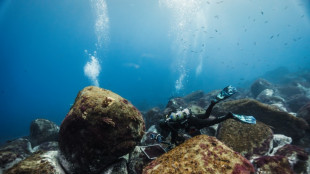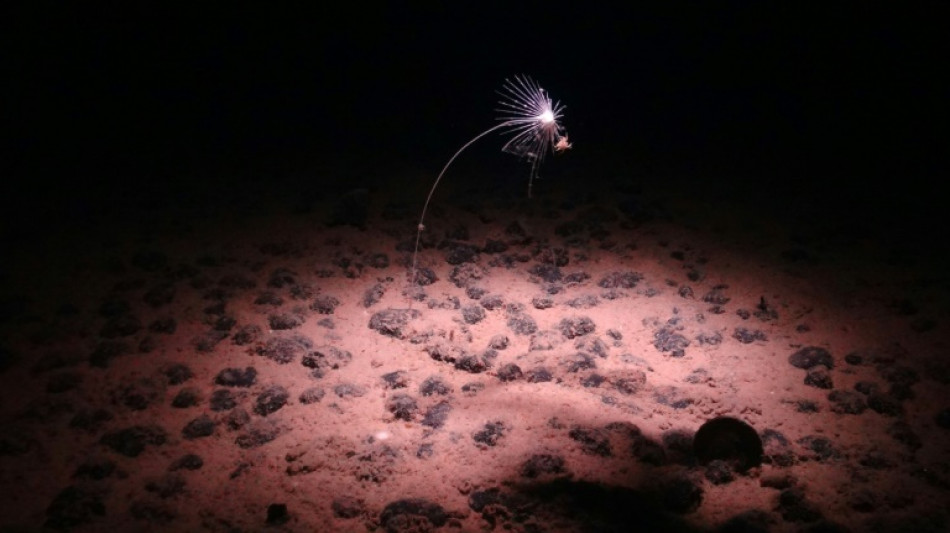
Race to name creatures of the deep as mining interest grows / Photo: © National Oceanography Centre / Smartex project (NERC)/AFP/File

In the cold, lightless Pacific Ocean deep, the seabed is scattered with metal-rich rocks coveted by miners -- and huge numbers of strange and rare animals almost entirely unknown to science.
Researchers are scrambling to name thousands of these newly discovered species.
The mining industry is pushing regulators to finalise rules that could open the way for extraction in parts of the vast Clarion-Clipperton Zone (CCZ), stretching between Hawaii and Mexico.
Once thought an underwater wasteland, the CCZ is now known to harbour an abundance of wildlife.
They range from tiny worms in the muddy sediment, to floating sponges tethered to the rocks like aquatic balloons and a giant sea cucumber dubbed the "gummy squirrel".
Campaigners say this biodiversity is the true treasure of Earth's largest and least understood environment.
They warn that mining could drive species into extinction before they have even been discovered.
Interest in mining the potato-sized "nodules", which contain metals used in technologies such as smartphone touchscreens and rechargeable batteries, has opened the way for researchers to explore the CCZ.
"We have a far greater understanding of that part of the world than we would have had if we weren't trying to exploit it," said Tammy Horton at Britain's National Oceanography Centre (NOC).
Scientists have scooped up sediment in box cores dropped from ships and deployed remote vehicles to take pictures and collect samples from the seafloor.
A snapshot of any given patch of CCZ seafloor might show just a solitary brittle star, but researchers seldom see the same creature twice.
There are "huge numbers of rare species", said Horton, adding that much of the diversity was among the creatures living in the mud.
The nodules are also a unique habitat, like coral gardens in miniature.
- 'First step' -
The first stocktake of data from scientific explorations in the CCZ, published in 2023, found that some 90 percent of 5,000 animal species recorded were new to science.
The International Seabed Authority (ISA) has set a target for over a thousand species to be described by 2030 in the regions targeted by miners.
The process is painstaking.
Where possible, each animal needs to be sketched, dissected and assigned a molecular "barcode" -- a sort of DNA fingerprint that allows other researchers to identify it.
It took Horton and a team of specialists a year to describe 27 of the hundred or more unnamed amphipods -- a type of small crustacean.
"The fundamental, basic, first step in any understanding of an environment is knowing what the animals are, how many of them there are and how wide their distribution is," she told AFP.
This would map out a baseline for life in the abyssal plain, so that potential harm can be better understood.
Conservation group Fauna & Flora has said risks range from damage to the ocean food web, to the potential for exacerbating climate change -- by churning up sediment that stores planet-heating carbon.
The ISA is due to finalise the international seabed mining code this year, but much work needs to be done.
- Cold War connections -
The oldest mining test site is a strip of CCZ seabed, ploughed in 1979.
Daniel Jones, a NOC researcher who trawled the archives to pinpoint the location, said the test followed an CIA plot to recover a Russian nuclear submarine, using deep-sea mining as a cover story.
The CIA leased a ship for real deep-sea mining, according to Jones.
He found an old photograph of the roughly eight-metre- (26-feet-) wide machine used to harvest nodules.
His team visited the test site in 2023, more than 40 years after the original disturbance.
Machine tracks were still clearly visible on the seafloor, he said.
There was "the first evidence of biological recovery" along the mined tracks, Jones told reporters recently, but the animals were not back up to their normal densities.
The slow pace of change in the CCZ is illustrated by the nodules themselves, likely millions of years in the making.
Each one probably started as a shard of hard surface -- a shark tooth or a fish ear bone -- that settled on the seabed.
They then grew slowly, by attracting minerals that naturally occur in the water at extremely low concentrations.
They contain metals like cobalt that are particularly in demand in the energy transition.
But the European Academies of Science Advisory Council (EASAC) has said the need for the nodules has been overstated and urged a mining moratorium.
EASAC Environment Director Michael Norton said that once started, deep sea exploitation would be hard to stop.
"It's a one-way street," he said. "Once you go down it, you won't turn around willingly."
J.P.Cortez--TFWP