The Fort Worth Press - Chunky canines: Study reveals dog obesity gene shared by humans

USD -
AED 3.672503
AFN 64.999987
ALL 81.750787
AMD 378.260554
ANG 1.79008
AOA 917.000259
ARS 1447.04903
AUD 1.424735
AWG 1.8025
AZN 1.705703
BAM 1.65515
BBD 2.013067
BDT 122.134821
BGN 1.67937
BHD 0.37706
BIF 2949.955359
BMD 1
BND 1.271532
BOB 6.906503
BRL 5.246497
BSD 0.999467
BTN 90.452257
BWP 13.162215
BYN 2.854157
BYR 19600
BZD 2.010138
CAD 1.365835
CDF 2200.000187
CHF 0.775835
CLF 0.021685
CLP 856.320322
CNY 6.938202
CNH 6.93846
COP 3629.16
CRC 495.478914
CUC 1
CUP 26.5
CVE 93.31088
CZK 20.630017
DJF 177.949824
DKK 6.31931
DOP 62.700992
DZD 129.735699
EGP 46.935606
ERN 15
ETB 154.846992
EUR 0.84625
FJD 2.20175
FKP 0.729917
GBP 0.730685
GEL 2.695005
GGP 0.729917
GHS 10.974578
GIP 0.729917
GMD 72.999988
GNF 8771.298855
GTQ 7.666172
GYD 209.107681
HKD 7.81225
HNL 26.40652
HRK 6.376699
HTG 131.004367
HUF 321.635502
IDR 16785
ILS 3.094805
IMP 0.729917
INR 90.426014
IQD 1309.366643
IRR 42125.000158
ISK 122.529886
JEP 0.729917
JMD 156.730659
JOD 0.708993
JPY 156.498504
KES 128.950275
KGS 87.450102
KHR 4034.223621
KMF 417.999749
KPW 899.945137
KRW 1456.205037
KWD 0.30721
KYD 0.83291
KZT 496.518171
LAK 21498.933685
LBP 89504.332961
LKR 309.337937
LRD 185.901857
LSL 15.973208
LTL 2.95274
LVL 0.60489
LYD 6.316351
MAD 9.162679
MDL 16.911242
MGA 4427.744491
MKD 52.197442
MMK 2099.936125
MNT 3569.846682
MOP 8.043143
MRU 39.687396
MUR 45.879662
MVR 15.450503
MWK 1732.791809
MXN 17.257035
MYR 3.932009
MZN 63.749832
NAD 15.973816
NGN 1367.70203
NIO 36.779547
NOK 9.668855
NPR 144.74967
NZD 1.660595
OMR 0.384528
PAB 0.999458
PEN 3.359892
PGK 4.282021
PHP 58.950503
PKR 279.546749
PLN 3.56809
PYG 6615.13009
QAR 3.645472
RON 4.311402
RSD 99.354054
RUB 76.124402
RWF 1458.735317
SAR 3.750153
SBD 8.058101
SCR 13.714455
SDG 601.506766
SEK 8.969805
SGD 1.27184
SHP 0.750259
SLE 24.474997
SLL 20969.499267
SOS 570.224434
SRD 37.894024
STD 20697.981008
STN 20.734071
SVC 8.745065
SYP 11059.574895
SZL 15.972716
THB 31.690383
TJS 9.340239
TMT 3.51
TND 2.890703
TOP 2.40776
TRY 43.511195
TTD 6.770395
TWD 31.588998
TZS 2580.289909
UAH 43.116413
UGX 3558.598395
UYU 38.520938
UZS 12251.99609
VES 371.640565
VND 25982
VUV 119.556789
WST 2.72617
XAF 555.124234
XAG 0.011067
XAU 0.0002
XCD 2.70255
XCG 1.80131
XDR 0.68948
XOF 555.135979
XPF 100.927097
YER 238.375042
ZAR 15.97944
ZMK 9001.200716
ZMW 19.565181
ZWL 321.999592
  • SCS

    0.0200

    16.14

    +0.12%

  • RBGPF

    0.1000

    82.5

    +0.12%

  • BCC

    3.8900

    88.82

    +4.38%

  • CMSC

    -0.1400

    23.52

    -0.6%

  • GSK

    4.1550

    57.495

    +7.23%

  • NGG

    1.5100

    87.74

    +1.72%

  • RYCEF

    0.1400

    17.14

    +0.82%

  • RIO

    -0.3200

    96.05

    -0.33%

  • BTI

    0.0400

    61.91

    +0.06%

  • BCE

    0.2150

    26.315

    +0.82%

  • VOD

    0.4510

    15.701

    +2.87%

  • RELX

    -0.2600

    30.25

    -0.86%

  • AZN

    4.4600

    188.78

    +2.36%

  • BP

    0.2900

    39.11

    +0.74%

  • JRI

    0.0700

    13.19

    +0.53%

  • CMSD

    -0.0900

    23.85

    -0.38%

Chunky canines: Study reveals dog obesity gene shared by humans
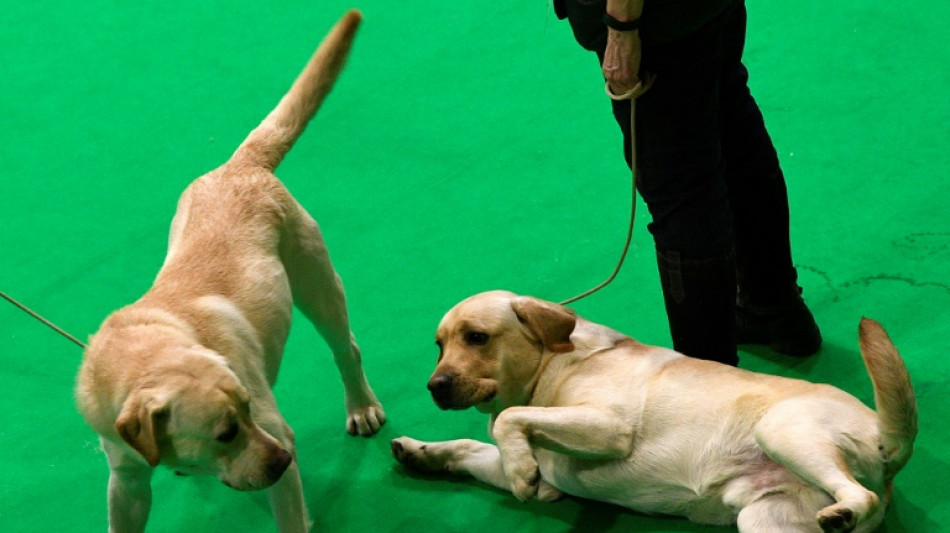
Chunky canines: Study reveals dog obesity gene shared by humans / Photo: © AFP/File

Chunky canines: Study reveals dog obesity gene shared by humans

Obesity is on the rise not just in humans but in dogs, whose history of selective breeding makes them an ideal species for studying the balance between genetics, diet, and lifestyle in weight gain.

Text size:

In a new paper published Thursday in Science, researchers identified a gene strongly linked to obesity in pet pooches -- and found it is also associated with weight gain in humans.

"The prevailing attitude towards obesity is that people are just a bit rubbish about controlling what they eat, whereas actually, our data shows that if you're a high-risk individual, it takes more effort to keep you slim," lead author Eleanor Raffan, a researcher in the University of Cambridge's Department of Physiology, Development, and Neuroscience, told AFP.

A veterinarian as well as a scientist, Raffan has long sought to study animal genetics to uncover broader biological insights that apply across species, including our own.

For this study, she and her colleagues focused on British Labrador Retrievers.

"Anyone who knows dogs will understand that starting with Labradors is a good idea because they're very prone to getting obese," she said. "They've got this reputation for being really foodie dogs, really obsessed by food."

The team collected slobber samples from 241 dogs and conducted a genome-wide association study, which examines an organism's entire set of genes to identify areas linked to a specific trait.

The top five genes were also present in humans, with the one exerting the strongest influence called DENND1B.

They also assessed how much the dogs pestered their owners for food and whether they were fussy eaters.

"Low-risk dogs tended to remain a healthy weight, irrespective of how their owners managed their food and exercise," said Raffan. "But if you were a high-genetic-risk dog, then if your owners were complacent about diet and exercise, you were likely to get really, really overweight."

For Raffan, the study has two major takeaways.

First, it sheds new light on how DENND1B affects a brain pathway responsible for regulating energy balance and appetite. Known as the leptin-melanocortin pathway, this system is a key target for some anti-obesity drugs.

"Only by understanding biology and the nuances of it can we possibly improve our treatment and management of obesity," she said.

Second, the study allowed researchers to quantify genetic risk for obesity in individual dogs -- and the level of effort required to keep them at a healthy weight. This is easier to measure in dogs than in humans, since their diet and exercise are entirely controlled by their owners.

"We shouldn't be rude to owners of overweight dogs," Raffan emphasized.

"It's not that they're hopeless individuals who don't care about their pets. It's just that they've got animals who persistently seek out opportunities to eat, and just a little bit extra every day is enough to cause weight gain over time."

S.Palmer--TFWP