The Fort Worth Press - Birdocracy: Noisy jackdaws take a 'vote' before flying

USD -
AED 3.672496
AFN 63.501197
ALL 83.072963
AMD 375.623475
ANG 1.790083
AOA 917.000069
ARS 1389.835001
AUD 1.448006
AWG 1.8
AZN 1.697841
BAM 1.695072
BBD 2.009612
BDT 122.428639
BGN 1.709309
BHD 0.377609
BIF 2964.709145
BMD 1
BND 1.2851
BOB 6.894519
BRL 5.156952
BSD 0.997742
BTN 92.939509
BWP 13.688562
BYN 2.956504
BYR 19600
BZD 2.006665
CAD 1.392785
CDF 2295.999651
CHF 0.798375
CLF 0.023224
CLP 916.999716
CNY 6.885602
CNH 6.88361
COP 3662.46
CRC 464.279833
CUC 1
CUP 26.5
CVE 95.56558
CZK 21.24979
DJF 177.673004
DKK 6.474098
DOP 60.312178
DZD 133.062353
EGP 54.236094
ERN 15
ETB 155.800822
EUR 0.866297
FJD 2.253798
FKP 0.755399
GBP 0.755645
GEL 2.685023
GGP 0.755399
GHS 10.970563
GIP 0.755399
GMD 74.000231
GNF 8752.513347
GTQ 7.632939
GYD 208.828972
HKD 7.83676
HNL 26.504427
HRK 6.526097
HTG 130.952897
HUF 333.592497
IDR 17006
ILS 3.12724
IMP 0.755399
INR 92.62535
IQD 1307.141959
IRR 1319124.999964
ISK 125.120297
JEP 0.755399
JMD 157.303566
JOD 0.708993
JPY 159.552503
KES 129.797745
KGS 87.44973
KHR 3990.137323
KMF 427.000333
KPW 899.984966
KRW 1509.289674
KWD 0.30934
KYD 0.831502
KZT 472.805432
LAK 21970.392969
LBP 89502.03926
LKR 314.804623
LRD 183.088277
LSL 16.955078
LTL 2.95274
LVL 0.60489
LYD 6.380628
MAD 9.374033
MDL 17.55613
MGA 4171.343141
MKD 53.422776
MMK 2099.725508
MNT 3578.768806
MOP 8.055104
MRU 39.637211
MUR 46.940202
MVR 15.459712
MWK 1730.071718
MXN 17.852885
MYR 4.031026
MZN 63.949845
NAD 16.954711
NGN 1378.750052
NIO 36.712196
NOK 9.754755
NPR 148.701282
NZD 1.75151
OMR 0.384545
PAB 0.997734
PEN 3.45194
PGK 4.316042
PHP 60.225005
PKR 278.39991
PLN 3.708349
PYG 6454.29687
QAR 3.638018
RON 4.416301
RSD 101.772347
RUB 80.185502
RWF 1457.240049
SAR 3.754249
SBD 8.038772
SCR 14.425806
SDG 601.000202
SEK 9.43975
SGD 1.285802
SHP 0.750259
SLE 24.650076
SLL 20969.510825
SOS 570.192924
SRD 37.350974
STD 20697.981008
STN 21.233539
SVC 8.730169
SYP 111.309257
SZL 16.948198
THB 32.600496
TJS 9.563492
TMT 3.51
TND 2.941459
TOP 2.40776
TRY 44.592198
TTD 6.768937
TWD 31.938504
TZS 2600.000224
UAH 43.698134
UGX 3743.234401
UYU 40.405091
UZS 12122.393971
VES 473.390499
VND 26340
VUV 119.350864
WST 2.77386
XAF 568.506489
XAG 0.013693
XAU 0.000214
XCD 2.70255
XCG 1.798209
XDR 0.70704
XOF 568.516344
XPF 103.361457
YER 238.649795
ZAR 16.970895
ZMK 9001.202795
ZMW 19.281421
ZWL 321.999592
  • RBGPF

    -13.5000

    69

    -19.57%

  • BCC

    -1.8800

    73.2

    -2.57%

  • CMSD

    0.1100

    22.26

    +0.49%

  • VOD

    0.0800

    15.21

    +0.53%

  • BCE

    -0.9300

    24.45

    -3.8%

  • RYCEF

    0.9000

    15.99

    +5.63%

  • GSK

    0.7000

    56.69

    +1.23%

  • RELX

    0.3600

    33.59

    +1.07%

  • NGG

    1.1500

    87.99

    +1.31%

  • CMSC

    0.0500

    22.04

    +0.23%

  • JRI

    0.0900

    12.61

    +0.71%

  • RIO

    -0.3600

    94.45

    -0.38%

  • BTI

    0.3900

    58.28

    +0.67%

  • AZN

    2.7600

    203.49

    +1.36%

  • BP

    0.9500

    47.12

    +2.02%

Birdocracy: Noisy jackdaws take a 'vote' before flying
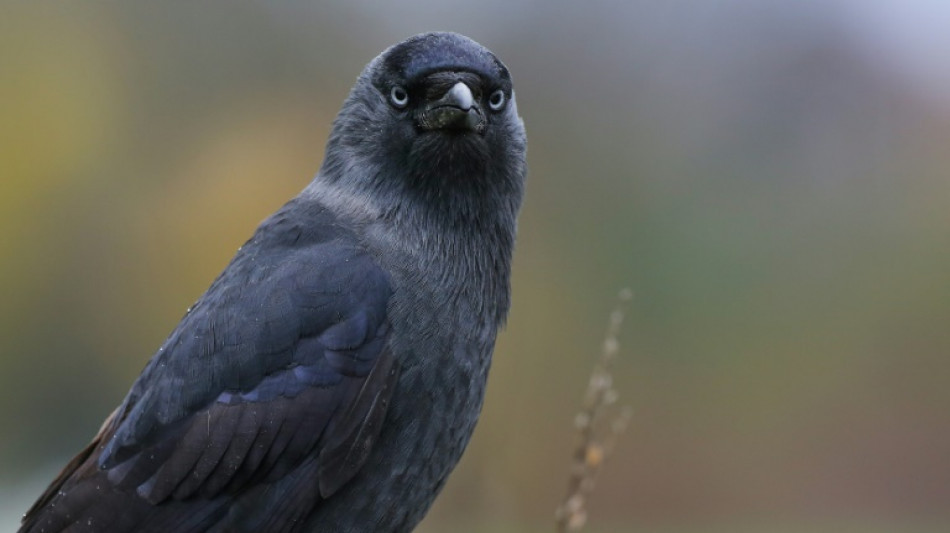
Birdocracy: Noisy jackdaws take a 'vote' before flying / Photo: © dpa/AFP/File

Birdocracy: Noisy jackdaws take a 'vote' before flying

A crescendo of calls from hundreds of noisy jackdaws can often be heard right before they take to the sky all at once, right around sunrise on cold winter mornings.

Text size:

Now, scientists who studied their daily activities in detail say these small black crows rely on "democratic" decision-making to coordinate their actions for the collective good.

The findings were published Monday in Current Biology.

"By establishing consensus to leave the roost early and in large flocks, birds may reduce predation risk, facilitate access to useful foraging information" and increase access to mates, wrote the authors.

Jackdaws -- which may get their name from their brief "Jack"-like squawk -- are found across Europe, North Africa and Asia, and form large groups known as "clatterings."

Prior research on consensus decision-making in animals had focused on small groups or members of a family.

Jackdaw roosts were interesting for size as well as diversity, comprising individuals of different ages, sexes, family groups and colonies spread across treetops.

It's likely individuals would have varying preferences about when to take off. But sticking together offers advantages, such as lowered risk of being hunted by birds of prey or small mammals.

To investigate, the team from the University of Exeter and other institutions recorded hours of audio and video of six different jackdaw roosts in Cornwall, Britain, with roost sizes varying from 160 to nearly 1,500 birds.

They found that the timing of departure was tightly linked to calling intensity with the group.

Occasionally, the birds left in dribs and drabs across 20 minutes, but most of the time they set out en masse, with hundreds of birds taking off within a span of four seconds.

On most mornings, the call intensity rose in the hour leading up to the biggest group departure -- but sometimes got delayed by rain or heavy cloud cover -- which led the team to conclude the vocalizations were a reliable source of information.

To confirm cause and effect, the researchers played recordings to the birds to see if they could get them to take off earlier than they would otherwise -- and succeeded in engineering departures that were on average 6.5 minutes earlier.

"Through their calls, jackdaws appear to effectively signal their willingness to leave, providing large groups with a means of achieving consensus to perform cohesive, collective departures from the roost," the team concluded.

On the few times the birds left in a steady stream, rather than in a big group, the calls did not crescendo to a high, indicating the birds had failed to reach consensus.

In future, the team wants to study how human activity -- such as noise pollution -- may hinder bird dynamics and their ability to communicate.

W.Lane--TFWP