What is microRNA? Nobel-winning discovery explained / Photo: © AFP

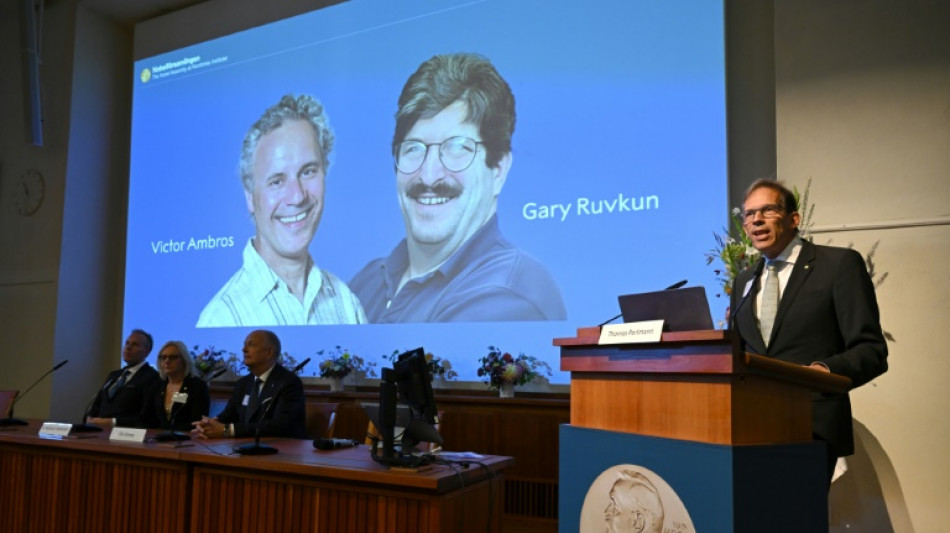
The Nobel Prize in Medicine was awarded on Monday to two US scientists for discovering microRNA, a previously unknown type of genetic switch which is hoped can pave the way for new medical breakthroughs.
But while several treatments and tests are under development using microRNAs against cancer, heart disease, viruses and other illnesses, none have actually yet reached patients.
And the world paid little attention when the new Nobel laureates Victor Ambros and Gary Ruvkun revealed their discovery decades ago, thinking it was just "something weird about worms", Cambridge University geneticist Eric Miska told AFP.
Here is an explainer about how exactly these tiny genetic switches work inside our bodies.
- What is microRNA? -
Each cell in the human body has the same set of instructions, called DNA. Some turn into brain cells, while others become muscles.
So how do the cells know what to become? The relevant part of the DNA's instructions is pointed to via a process called gene regulation.
Ribonucleic acid (RNA) normally serves as a messenger. It delivers the instructions from the DNA to proteins, which are the building blocks of life that turn cells into brains -- or muscles.
Miska gave the example of the messenger RNA vaccines rolled out against Covid-19 during the pandemic, which insert a message with new instructions to build proteins that block viruses.
But the two new Nobel winners Ambros and Ruvkun discovered a whole new type of gene regulator that had previously been overlooked by science.
Rather than being the messenger which relays information, microRNA instead acts as a switch to turn other genes off and on.
"This was a whole new level of control that we had totally missed," said Miska, who has worked on microRNA for two decades, including with the new Nobel laureates.
"The discovery of microRNAs brought an additional level of complexity by revealing that regions that were thought to be non-coding play a role in gene regulation," French researcher Benoit Ballester told AFP.
- What did the Nobel winners do? -
Back in the 1980s, Ambros and Ruvkun had been working separately on how genes interact in one-millimetre-long roundworms called C.elegans.
When they compared their work, it led to the discovery of microRNA. Ambros revealed the finding in a 1993 paper.
"Nobody really paid much attention," Miska said, explaining that most scientists at the time thought it only applied to worms.
Then in 2000, Ruvkun published research showing that microRNA is present right across the animal kingdom, including in humans and even some viruses.
"This was not just something weird that worms do, but in fact all animals and plants are totally dependent for development and normal function on them," Miska said.
More than a thousand genes that respond to microRNAs are now believed to be in the human body.
- How could this help us? -
There are numerous new treatments and tests using microRNA that are undergoing trials but none have been made widely available.
"Though there are no very clear applications available yet in microRNAs, understanding them, knowing that they exist, understanding their counter-regulatory networks, is always the first step," the Karolinska Institute's Gunilla Karlsson Hedestam told journalists in Stockholm.
MicroRNAs are particularly promising for fighting cancer because some of these switches "act as a tumour suppressor, so they put a brake on cells dividing inappropriately," Miska said.
Others, meanwhile, induce "cells to divide, which can lead to cancer", he added.
Because many viruses use microRNAs, several antiviral drugs are at varying stages of development, including for hepatitis C.
One complicating factor has been that microRNAs can be unstable.
But scientists also hope they can be used as a test called a "biomarker", which could reveal what type of cancer a patient could be suffering from, for example.
- What next? -
It also appears probable that microRNAs could be involved in the evolution of our species, Miska said.
While human brains are difficult to study, Miska hoped future research will discover more.
P.Grant--TFWP