The Fort Worth Press - In Ecuadoran Amazon, butterflies provide a gauge of climate change

USD -
AED 3.672501
AFN 64.00006
ALL 82.459567
AMD 376.320011
AOA 916.999912
ARS 1387.000328
AUD 1.422242
AWG 1.8
AZN 1.700244
BAM 1.671981
BBD 2.012823
BDT 122.815341
BHD 0.377462
BIF 2970.5
BMD 1
BND 1.273995
BOB 6.905365
BRL 5.100702
BSD 0.999316
BTN 92.260676
BWP 13.408103
BYN 2.916946
BYR 19600
BZD 2.009908
CAD 1.38545
CDF 2300.99984
CHF 0.79179
CLF 0.02281
CLP 897.729738
CNY 6.8301
CNH 6.836971
COP 3647.05
CRC 464.865789
CUC 1
CUP 26.5
CVE 94.850432
CZK 20.92605
DJF 177.720232
DKK 6.411705
DOP 60.649978
DZD 132.470986
EGP 53.241904
ERN 15
ETB 155.624997
EUR 0.85798
FJD 2.214901
FKP 0.755232
GBP 0.746965
GEL 2.685007
GGP 0.755232
GHS 11.015022
GIP 0.755232
GMD 73.00007
GNF 8779.999696
GTQ 7.645223
GYD 209.079369
HKD 7.83295
HNL 26.620439
HRK 6.462041
HTG 131.013289
HUF 323.342983
IDR 17015.15
ILS 3.08836
IMP 0.755232
INR 92.2827
IQD 1310
IRR 1315000.000203
ISK 123.390025
JEP 0.755232
JMD 157.315666
JOD 0.708965
JPY 158.734023
KES 129.399023
KGS 87.450299
KHR 4013.999549
KMF 424.496037
KPW 899.988897
KRW 1483.397158
KWD 0.30921
KYD 0.832781
KZT 477.797202
LAK 21962.501654
LBP 89550.000262
LKR 315.00748
LRD 184.201804
LSL 16.614985
LTL 2.95274
LVL 0.60489
LYD 6.345004
MAD 9.305009
MDL 17.208704
MGA 4137.500254
MKD 52.868821
MMK 2100.006416
MNT 3571.582477
MOP 8.062591
MRU 40.087009
MUR 46.520124
MVR 15.459682
MWK 1737.000346
MXN 17.46145
MYR 3.984987
MZN 63.95985
NAD 16.609901
NGN 1378.97997
NIO 36.729947
NOK 9.58317
NPR 147.619434
NZD 1.71858
OMR 0.38449
PAB 0.999308
PEN 3.40375
PGK 4.310031
PHP 59.532055
PKR 279.000048
PLN 3.65087
PYG 6482.581748
QAR 3.646026
RON 4.370105
RSD 100.684987
RUB 78.547319
RWF 1460.5
SAR 3.752621
SBD 8.04851
SCR 14.880128
SDG 600.999697
SEK 9.330385
SGD 1.275375
SLE 24.650254
SOS 571.499242
SRD 37.553982
STD 20697.981008
STN 21.44
SVC 8.744604
SYP 110.549356
SZL 16.615035
THB 32.09942
TJS 9.498763
TMT 3.5
TND 2.892016
TRY 44.501894
TTD 6.778082
TWD 31.735403
TZS 2587.503915
UAH 43.307786
UGX 3697.197396
UYU 40.598418
UZS 12230.000204
VES 474.4169
VND 26332.5
VUV 119.420937
WST 2.770913
XAF 560.735672
XAG 0.0136
XAU 0.000213
XCD 2.70255
XCG 1.8011
XDR 0.698977
XOF 564.000179
XPF 102.549508
YER 238.575002
ZAR 16.445497
ZMK 9001.195399
ZMW 19.112505
ZWL 321.999592
  • BCC

    4.5200

    79.23

    +5.7%

  • GSK

    1.5300

    57.37

    +2.67%

  • BCE

    0.2900

    24.12

    +1.2%

  • CMSD

    0.2100

    22.5

    +0.93%

  • RIO

    3.7900

    98.45

    +3.85%

  • NGG

    2.4400

    89.96

    +2.71%

  • CMSC

    0.1500

    22.29

    +0.67%

  • BTI

    1.1500

    59.95

    +1.92%

  • RBGPF

    -13.5000

    69

    -19.57%

  • AZN

    3.4600

    204.27

    +1.69%

  • BP

    -1.3500

    45.89

    -2.94%

  • JRI

    0.1600

    12.85

    +1.25%

  • RYCEF

    -0.5000

    15.25

    -3.28%

  • RELX

    0.5700

    33.93

    +1.68%

  • VOD

    0.4600

    15.77

    +2.92%

In Ecuadoran Amazon, butterflies provide a gauge of climate change
In Ecuadoran Amazon, butterflies provide a gauge of climate change / Photo: © AFP/File

In Ecuadoran Amazon, butterflies provide a gauge of climate change

Biologists on a trail in the Ecuadoran Amazon hold their breath as they distribute a foul-smelling delicacy to lure butterflies, critical pollinators increasingly threatened by climate change.

Text size:

A team has hung 32 traps made of green nets, each baited with rotting fish and fermented bananas. They are meant to blend in with the forest canopy. Their pungent odor clearly does not.

Since last August, a team of biologists and park rangers has been monitoring butterfly numbers in the Cuyabeno Wildlife Reserve, a park famed for its abundant flora and fauna.

They catch and document the colorful insects, releasing most with an identifying mark on their wings. Some of them, possibly from previously unknown species, are kept for further study.

The results of the team's work, however, have been discouraging.

Butterflies are "bioindicators," living organisms whose well-being provides a measure of the health of their surrounding ecosystem, and their numbers are decreasing, biologist Maria Fernanda Checa told AFP.

While the number of species may not have declined by more than 10 percent, in terms of absolute butterfly numbers "the decrease is very significant... maybe 40/50 percent," she said.

"It is something that alarms us."

- Bioindicators -

Under expedition leader Elisa Levy, a team checks the nets for captured butterflies.

They hold the insects delicately by their tiny abdomens and manipulate their legs and wings with tweezers.

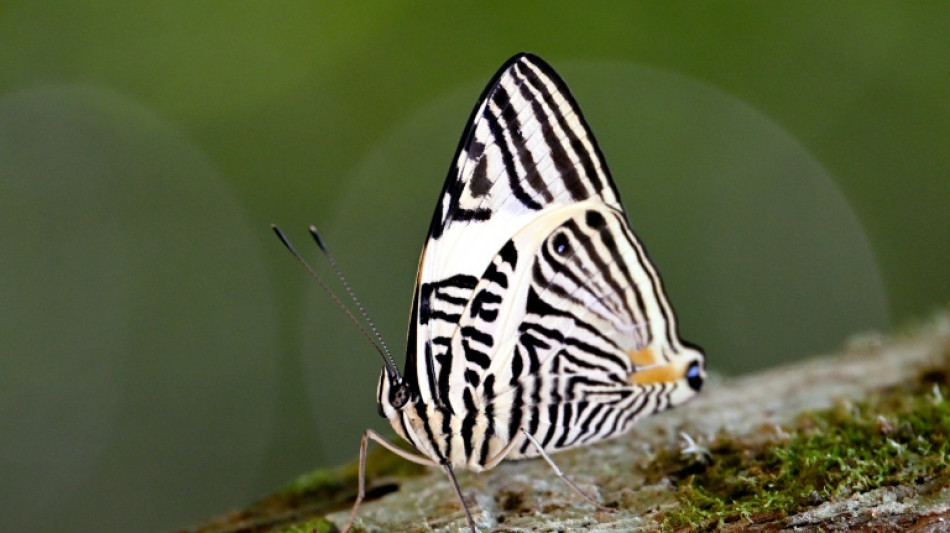
Some are bright red and blue, others have what resemble zebra stripes. Some are see-through, like glass.

About three-quarters of fruit- or seed-producing crops for human consumption depend on pollinators, which provide a free service worth billions of dollars.

The UN has warned that 40 percent of invertebrate pollinators -- particularly bees and butterflies -- risk global extinction, posing certain risks to humanity itself.

Butterflies, said Checa, are "very sensitive, even to small changes in the ecosystem" throughout their short lifespan from egg to caterpillar to reproductive adult.

Levy explained that tropical plants -- unlike ones in regions with distinct seasons -- are not accustomed to extreme weather variations.

If they do not adapt to a fast-changing climate, these plants could be lost, along with the butterfly larvae that feed on them.

Ecuador, relatively small but extremely biodiverse, hosts about 4,000 butterfly species -- nearly as many as its much larger neighbors Peru and Colombia.

Yet in places like the Yasuni National Park, which neighbors Cuyabeno, "the rate of species discovery is slower than the rate of extinction," said Checa.

P.McDonald--TFWP