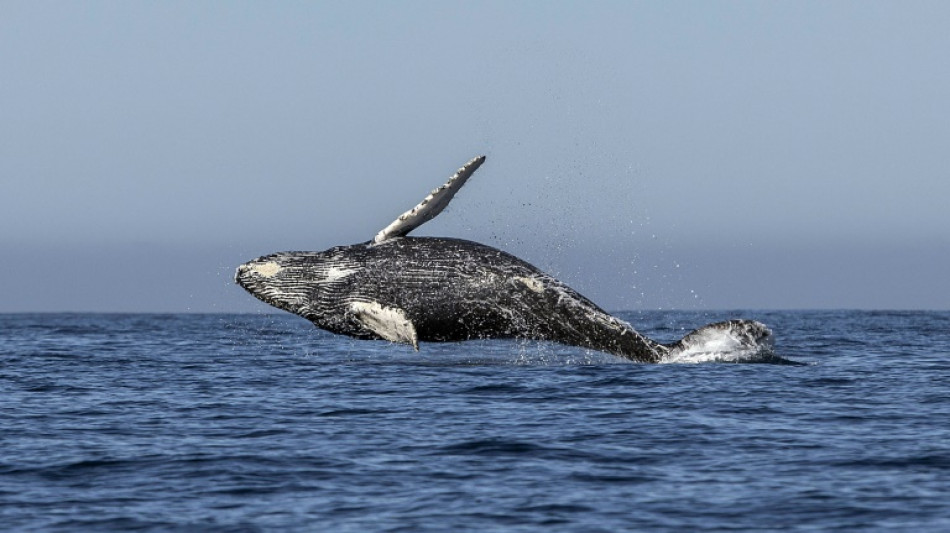
Heatwaves may be driving whale decline in Pacific: study / Photo: © AFP

The number of North Pacific humpback whales plummeted 20 percent in less than a decade, and marine heatwaves may be the main culprit, according to a study released Wednesday that spells a troubled future for the majestic sea mammals.
Thanks to conservation efforts and the end of commercial whaling in 1976, the region's humpback population steadily increased until 2012.
But over the last decade, whale numbers have declined sharply, researchers reported in the journal Royal Society Open Science.
A team of 75 scientists compiled the largest photo-identification dataset ever created for a large marine mammal to track North Pacific humpback populations from 2002 to 2021.
Using images of the whale's unique tails the team was able to log some 200,000 sightings of more than 33,000 individuals.
Up to 2012 the humpback population steadily increased, and it was widely assumed it would eventually level off at their natural "carrying capacity" -- the number of whales the ocean can support.
Instead, they saw a steep population decline.
From 2012 to 2021 the number of humpbacks fell 20 percent from some 33,000 individuals to just over 26,600.
For a subset of whales that wintered in Hawaii, the drop was even more pronounced: 34 percent.
That turned out to be a highly significant difference.
From 2014 through 2016 the strongest and longest marine heatwave ever recorded ravaged the Pacific northeast with temperate anomalies sometimes exceeding three to six degrees Celsius, altering the marine ecosystem and the availability of humpback prey.
"My jaw was on the floor," study author Ted Cheeseman, whale biologist and a PhD student at Southern Cross University in New South Wales, told AFP. "This is a much bigger signal than we expected."
"Our estimation is that about 7,000 whales mostly starved to death," he said.
It is normal even in healthy populations for numbers to fluctuate, but such an abrupt decline for a long-lived species points to a major disruption in the oceans.
- 'The ceiling crashed' -
In this case, the scientists speculate, the extreme marine heat actually reduced the carrying capacity threshold for humpbacks.
"Instead of the whales coming up to the ceiling, the ceiling crashed down on the whales," Cheeseman said.
The fact that humpbacks were unable to shift their already flexible diet is a telltale indicator for overall ocean health.
"It's not just the whales' food that declined," Cheeseman added, noting drops in the populations of tufted puffins, sea lions, and seals. "A warmer ocean produces less food."
Some commercial fisheries also felt the impact.
According to the Intergovernmental Panel on Climate Change, marine heatwaves -- already more frequent and intense -- are projected to increase globally over the course of this century.
- Still a success story -
For hundreds of years, whalers from across the planet hunted humpback whales for their oil, meat and baleen, their feeding filtration system.
By 1986, the IUCN had listed the species as globally endangered.
Humpback whales continue to face threats today, primarily from ship strikes and entanglements in fishing nets.
But international restrictions on commercial whaling allowed the global humpback whale population to rebound to more than 80,000 mature individuals.
But today conservation goes hand-in-hand with climate action.
"It is a great success story that these whales are no longer in immediate danger of extinction like they were 50 years ago," Cheeseman said.
"And yet, there's a new reality of changing oceans that we have to live with."
T.Mason--TFWP