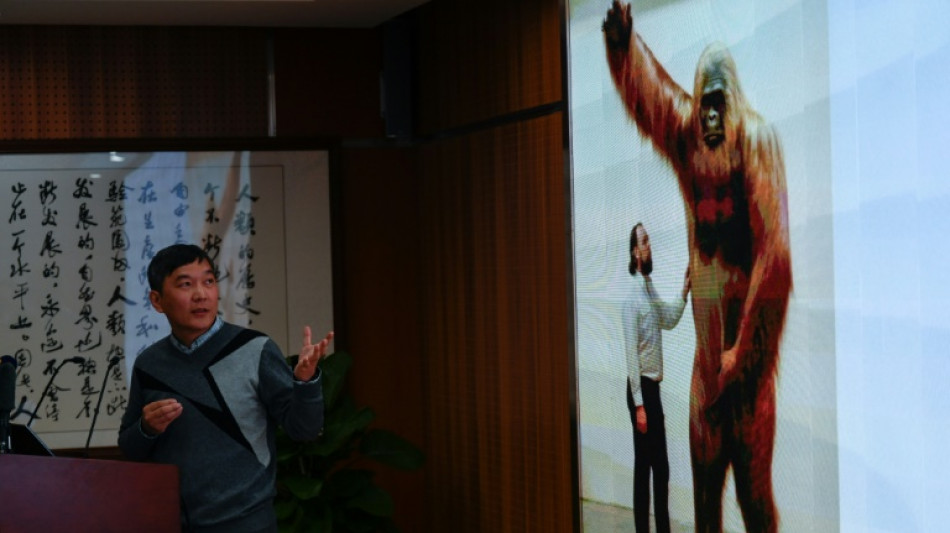
Late apes: Biggest primate ever died off due to 'huge mistake' / Photo: © AFP

The largest primate ever to walk the Earth went extinct because it could not adapt to its changing environment, with the mighty beast reduced to living off bark and twigs before dying off, scientists said on Wednesday.
Gigantopithecus blacki, which stood three metres tall (10 feet) and weighed up to 300 kilogrammes (660 pounds), thrived in the forests of southern Asia until a little more than 200,000 years ago.
Exactly why the great ape died off after flourishing for hundreds of thousands of years has been one of the lasting mysteries of palaeontology ever since a German scientist first stumbled on one of its teeth at a Hong Kong apothecary in the 1930s.
The molar was so massive it was being sold as a "dragon's tooth".
"It was three to four times bigger than the teeth from any great ape," Renaud Joannes-Boyau, a researcher at Australia's Southern Cross University, told AFP.
"That intrigued him and that's where all this research started," said Joannes-Boyau, a co-author of a new study in the journal Nature.
All that has been found of the Gigantopithecus since are four partial jawbones and around 2,000 teeth, hundreds of which were discovered inside caves in southern China's Guangxi province.
Even after a decade of excavations in these caves, the cause of the ape's extinction remained elusive, said the study's co-lead author Yingqi Zhang of China's Institute of Vertebrate Palaeontology and Palaeoanthropology.
- Huge apes can't jump -
Seeking to establish a timeline of the animal's existence, the team of Chinese, Australian and US scientists collected fossilised teeth from 22 caves.
The team used six different techniques to determine the age of the fossils, including a relatively new method called luminescence dating which measures the last time minerals were exposed to sunlight.
The oldest teeth dated back more than two million years, while the most recent were from around 250,000 ago.
Now the researchers can tell "the complete story about Gigantopithecus's extinction" for the first time, Zhang told AFP in his office in Beijing.
They established that the animal's "extinction window" was between 215,000 and 295,000 years ago, significantly earlier than previously thought.
During this time, the seasons were becoming more pronounced, which was changing the local environment.
The thick, lush forest that Gigantopithecus had thrived in was starting to give way to more open forests and grassland.
This increasingly deprived the ape of its favourite food: fruit.
The huge animal was bound to the ground, unable swing into the trees for higher food.
Instead, it "relied on less nutritious fall-back food such as bark and twigs," said Kira Westaway, a geochronologist at Australia's Macquarie University and co-lead author.
Zhang said this was a "huge mistake" which ultimately led to the animal's extinction.
- Clever relative -
The primate's size made it difficult to go very far to search for food -- and its massive bulk meant that it needed plenty to eat.
Despite these challenges, "surprisingly G. blacki even increased in size during this time," Westaway said.
By analysing its teeth, the researchers were able to measure the increasing stress the ape was under as its numbers shrunk.
They also compared Gigantopithecus' fate to its orangutan relative, Pongo weidenreichi, which handled the changing environment far better.
The orangutan was smaller and more agile, able to move swiftly through the forest canopy to gather a variety of food such as leaves, flowers, nuts, seeds, and even insects and small mammals.
It became even smaller over time, thriving as its massive cousin Gigantopithecus starved.
Westaway emphasised that it was important to understand the fate of the species that came before us -- particularly "with the threat of a sixth mass extinction event looming over us".
J.M.Ellis--TFWP