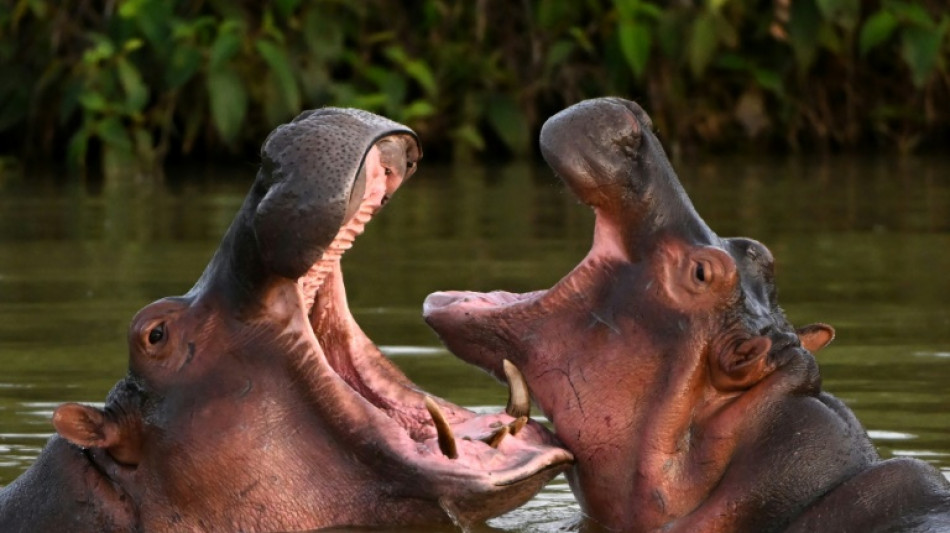
Colombia grapples with Escobar's hippopotamus legacy / Photo: © AFP

In their homeland in Africa, they are responsible for more human deaths than almost any other animal, but in Colombia, hippopotami have become loved members of the local community and a tourist attraction.
However, in a town close to the city of Medellin, this legacy of the late drug baron Pablo Escobar, is increasingly posing a problem, and one that experts think may soon turn deadly.
Several months ago, one of hippos burst into a school yard in Doradal with both pupils and parents present.
"The mothers get scared when they see an animal of that size," teacher Dunia Arango told AFP.
This time, the uninvited guest chomped at some fruit trees before moving off into the adjacent fields.
But a bloat of hippos have set up home in a lake just 20 meters (yards) from the school.
"There are about 35 children playing that could approach them and provoke a tragedy," said David Echeverri, an official from the local environment authority.
"While they may look very calm, at any moment, given their highly unpredictable behavior, they can attack, as has happened before," he added.
- 'It threw me two meters' -
John Aristides, 33, remembers very well that afternoon in October 2021 when he was fishing on the banks of a creek when a hippopotamus "lunged at me and hit me on the head with its lips."
He slipped trying to get away and was bitten on the arm.
"It grabbed me and threw me two meters," he added. "It didn't tear off my arm because they have very wide teeth."
But Aristides still spent a month in hospital recovering.
That is the closest Colombia has come to a fatal encounter but "if we don't do anything, then we expect to have thousands of hippopotami wandering around" in the future, said Echeverri, who two weeks ago buried a hippo that had been hit by a driver.
After cocaine king Escobar was gunned down by police in 1993, his private ranch and collection of exotic animals, including hippos, were left to nature in an area of abundant vegetation and where there are no predators.
The hippo numbers exploded and there are now 160 of the two ton beasts wandering freely around this part of northwestern Colombia.
A study by the National University estimated that the local population of hippopotami could rise to a thousand by 2035.
Biologists say local fauna such as the manatee, classified as an endangered species by the International Union for the Conservation of Nature, have been displaced.
Last year, the environment ministry declared hippos an "invasive species," opening the door to a possible cull, one of several solutions being sought to the potentially growing problem.
- 'Expensive and ineffective' -
Fisherman Alvaro Diaz, 40, takes tourists hippopotamus watching by canoe on the Magdalena, the longest river in Colombia.
When he notices the hippos are bothered, he keeps his group at least 30 meters away.
"We see them very often ... we live peacefully with them," he insisted.
Diaz believes, however, that the hippo population needs to be controlled through castrations and contraceptive devices.
The local environment body has tried both, but Echeverri claims they were "expensive and ineffective."
Echeverri says killing them "without pain, in a technically correct manner, is not easy either" given that it would involve capturing and sedating them first.
In a bid to save the hippos, Antioquia state, where Doradal is, announced a plan to transport 70 hippopotami to wild sanctuaries in Mexico and India.
The plan just needs approval from national authorities in all three countries.
Echeverri believes this project is "possible and necessary" given he has already led a project to capture seven hippos and send them to zoos inside Colombia.
Farmers complain of damage to their crops, but locals have grown fond of the animals.
"Don't take them all. It's already become our culture to live with them and it's great to have this population with us," said Arango, keeping one eye on her pupils.
C.Rojas--TFWP