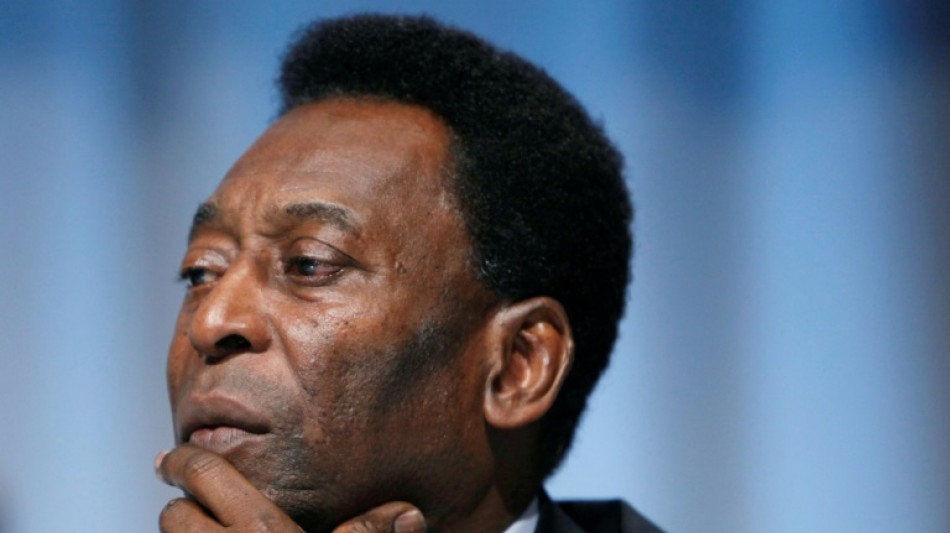
Pele's politics still a touchy subject in Brazil / Photo: © AFP/File

Pele is revered in Brazil as the eternal "King of Football."
But the legendary player's image is more complicated when it comes to the trickier terrain of politics in his home country, where he faced criticism for his failure to speak out on racism and his supposed closeness with the former military regime.
Widely regarded as the greatest footballer in history, Pele died Thursday at age 82, triggering an outpouring of emotion in Brazil -- and a national reexamination of his legacy.
Pele's surge to global superstardom overlapped with the rise of Brazil's Cold War-era military regime, which ruled the South American country with an iron fist from 1964 to 1985.
The legendary player was photographed rubbing shoulders with the likes of dictators Emilio Garrastazu Medici and Ernesto Geisel, two of the most hardline generals to preside over a regime that killed or "disappeared" hundreds of people.
Clutching his World Cup trophies and grinning alongside the generals, the black footballer also drew criticism for his silence on racism, at a time when Brazil -- the last country in the Americas to abolish slavery -- was presenting itself to the world as a harmonious "racial democracy."
"He acted like a submissive black who accepts everything and fights nothing," fellow player Paulo Cezar Caju, his teammate on Brazil's storied 1970 World Cup-winning squad, once said.
Pele drew fresh criticism when asked about the dictatorship years in a Netflix documentary on his life, released in 2021.
"For me, at least, it changed absolutely nothing," he said. "Football kept going just the same."
In the same documentary, famed Brazilian sports journalist Paulo Cesar Vasconcellos underlines Pele's silence on political issues in those troubled times.
He "accepted the regime, which treated him well because it knew how important he was," Vasconcellos said.
- Lesser-known legacy -
But lesser-known archive photos show a different side of Pele.
In one, he wears a yellow jersey stamped with the phrase "Diretas ja" -- direct elections -- the rallying cry of the anti-government protests that swept Brazil in the 1980s, triggering the dictatorship's downfall.
That 1984 picture appeared on the cover of leading Brazilian sports magazine Placar.
Other images resurfaced during the month Pele spent in hospital before he died, such as a 1989 press conference in which he announced he was thinking of running for president and declared himself a "socialist."
He did not ultimately run, but served as sports minister under center-right president Fernando Henrique Cardoso from 1995 to 1998.
Pele was an assertive, hands-on minister who fought to guarantee footballers' rights at their clubs -- reportedly drawing the ire of the most powerful man in football, fellow Brazilian and then-FIFA president Joao Havelange.
- 'Made me love Brazil' -
Pele defended himself against his critics, saying he preferred to make a subtler statement on issues such as racism.
In comments cited in a 2020 article in Spanish newspaper El Pais, he said he'd been called "monkey" and worse, but that he "didn't care."
"I preferred to set an example for my family and fans. That's my fight."
The same article compared him to American NBA great Michael Jordan, who revolutionized basketball in the 1990s, but who also faced criticism for his perceived failure to take a stand on hot-button topics of the day.
In the Netflix documentary, Pele reminded viewers he had spoken out on issues important to him, such as dedicating his 1,000th career goal in 1969 to Brazilian children suffering from hunger.
"I'm sure I've done more to help Brazil with my football and my way of life than a lot of people who make their living in politics," he said.
And although some criticize him for not speaking out on racism, others say the mere fact of seeing a black man rise to such heights was an inspiration.
"Pele is the first person who made me love Brazil," prominent black intellectual Silvio Almeida -- set to become culture minister under left-wing president-elect Luiz Inacio Lula da Silva -- tweeted after Pele's death.
"Seeing a Brazilian black man like me become the uncontested greatest at what he did made me think we could believe in something."
L.Davila--TFWP