In Uruguay, an effort to save horses from foreign plates
/ Photo: © AFP

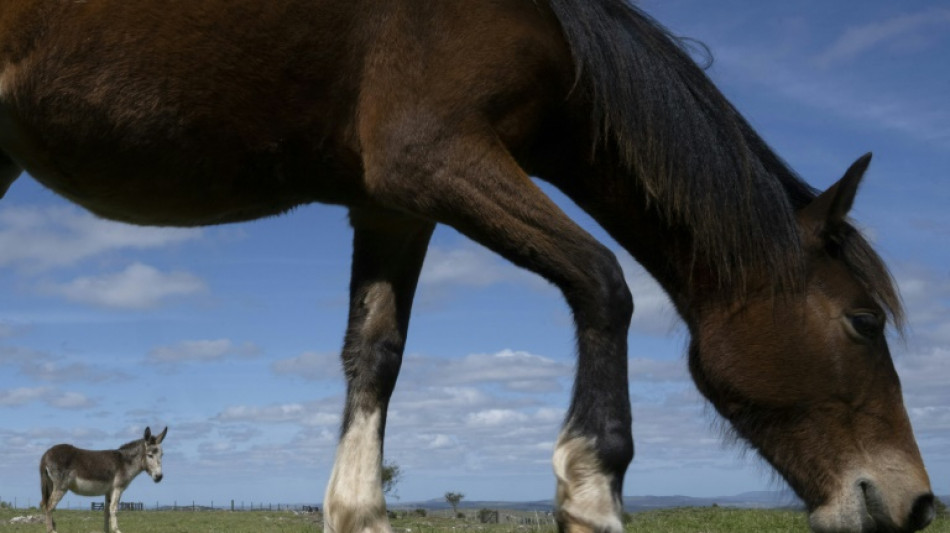
Among a motley collection of rescued farm animals, four horses graze peacefully on a farm outside the Uruguayan capital Montevideo, blissfully unaware they had narrowly escaped the chopping block.
Uruguay, a country where horses are not considered food but companions, has seen a rise in equine meat exports, prompting efforts to rescue horses destined for slaughter.
In 2020, the small South American nation was the seventh-largest exporter of horse meat, according to the OEC economic data site, with Belgium, Russia, France and Japan among the top importers.
Most of Uruguay's tens of thousands of race, sports and work horses end up on someone's plate somewhere else in the world after they become injured, old, or their owners simply cannot care for them anymore.
Uruguayan horses are not bred for meat, but used in racing or dressage and on farms -- often by cattle-breeding gauchos who prefer to travel the grassy plains on horseback rather than by car.
In Pan de Azucar, some 115 kilometers (71 miles) east of Montevideo, horses destined for slaughter are finding a second chance on the farm of Juan Pablo Pio.
For now, he is playing host to four horses that were bought by the NGO Santuarios Primitivo, who took the animals from a truck headed for one of Uruguay's three equine slaughterhouses, and them brought to his farm.
"They have come to live what is left of their lives here," said Pio, who described his mission as "doing things because they are right and not because they are profitable."
"Their only mission... is to exist," he added of the four-footed newcomers.
Pio also has a rescued chicken, a donkey, a pig and a cow.
- Fattened up -
Santuarios Primitivo was created three years ago by Pablo Amorin y Martin Erro, friends with ties to the equestrian world.
Since then, they have saved some 250 horses and found new homes for them on dozens of farms across the small South American nation.
Amorin told AFP that his team contacts herdsmen who gather unwanted horses from around Uruguay to be fattened up and sold for slaughter.
"We tried to go to the slaughterhouses, but they wouldn't open their doors for us to buy (horses) from them," he said.
"So, we turned our attention to... the 'tropilleros.' When we have money or space to buy and adopt horses, we talk to the herdsmen and tell them: 'When the next shipment comes in, we want five horses for ourselves'."
Many of the herdsmen are happy to help, said Amorin, and sometimes even ask the rescuers to take a particular horse that they had grown fond of from among the condemned.
- 'Noble animal' -
Uruguay is cattle country: beef is its main export commodity and there are more than three cows for each of the country's 3.5 million inhabitants -- the highest number per capita in the world.
As for horses, there is one for every seven inhabitants, according to the Uruguayan Equine Veterinary Association -- about half-a-million.
In 2021, the country slaughtered 58,152 horses, according to Uruguay's INAC national meat institute -- up 61 percent from 2020 and the highest number by far in a decade.
Uruguay's horse meat export volume rose percent in 2021, valued at some $28.8 million, said the INAC. In 2022, exports rose further still.
Beef is cheap in Uruguay, and for an Uruguayan to eat horse meat would be sacrilege. But the fact that their horses are being eaten abroad is an uncomfortable open secret.
"The horse carries symbolic value in our culture," anthropologist Gustavo Laborde told AFP.
In Uruguay, it is said that "the country was made on horseback," he added.
Yet as much as the horse is regarded as a "noble animal," there was an element of "hypocrisy" in balking at horse meat while turning a blind eye to the animals' often tough working lives after which "the vast majority of horses end up in the refrigerator" anyway, said Laborde.
M.McCoy--TFWP