Wearable Brain Sensor Could Bring Real-Time Cognitive Fatigue Monitoring Into Everyday Environments

Bandage-sized wireless fNIRS technology points toward future applications in mission-critical work, training, education and human performance
TAMPA, FL / ACCESS Newswire / September 22, 2026 / What if an air traffic controller could recognize the onset of cognitive fatigue before it began affecting reaction time or decision-making? What if a mission-critical team could objectively track cognitive workload during a long, demanding operation? Or what if teachers could identify when a student is becoming too mentally fatigued to keep absorbing new information?

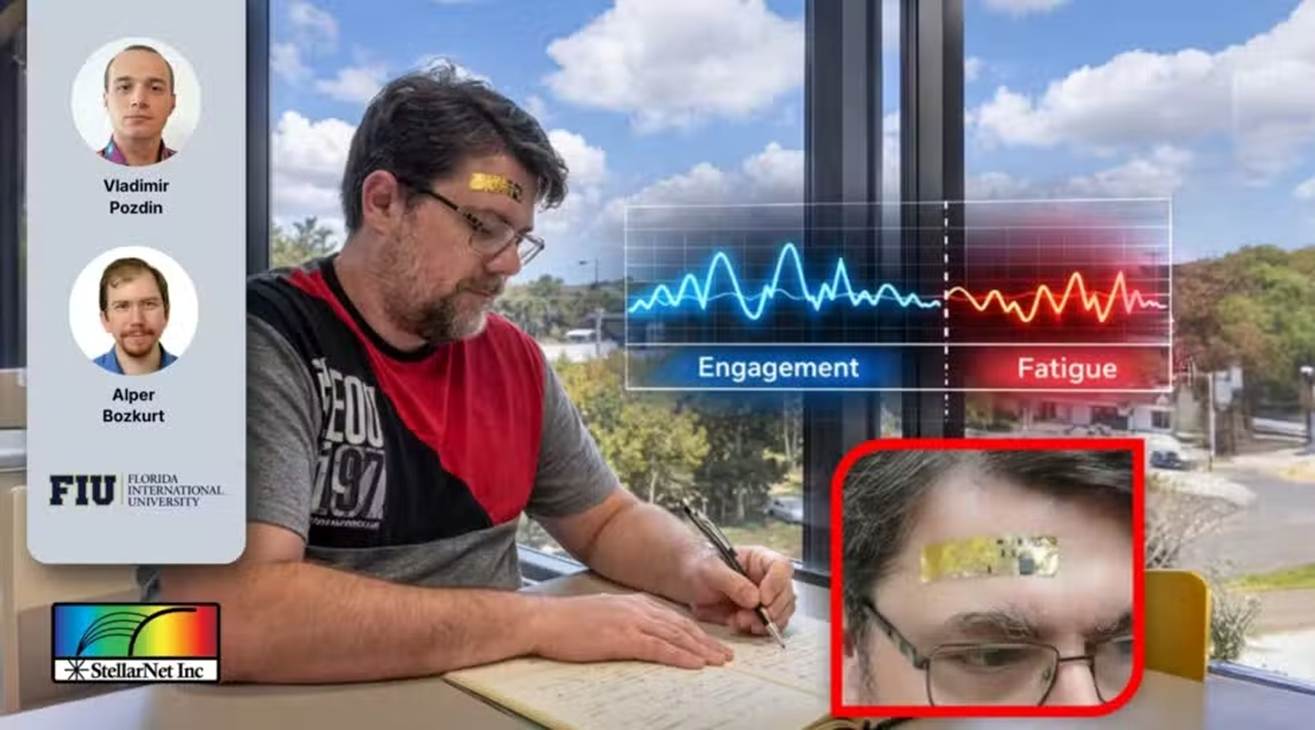
Those possibilities are what make a new bandage-sized wearable brain-monitoring sensor so intriguing. Developed by researchers including Vladimir A. Pozdin, Ph.D., of Florida International University and Alper Bozkurt, Ph.D., of North Carolina State University, the wireless device uses functional near-infrared spectroscopy (fNIRS) to measure changes in cerebral blood oxygenation associated with brain activity while allowing the wearer to move freely.
The research was also recognized with third place in StellarNet's 2026 Spectroscopy Application Challenge, an annual program highlighting innovative uses of spectroscopy and optical measurement technology.
A New Window Into Human Performance
Cognitive fatigue can slow reaction time and affect performance, yet it can be difficult to identify objectively. Wearable fNIRS creates the possibility of studying cognitive workload where performance actually happens - from pilots and other critical workers to training teams and classrooms - rather than only in a controlled laboratory.
The current prototype is a research platform, not an operational fatigue-warning system. But the researchers specifically point toward unrestricted monitoring and future AI-driven analysis, raising the possibility that larger real-world datasets could eventually help identify patterns associated with cognitive workload, fatigue and recovery.
A Bandage-Sized Optical Platform
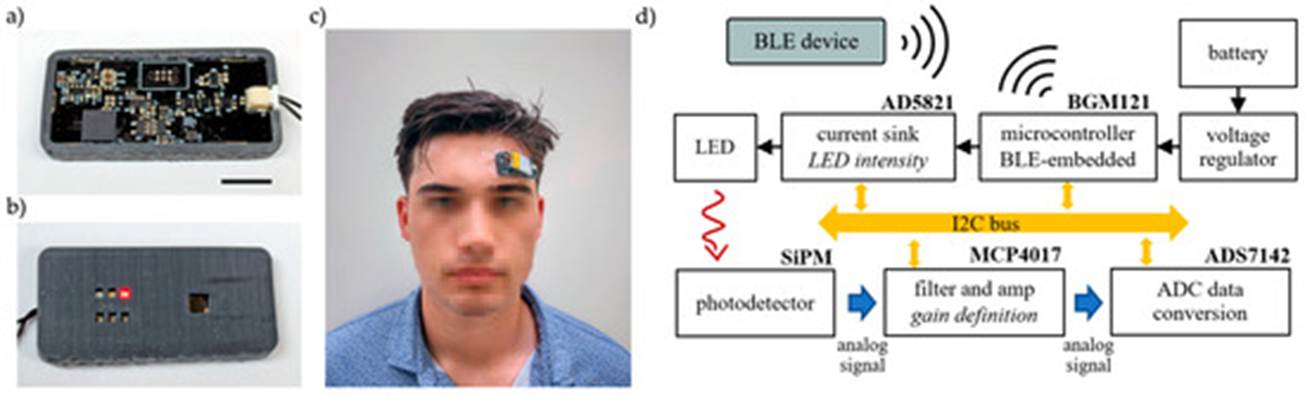
Published in the peer-reviewed journal Biosensors in 2025, the system integrates optical sources, photodetection, signal processing, Bluetooth Low Energy communication and data acquisition onto a 19 × 44 mm circuit board. The complete system, including its battery, was secured to the forehead with medical film dressing. A 500 mAh battery provided approximately 50 hours of continuous operation at a 10 Hz sampling rate.
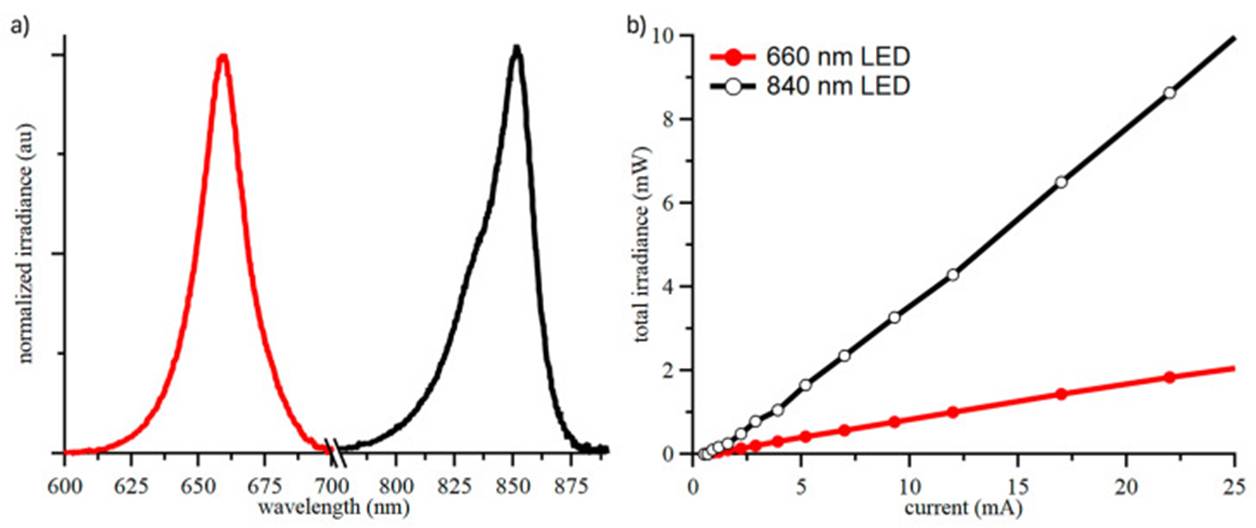
The device uses 660 nm and 840 nm LEDs because oxygenated and deoxygenated hemoglobin interact differently with light at the two wavelengths. By measuring changes in the returned optical signal, the system can calculate changes in cerebral oxygenation associated with brain activity.
For this characterization, the research incorporated StellarNet's IS6 LED Measurement System / 6-inch integrating sphere to measure the LED optical output and power. The published measurements were used to help determine hemoglobin optical constants and establish LED-drive safety limits based on IEC 62471.
The Light Behind the Measurement
The researchers characterized the spectral output and total irradiated power of the 660 nm and 840 nm LEDs used for fNIRS sensing. The two wavelengths provide the optical information needed to distinguish changes in oxygenated and deoxygenated hemoglobin, while the power measurements help define safe operating limits.
Testing Cognitive Activity
The researchers validated the wearable system using arterial occlusion, breath-holding and cognitive-workload experiments. During the cognitive study, participants performed repeated two- and three-digit arithmetic tasks while the device monitored cerebral oxygenation. The authors reported measurable hemodynamic responses associated with cognitive activity; in one participant, the response changed over repeated cycles in a pattern the researchers said correlated with fatigue.
The work does not establish the device as a diagnostic tool or prove that it can currently warn an air traffic controller, pilot, student or other user that fatigue is affecting performance. Instead, it demonstrates a compact wireless platform capable of measuring brain-related hemodynamic changes and points toward future monitoring in unrestricted and unsupervised daily-life environments.
Research Recognized by StellarNet
Pozdin and Bozkurt's work received third place in the 2026 StellarNet Spectroscopy Application Challenge. StellarNet's annual program recognizes researchers using spectroscopy and optical measurement technology in innovative scientific applications.
"This is what makes wearable spectroscopy so exciting," said Jason Pierce, President of StellarNet, Inc. "We already monitor machines, environments and processes with incredible precision. The possibility of using light to better understand cognitive workload while people are actually working, learning or performing opens an entirely different category of measurement. The research is still early, but the potential applications are fascinating."
For wearable fNIRS, the broader opportunity is to move useful optical measurements out of the traditional laboratory and closer to the environments where human performance matters. Combining compact optical sensing with wireless communication, longer-duration data collection and future analytical algorithms could give researchers a new way to study cognition, workload and fatigue in real-world settings.
About StellarNet
StellarNet, Inc. is a manufacturer of compact spectrometers, spectroscopy systems and analytical software for research, education and industrial applications. Founded in 1991 and headquartered in Tampa, Florida, StellarNet develops UV-VIS, NIR, Raman, fluorescence, radiometry and other optical measurement technologies.
Media Contact
StellarNet, Inc.
14390 Carlson Circle
Tampa, FL 33626 USA
+1 (813) 855-8687
[email protected]
References / Source Links
1. Victorio, M.; Dieffenderfer, J.; Songkakul, T.; Willeke, J.; Bozkurt, A.; Pozdin, V.A. "Wearable Wireless Functional Near-Infrared Spectroscopy System for Cognitive Activity Monitoring." Biosensors 2025, 15(2), 92. https://doi.org/10.3390/bios15020092
2. StellarNet, Inc. 2026 Spectroscopy Application Challenge Results
3. StellarNet, Inc. LED Measurement Systems - IS6 6-inch Integrating Sphere
SOURCE: StellarNet
View the original press release on ACCESS Newswire
H.Carroll--TFWP