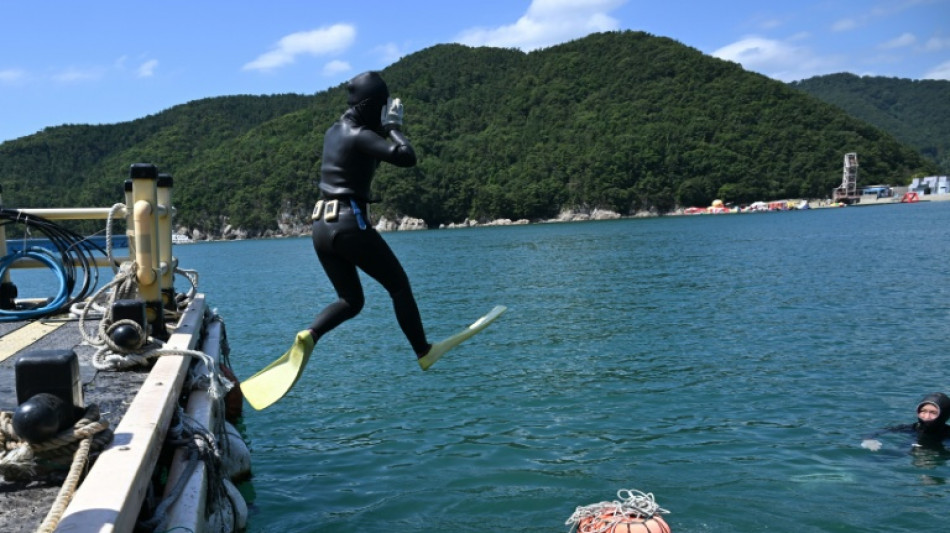
Women quit South Korea's grind for diving tradition / Photo: © AFP

Jin So-hee had to suffer to join the centuries-old tradition of South Korean women diving to harvest seafood. But she is now part of a new generation to earn a place in the waves.
The nation's rapid economic transformation drew workers away from being haenyeo, the so-called "sea women" who dive without oxygen tanks to catch what they can.
But South Korea's all-consuming work culture is now pushing some back towards a meaningful -- and punishing -- way to make a living.
Jin, 33, grew up in Busan, the country's second-largest city, earning qualifications in skincare and nail art before working as a nursing assistant to help make ends meet.
Worn down by long hours, one-day weekends and limited pay, she decided to head for the quiet coastal town of Geoje at age 25.
There, she came across haenyeo in their 70s, earning a living in nature and diving well past retirement age, and decided to join them.
But Jin lost seven kilograms (15 pounds) in her first year as a haenyeo and said she was sometimes so exhausted she "barely had the strength to lift a spoon".
The intense work requires haenyeo to dive, protected only by a wetsuit and goggles applied with mugwort and saliva to prevent fogging up, as tradition dictates.
Jin also suffered severe ear pain from the water pressure, followed by splitting headaches after dives -- ailments that have plagued generations of haenyeo.
"The pain was so bad it brought tears to my eyes... I couldn't hear a thing," she said.
Determined to continue, Jin learned modern freediving, the sport of diving underwater without using breathing equipment, and scuba diving, including techniques to equalise the pressure in her ears.
- Female independence -
For centuries, haenyeo have held a distinctive place in Korean history, with generations of women becoming family breadwinners.
Their culture, recognised by the UN cultural body UNESCO, has come to symbolise female independence and resilience in a country long shaped by deeply patriarchal traditions.
The UNESCO listing specifically notes the island of Jeju as the heart of the tradition, where the number of haenyeo fell to 2,371 last year from 3,437 in 2021.
But their culture and tradition exist elsewhere on South Korea's coast -- including Geoje.
Another challenge for Jin and her fellow new-generation diver, Woo Jung-min, has been breaking into Geoje's tight-knit community of older haenyeo.
Fiercely private, the divers were initially wary of Jin and Woo filming their lives for YouTube, which the pair have used to promote and record the experiences of people like them.
But the pair persisted.
"We wanted to document the fact that there were young haenyeo like us, so that someday, this could become a kind of record and perhaps even an asset for future generations," Woo, 40, said.
- 'Sea is dangerous' -
Choi Young-hee, 60, took an equally unlikely path to the sea, becoming a haenyeo in her late 40s after nearly two decades selling clothes and accessories in Seoul department stores.
Left weary by seven-day workweeks and demanding customers, she was visiting Geoje when she spotted figures in the sea repeatedly diving and surfacing.
At first, Choi thought they were dolphins. They were haenyeo.
The sight captivated her and made her question her life.
"Why was I ... competing so fiercely in the city?" Choi recalled thinking.
Today, Choi runs an organisation teaching haenyeo culture and training aspiring divers.
Yet even as women like Jin, Woo and Choi help keep the tradition alive, the world beneath them is changing.
Haenyeo numbers continue to fall, while warming seas disrupt marine ecosystems, thinning catches and making their dangerous profession more precarious.
An old haenyeo saying captures the danger: "You earn your living in the realm of the dead and spend it in the world of the living."
Even a pinhole in a wetsuit can be critical in the bitter winter sea, Woo said.
"The sea is so dangerous, and the physical and mental toll so immense, that we practically call it the underworld," she told AFP.
But Woo and Jin also remember why the sea is worth the hardship -- a world of startling beauty they say is fading with climate change.
Jin recalls red sea squirts -- a sack-like marine invertebrate -- turning the ocean floor into "a field of roses" each spring.
"You could look underwater and think, 'Spring is here'," she said, noting that display has now disappeared.
T.M.Dan--TFWP