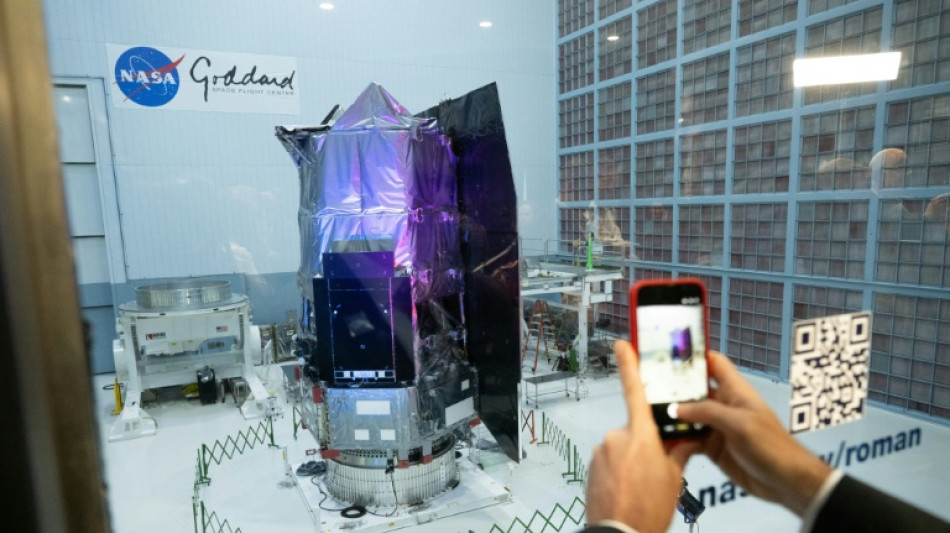
NASA launches Roman telescope on cosmic mapping mission / Photo: © AFP

NASA launched its new flagship space telescope on Sunday, embarking on a multi-year mission to create an unprecedented map of the cosmos and shed light on some of the biggest mysteries in physics.
Designed to take a panoramic view of the vast reaches of space, the Roman Space Telescope "will help unlock the secrets of the universe," US President Donald Trump said Friday during a ceremony at NASA headquarters in Houston, Texas.
Standing over 12 meters (39 feet) tall, the state-of-the-art observatory launched from the Kennedy Space Center in Florida at 7:26 am (1126 GMT) aboard a SpaceX Falcon Heavy rocket.
Developed over more than a decade at a cost topping $4 billion, the telescope is named after pioneering US astronomer Nancy Grace Roman, who became known as the "Mother of Hubble," another of NASA's flagship telescopes.
While Hubble revealed that the universe is expanding faster than previously thought, Roman will seek to answer some of the other unsolved mysteries, including those of dark matter and dark energy.
"Roman will give the Earth a new atlas of the universe," NASA administrator Jared Isaacman said in April when he unveiled the project to the press.
- Studying the invisible -
With a field of view more than 100 times larger than Hubble's -- and significantly wider than James Webb's -- Roman will survey vast swaths of the sky from a vantage point 1.5 million kilometers (930,000 miles) from Earth, which it will take about 100 days to reach.
Designed to work in tandem with other observatories such as Webb, which offers greater power and precision, Roman aims to discover thousands of exoplanets as well as tens of thousands of supernovae, the explosive deaths of massive stars.
"It will be the biggest catalog of astronomical objects anybody's ever produced, and it will help us understand how common are solar systems like our own," Dave Content, Roman's technical manager, told AFP.
The new telescope will also shed light on two of the biggest mysteries in physics: dark matter and dark energy. Their origins remain unknown, but together they are believed to make up about 95 percent of the universe.
Dark matter is thought to act as a kind of gravitational glue, while dark energy is believed to be a repulsive force driving the universe's expansion.
With its infrared vision, Roman will be able to detect light emitted by celestial objects billions of years ago, effectively looking back in time and offering scientists a glimpse into the universe's distant past and helping them better understand these two mysterious phenomena.
- Surprise -
Roman's observations will complement the work of the Rubin Observatory in Chile and the European Space Agency's (ESA) Euclid probe, and are highly anticipated because they could challenge scientists' understanding of the universe's structure.
Julie McEnery, Roman's senior project scientist, said recent research suggests the way scientists have been thinking about the universe's early expansion, based on the predictions of existing models, may be wrong.
"Recent observations hint that our standard model of the universe is incorrect," she told a press conference on Saturday, adding that Roman will help clear that up.
"It will definitively say, 'Yeah, the model works, or it doesn't.' And if it doesn't, it's going to provide us with the precision and quality of data that will allow us to start to distinguish between those options."
Scientists and the general public will have access to all of Roman's data. But the sheer volume will be daunting, Content warned.
The telescope will be generating about 1.3 terabytes of data a day, "which means you basically can't download the data to anybody's laptop," he said.
For McEnery, the more data, the better.
"I very much hope, and in fact expect, that the most exciting science from Roman will be a surprise, something we couldn't predict, and that will set the stage for the next deeper set of questions for future missions to address."
J.Ayala--TFWP