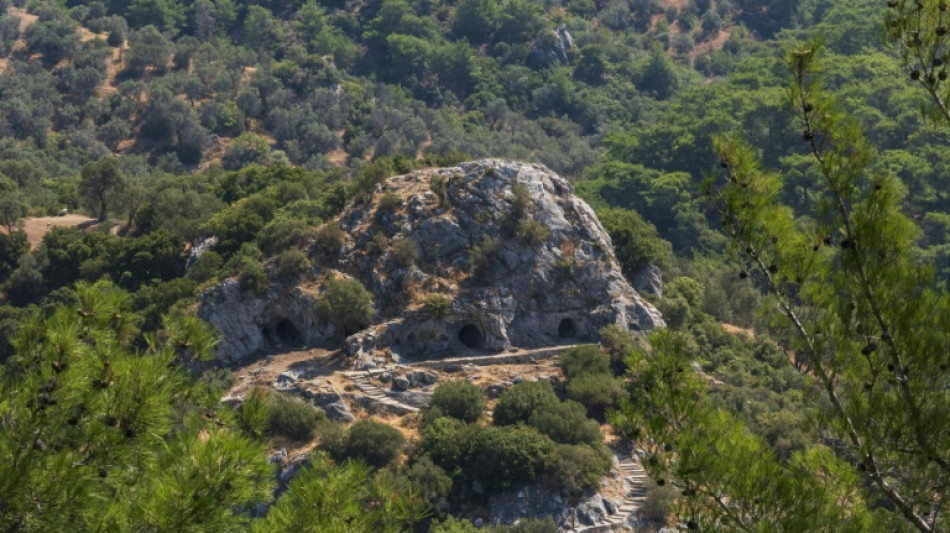
Is this cave in Turkey where Homer wrote 'The Odyssey'? / Photo: © AFP

On a Turkish hillside overlooking the olive-covered slopes outside Izmir is a cave known to generations of locals as the place where Homer penned "The Odyssey".
"This place was always called Homer's Valley by the locals. Travellers from all over the world would come and see the cave where Homer is said to have composed his poems," explained Turkish researcher Altan Altin, who has written a book on the subject.
In fact, nobody knows exactly where Homer wrote his epic poems and there is much mythology around the idea of his cave. Today, of course, the debate has become livelier and more immediate thanks to Christopher Nolan's blockbuster film "The Odyssey".
The poet has for a very long time been associated with the Izmir region of Turkey's Aegean coast, which for most of its history was known as ancient Smyrna.
"The Smyrnaeans have the river Meles, with its lovely water, and at its springs is the grotto, where they say Homer composed his poems," wrote the 2nd-century Greek chronicler and geographer Pausanias.
Those words have fuelled a centuries-long debate, one that continues today, about Homer's life and the location of the river where he was thought to have been born in the year 8 BC.
- Remarkable precision -
Visiting the cave, which is filled with rocks, is not easy.
Inside, travellers have left Greek scrawled on the walls, although it is not clear how old the writing is.
Although other places, notably the Greek island of Chios, also lay claim to Homer's origins, ancient Smyrna and its hinterland -- where Bornova is located -- are closely associated with the poet.
"For me, there's no doubt, Homer is from Bornova. In any case, he is from Ionia, which includes Smyrna and Chios. He's from these lands," Altin told AFP. Ionia is the name of an ancient Greek region on Turkey's Aegean coast.
To support his thesis, Altin pointed to a 3rd-century BC frieze depicting the deification of Homer, which he says reproduced the Bornova cave with remarkable precision.
"This bas-relief was already known, but no one had ever noticed the identical details to those found in Homer's cave. This is the first time such a detailed geographical description came to light," he said.
Archaeological evidence from the area also suggests a link to Homer.
"The discoveries from the excavations, especially coins bearing Homer's likeness, show us that the inhabitants of ancient Smyrna considered the poet to be one of their own," archaeologist Mehmet Akif Erdem said.
"'The Iliad' and 'The Odyssey' were written in the (ancient Greek) dialects of Ionic and Aeolic, suggesting that ancient Smyrna and Bornova could be among Homer's native lands," he said.
- Homer everywhere -
Beyond the academic debate about his origins, Homer is everywhere in Bornova.
At Yesilova Hoyuk, a Neolithic site considered to be the oldest known prehistoric human settlement in İzmir, there is a bust of Homer with the inscription: "I compiled The Iliad and The Odyssey epics on this land. I lived in Bornova."
The town -- which already hosts a book fair dedicated to Homer and has a statue of Trojan War hero Hector in a local park -- is planning to refurbish the cave and open it to visitors to capitalise on the revival of interest in the ancient poet.
"Preserving Homer's legacy is a duty we owe to humanity. He is one of the founding fathers of literature," Bornova Mayor Omer Eski told AFP.
"The stories he tells are about this land. The question is not whether we should claim Homer or not. His story is also ours," he said.
But not everyone shares his vision.
In 2024, municipal officials from President Recep Tayyip Erdogan's ruling AKP party proposed renaming Homer's Valley after a Turkish fighter, saying the site should not have a Greek name.
"Erasing Homer's name would be one of the worst things we could do to Bornova," retorted the mayor, whose aim is to "make Homer known to the whole world as a person from Bornova" and to make the town a tourist attraction.
- 'Proud to be his compatriot' -
Mustafa Kocyigit, who runs the Gargantua bookshop in Izmir, said the success of Nolan's film has revived interest in Homer and boosted sales of the poem "The Odyssey".
"I knew Homer was from these lands, but I didn't know he was specifically from Izmir. We are incredibly lucky," said teacher Safak Tosun outside one of the city's cinemas where the film is showing.
"I feel proud, honoured and deeply privileged to be his fellow countryman."
For the researcher Altin, there are clues in Homer's writing that he says shows the poet came from the area.
"When you dive into the Iliad, you really understand that Homer was an Anatolian. You find anecdotes and cultural references that are completely unknown elsewhere," he said.
He believes Homer's origins should not stir up rivalry between Turkey and Greece.
"Homer is 2,800 years old, while the Turkish-Greek border is only a century old," he shrugs.
"Homer is Greek. Homer is Anatolian. None of us is older than he is, not even our countries."
J.P.Estrada--TFWP