The Fort Worth Press - SpaceX rocket stage expected to slam into Moon

USD -
AED 3.67295
AFN 66.503991
ALL 80.603989
AMD 366.170403
AOA 917.000367
ARS 1491.937904
AUD 1.414627
AWG 1.80125
AZN 1.70397
BAM 1.696506
BBD 2.013896
BDT 123.776354
BHD 0.377104
BIF 2987.5
BMD 1
BND 1.281271
BOB 11.884005
BRL 5.083304
BSD 0.999879
BTN 95.145572
BWP 13.496235
BYN 2.977343
BYR 19600
BZD 2.010921
CAD 1.39555
CDF 2262.50392
CHF 0.80802
CLF 0.023137
CLP 913.560396
CNY 6.747604
CNH 6.743285
COP 3157.16
CRC 454.53954
CUC 1
CUP 26.5
CVE 95.703894
CZK 20.982104
DJF 177.720393
DKK 6.46804
DOP 58.250393
DZD 132.93304
EGP 49.555853
ERN 15
ETB 160.000358
EUR 0.86495
FJD 2.20855
FKP 0.743241
GBP 0.741235
GEL 2.610391
GGP 0.743241
GHS 11.76039
GIP 0.743241
GMD 73.503851
GNF 8775.000355
GTQ 7.628986
GYD 209.187745
HKD 7.84315
HNL 26.880388
HRK 6.518804
HTG 130.738004
HUF 314.060388
IDR 17801
ILS 2.99985
IMP 0.743241
INR 95.13785
IQD 1310.5
IRR 1375550.000352
ISK 123.340386
JEP 0.743241
JMD 158.790465
JOD 0.70904
JPY 157.80604
KES 128.780385
KGS 87.450384
KHR 4052.503796
KMF 426.00035
KRW 1407.890383
KWD 0.30866
KYD 0.833247
KZT 468.616634
LAK 22582.503779
LBP 89550.000349
LKR 335.380452
LRD 181.550382
LSL 16.130381
LTL 2.95274
LVL 0.60489
LYD 6.365039
MAD 9.305039
MDL 17.387495
MGA 4310.000347
MKD 53.374161
MMK 2099.552715
MNT 3596.040078
MOP 8.079926
MRU 40.090379
MUR 47.050378
MVR 15.450378
MWK 1737.000345
MXN 17.136204
MYR 4.090104
MZN 63.905039
NAD 16.250377
NGN 1364.860377
NIO 36.795607
NOK 9.51237
NPR 152.232915
NZD 1.696641
OMR 0.382792
PAB 0.999866
PEN 3.385039
PGK 4.42225
PHP 60.705038
PKR 277.803701
PLN 3.719205
PYG 5945.498155
QAR 3.644504
RON 4.536304
RSD 102.024038
RUB 81.892834
RWF 1465
SAR 3.780227
SBD 8.065696
SCR 14.475038
SDG 600.503676
SEK 9.480804
SGD 1.278204
SLE 24.603667
SOS 600.503662
SRD 37.866504
STD 20697.981008
STN 21.375
SVC 8.749095
SZL 16.245038
THB 33.050369
TJS 9.223917
TMT 3.51
TND 2.912038
TRY 47.697504
TTD 6.777323
TWD 32.250604
TZS 2647.503038
UAH 44.783463
UGX 3724.827703
UYU 40.249652
UZS 11950.000334
VES 755.762404
VND 26204.5
VUV 119.010387
WST 2.728415
XAF 568.992228
XAG 0.015756
XAU 0.00023
XCD 2.70255
XCG 1.802071
XDR 0.708194
XOF 568.000332
XPF 103.350363
YER 238.403589
ZAR 16.14632
ZMK 9001.203584
ZMW 18.872278
ZWL 321.999592
  • BCC

    2.3400

    86.6

    +2.7%

  • CMSC

    0.0240

    21.744

    +0.11%

  • CMSD

    -0.1600

    21.82

    -0.73%

  • RBGPF

    0.7600

    70.5

    +1.08%

  • JRI

    0.1500

    12.81

    +1.17%

  • GSK

    0.7900

    52.96

    +1.49%

  • BTI

    0.6000

    59.33

    +1.01%

  • NGG

    0.4700

    80.88

    +0.58%

  • BCE

    -0.0200

    22.75

    -0.09%

  • RIO

    1.4500

    101.1

    +1.43%

  • RELX

    0.0485

    35.52

    +0.14%

  • BP

    -0.6000

    41.63

    -1.44%

  • RYCEF

    0.2300

    20.85

    +1.1%

  • VOD

    0.1900

    16.19

    +1.17%

  • AZN

    1.4100

    161.42

    +0.87%

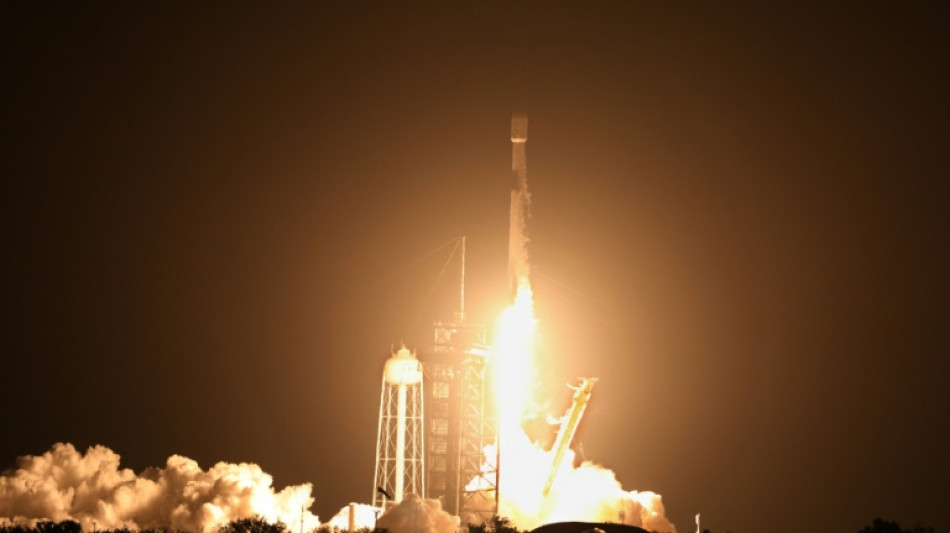
SpaceX rocket stage expected to slam into Moon
SpaceX rocket stage expected to slam into Moon / Photo: © AFP/File

SpaceX rocket stage expected to slam into Moon

A SpaceX rocket's upper stage is set to unintentionally crash into the Moon on Wednesday, a collision that poses no danger to Earth but will leave behind a lunar crater.

Text size:

Scientists and amateur stargazers alike are looking forward to observing the sunlit plume of rubble and debris that is expected after the Falcon 9 upper stage strikes the lunar surface at approximately 2:35 am Eastern (0635 GMT.)

"It might be possible for folks with a telescope to observe the plume of ejecta created by the impact," said Benjamin Fernando of Los Alamos National Laboratory in New Mexico, the lead author on a recent paper on the anticipated impact.

"It is unclear how bright it will be, which is one of the reasons why we are looking to study this event," the researcher told AFP.

Assuming all of the propellant is spent, authors of the paper estimate the spacecraft weighs approximately 8,800 pounds (4,000 kilograms).

It is expected to slam into the Moon's northern hemisphere near the Einstein Crater, at some 5,400 miles per hour (8,690 kilometers per hour).

"There is no danger to Earth," said NASA spokesperson Jimi Russell in a statement.

"NASA will continue to track the booster for training purposes, as well as later observe the impact site for scientific purposes."

The Falcon 9 rocket took off last January, carrying two lunar landers. The booster returned to Earth, but the upper stage stayed in space to push the landers onward.

Generally, for such "high-energy missions," SpaceX performs a maneuver to make sure the second stage "is safe per the appropriate rules and regulations," said Julianna Scheiman, director of NASA Science and Dragon Programs at SpaceX, at a Monday news conference.

"We did that," she continued, but "what has happened is essentially a mixture of solar activity and gravity forces have put it on a path towards the Moon."

Like many scientists, Scheiman added that "I also am very excited to see the observation."

The paper authors encouraged both professional and amateur astronomers to attempt viewing or recording the collision.

"This event provides an opportunity to test a pipeline for localizing impacts on the lunar surface for future seismic experiments, investigating the dust and plume dynamics from impact events on the Moon, and considering hazards from artificial space debris impacts," wrote the research team.

NASA hopes to soon establish a sustained human presence on the Moon, making it critical to better understand space debris in lunar orbit.

The Moon routinely weathers impact from space debris including meteoroids. Artificial collisions are less common.

In the 1970s, the US space agency carried out deliberate crashes during its Apollo program to collect seismic data.

N.Patterson--TFWP