The Fort Worth Press - Webb telescope finds CO2 for first time in exoplanet atmosphere

USD -
AED 3.672962
AFN 65.000396
ALL 79.569641
AMD 363.410009
ANG 1.790365
AOA 918.000118
ARS 1512.732505
AUD 1.403509
AWG 1.8
AZN 1.684438
BAM 1.695609
BBD 2.01466
BDT 123.160418
BGN 1.683441
BHD 0.377012
BIF 2995
BMD 1
BND 1.273738
BOB 10.998357
BRL 5.144046
BSD 1.000308
BTN 95.98391
BWP 13.567066
BYN 3.037656
BYR 19600
BZD 2.011747
CAD 1.39515
CDF 2309.999597
CHF 0.819885
CLF 0.024143
CLP 953.330119
CNY 6.706399
CNH 6.706796
COP 3133.79
CRC 447.438348
CUC 1
CUP 26.5
CVE 95.999895
CZK 21.106303
DJF 177.71991
DKK 6.489345
DOP 58.850154
DZD 133.63037
EGP 52.199498
ERN 15
ETB 160.949926
EUR 0.86806
FJD 2.21295
FKP 0.741937
GBP 0.744595
GEL 2.603264
GGP 0.741937
GHS 11.505024
GIP 0.741937
GMD 73.99969
GNF 8795.314945
GTQ 7.636255
GYD 209.277425
HKD 7.844805
HNL 26.847168
HRK 6.531703
HTG 130.738787
HUF 316.004029
IDR 17690
ILS 3.027501
IMP 0.741937
INR 95.90965
IQD 1310.5
IRR 1374600.000237
ISK 121.320336
JEP 0.741937
JMD 157.856864
JOD 0.708988
JPY 155.228505
KES 129.498728
KGS 87.449898
KHR 4050.422208
KMF 427.000462
KPW 900.000318
KRW 1367.705023
KWD 0.30856
KYD 0.833583
KZT 444.773881
LAK 22392.336201
LBP 89575.662472
LKR 331.544497
LRD 173.548166
LSL 16.285389
LTL 2.95274
LVL 0.60489
LYD 6.345021
MAD 9.466964
MDL 17.439779
MGA 4325.19127
MKD 53.344315
MMK 2099.62457
MNT 3595.075141
MOP 8.082447
MRU 40.060447
MUR 47.290412
MVR 15.410502
MWK 1736.502094
MXN 17.15007
MYR 4.068397
MZN 63.892219
NAD 16.285247
NGN 1326.720329
NIO 36.811146
NOK 9.361295
NPR 153.579928
NZD 1.739085
OMR 0.384497
PAB 1.000282
PEN 3.355918
PGK 4.522953
PHP 62.724028
PKR 277.25311
PLN 3.781535
PYG 5918.765443
QAR 3.636395
RON 4.568901
RSD 101.865037
RUB 84.244494
RWF 1475.913668
SAR 3.753075
SBD 8.03625
SCR 14.650196
SDG 601.50092
SEK 9.78923
SGD 1.274225
SHP 0.742225
SLE 24.640299
SLL 20969.491881
SOS 571.673797
SRD 37.752497
STD 20697.981008
STN 21.240534
SVC 8.752834
SYP 13002.000254
SZL 16.283395
THB 33.282013
TJS 9.226022
TMT 3.5
TND 2.928519
TOP 2.40776
TRY 48.657898
TTD 6.782056
TWD 31.792499
TZS 2645.002985
UAH 44.609389
UGX 3916.077853
UYU 40.244484
UZS 11793.315705
VES 841.183975
VND 25998.5
VUV 118.157011
WST 2.736734
XAF 569.409897
XAG 0.01559
XAU 0.000231
XCD 2.70255
XCG 1.802758
XDR 0.707052
XOF 569.409897
XPF 103.393717
YER 236.499459
ZAR 16.289965
ZMK 9001.251421
ZMW 19.630588
ZWL 321.999592
SSP 5655.283496
MXV 1.944584
  • RYCEF

    0.2600

    19.3

    +1.35%

  • CMSC

    0.0990

    20.419

    +0.48%

  • RBGPF

    0.0000

    69.99

    0%

  • RIO

    -2.1950

    95.065

    -2.31%

  • RELX

    -0.0500

    34.17

    -0.15%

  • NGG

    0.9500

    75.88

    +1.25%

  • GSK

    0.1600

    50.17

    +0.32%

  • VOD

    -0.3850

    17.295

    -2.23%

  • CMSD

    0.1950

    20.265

    +0.96%

  • BCE

    -0.4300

    22.47

    -1.91%

  • BTI

    -0.4600

    56.06

    -0.82%

  • AZN

    0.3450

    162.195

    +0.21%

  • JRI

    -0.0100

    11.61

    -0.09%

  • BP

    -1.6700

    45.29

    -3.69%

  • BCC

    -1.2050

    74.725

    -1.61%

Webb telescope finds CO2 for first time in exoplanet atmosphere
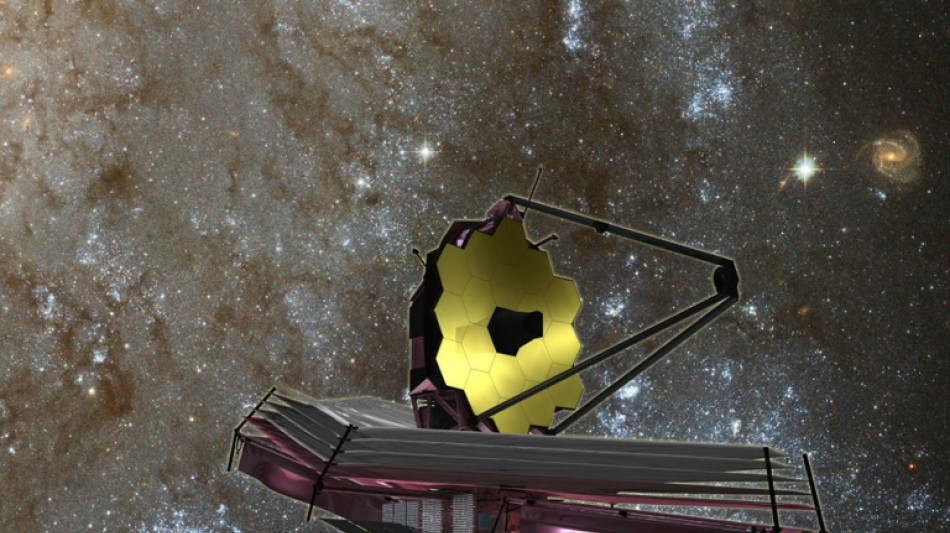
Webb telescope finds CO2 for first time in exoplanet atmosphere / Photo: © NASA/AFP/File

Webb telescope finds CO2 for first time in exoplanet atmosphere

The months-old James Webb Space Telescope has added another major scientific discovery to its growing list: detecting for the first time signs of carbon dioxide in the atmosphere of a planet outside our solar system.

Text size:

Although the exoplanet would never be able to support life as we know it, the successful discovery of CO2 gives researchers hope that similar observations could be carried out on rocky objects more hospitable to life.

"My first thought: wow, we really do have a chance to detect the atmospheres of terrestrial-size planets," tweeted Natalie Batalha, a professor at the University of California at Santa Cruz and one of hundreds who worked on the Webb project.

Their study of exoplanet WASP-39, a hot gas giant closely orbiting a star 700 light years away, will soon be published in the journal Nature.

"For me, it opens a door for future research on super-Earths (planets larger than Earth but smaller than Neptune), or even Earth-sized planets," Pierre-Olivier Lagage, an astrophysicist with France's Atomic Energy Commission (CEA), told AFP.

The detection of CO2 will also help scientists learn more about how WASP-39 formed, NASA said in a press release. The exoplanet, which orbits its star once every four Earth days, has a mass one-quarter that of Jupiter but a diameter 1.3 times bigger.

The frequency of its orbit and large atmosphere made WASP-39 an ideal candidate for an early test of Webb's state-of-the-art infrared sensor, known as NIRSpec.

Each time the exoplanet crosses in front of its star, it blocks out an almost imperceptible amount of light.

But around the edges of the planet, a tiny amount of light passes through the atmosphere.

Webb's highly sensitive NIRSpec can detect the small changes that the atmosphere has on the light, allowing scientists to determine its gas composition.

The Hubble and Spitzer telescopes had already detected water vapor, sodium and potassium in WASP-39's atmosphere, but carbon dioxide can now be added to that list thanks to Webb and its NIRSpec instrument.

"It was a special moment, crossing an important threshold in exoplanet sciences," said Zafar Rustamkulov, a Johns Hopkins University researcher, in the NASA press release.

F.Garcia--TFWP