Artemis 2 Moon mission: a primer / Photo: © AFP

NASA's Artemis 2 lunar mission is set to be the first crewed flyby of the Moon in more than half a century, and could launch as soon as April 1.
Here is what to know about the highly anticipated mission that will usher in a new chapter of space exploration:
- The goal -
Artemis is the legacy of initiatives launched in the 2000s to succeed the American space shuttles. Those efforts survived several presidencies until Donald Trump officially established the program during his first White House term.
It aims to return Americans to the Moon to establish a long-term presence there and pave the way for eventual missions to Mars.
The upcoming mission is intended to last approximately 10 days, and will mark the first crewed Artemis flight.
The second phase follows the Artemis 1 mission in 2022, when an uncrewed spacecraft flew around the Moon.
NASA intends to now verify that both that spacecraft and the rocket are in working order before attempting a lunar landing -- a milestone now scheduled for the Artemis 4 mission in 2028.
Unlike in the Apollo program -- the US spaceflight effort that landed the first humans on the Moon in 1969 -- NASA this time is collaborating both with private industry and other countries, notably in Europe.
This includes SpaceX and Blue Origin, rival companies founded respectively by billionaires Elon Musk and Jeff Bezos that are tasked with developing lunar landers.
- The team -
Four astronauts -- three Americans and one Canadian -- will take flight in this major mission.
Reid Wiseman, a 50-year-old former naval aviator and test pilot who also formerly served as a deputy chief of NASA's astronaut office, will be in command.
Victor Glover, 49, also served in the US Navy. He will pilot the spacecraft while also becoming the first Black man -- and first non-white person -- to travel to the Moon.
And engineer-by-training Christina Koch, 47, will becoming the first woman to participate in a lunar mission.
Canadian Jeremy Hansen, a 50-year-old former fighter pilot, will become the first non-American to fly around the Moon.
- The countdown begins-
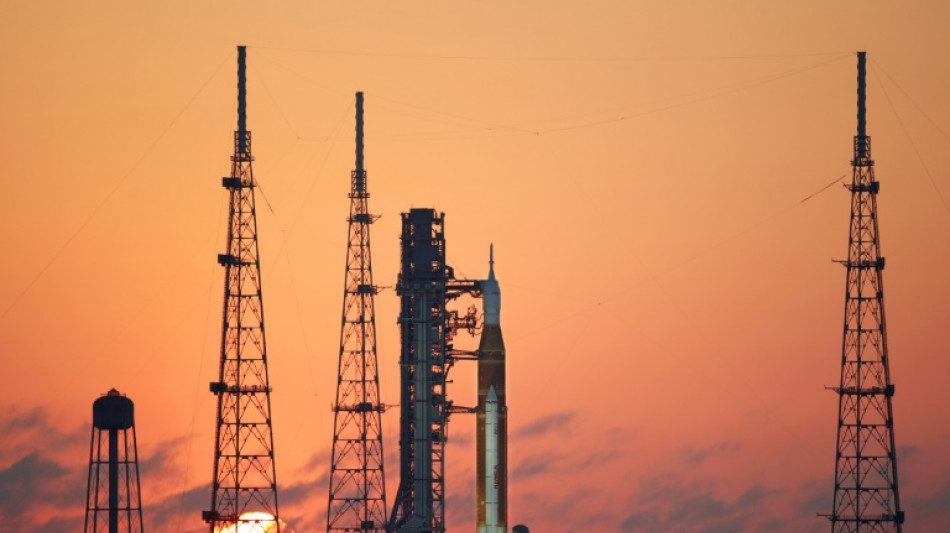
The crew will fly aboard the Orion spacecraft, perched atop NASA's powerful SLS rocket.
This orange and white rocket stands 98 meters (321 feet) tall, approximately 10 meters shorter than the Apollo-era Saturn V rocket.
It will launch from the Kennedy Space Center in Cape Canaveral, Florida.
The planned trajectory is hyper-precise, and can only take place during very specific time periods.
- The trajectory -
After liftoff, the team will not immediately head towards the Moon, instead entering orbit around Earth.
During this time the astronauts will conduct various checks to ensure the reliability and safety of the spacecraft -- it has never carried human's before -- prior to venturing further.
They will also test its manual piloting capabilities during docking simulations.
If all trials are successful, Orion will then provide the necessary thrust to leave Earth's orbit and head to the Moon.
For several days, the astronauts will conduct additional tests and experiments while en route.
Once they reach the Moon they will fly over its far side.
At this moment communications with Earth will be interrupted: the four astronauts are expected to become the human beings who've traveled farthest from Earth, breaking the Apollo 13 record.
Their observations should help NASA choose a landing site for Artemis 4, which will venture to the Moon's south pole -- where no human has ever been.
- The return -
Artemis 2 will then follow a so-called "free-return" trajectory, designed to use the Moon's gravity to send it back towards Earth without propulsion.
This piece of the journey will last approximately three or four days, punctuated by re-entry into the atmosphere -- one of the mission's most delicate maneuvers.
During Artemis 1, the heat shield protecting the spacecraft eroded in unexpected ways, according to a NASA technical report.
The US space agency has thus adjusted the spacecraft's trajectory so that the angle or re-entry into the atmosphere should be slightly less severe for the shield.
Once that stage is complete, powerful parachutes will slow the spacecraft, which will splash down in the Pacific Ocean off the California coast.
M.Delgado--TFWP