The Fort Worth Press - Webb telescope captures colourful Cartwheel Galaxy

USD -
AED 3.673097
AFN 62.999892
ALL 83.60053
AMD 377.460033
ANG 1.790083
AOA 917.000162
ARS 1396.201602
AUD 1.405501
AWG 1.8
AZN 1.703806
BAM 1.698067
BBD 2.012346
BDT 122.592856
BGN 1.709309
BHD 0.377576
BIF 2971
BMD 1
BND 1.27672
BOB 6.904306
BRL 5.178599
BSD 0.99914
BTN 92.269556
BWP 13.578585
BYN 2.99684
BYR 19600
BZD 2.009473
CAD 1.369175
CDF 2265.000051
CHF 0.7846
CLF 0.022985
CLP 907.560131
CNY 6.88685
CNH 6.88147
COP 3698.75
CRC 468.334867
CUC 1
CUP 26.5
CVE 97.149892
CZK 21.160975
DJF 177.719886
DKK 6.471775
DOP 60.949815
DZD 132.090399
EGP 52.247699
ERN 15
ETB 157.374982
EUR 0.86604
FJD 2.2071
FKP 0.751829
GBP 0.74834
GEL 2.72013
GGP 0.751829
GHS 10.884989
GIP 0.751829
GMD 73.477673
GNF 8780.000295
GTQ 7.653371
GYD 209.039327
HKD 7.837251
HNL 26.569754
HRK 6.528505
HTG 131.058583
HUF 336.315028
IDR 16970
ILS 3.099451
IMP 0.751829
INR 92.40205
IQD 1310
IRR 1314000.000258
ISK 124.370067
JEP 0.751829
JMD 157.174113
JOD 0.708978
JPY 158.924498
KES 129.549688
KGS 87.449523
KHR 4009.999789
KMF 427.00018
KPW 900.043905
KRW 1484.575002
KWD 0.30668
KYD 0.832653
KZT 481.436783
LAK 21474.999876
LBP 89550.00017
LKR 311.138509
LRD 183.502002
LSL 16.690109
LTL 2.95274
LVL 0.60489
LYD 6.399112
MAD 9.395009
MDL 17.430149
MGA 4155.000346
MKD 53.463251
MMK 2100.153228
MNT 3574.497589
MOP 8.064858
MRU 40.105042
MUR 46.640549
MVR 15.450311
MWK 1736.000162
MXN 17.650102
MYR 3.924973
MZN 63.897936
NAD 16.689905
NGN 1356.690045
NIO 36.719761
NOK 9.576885
NPR 147.632919
NZD 1.704055
OMR 0.38447
PAB 0.99918
PEN 3.428502
PGK 4.302502
PHP 59.598015
PKR 279.274986
PLN 3.68888
PYG 6476.931358
QAR 3.64325
RON 4.410703
RSD 101.718001
RUB 82.371475
RWF 1459
SAR 3.754562
SBD 8.05166
SCR 15.021868
SDG 600.999693
SEK 9.26904
SGD 1.27583
SHP 0.750259
SLE 24.598675
SLL 20969.510825
SOS 571.508373
SRD 37.625007
STD 20697.981008
STN 21.6
SVC 8.742121
SYP 110.875895
SZL 16.689955
THB 32.25099
TJS 9.576859
TMT 3.51
TND 2.932502
TOP 2.40776
TRY 44.180699
TTD 6.779043
TWD 31.836034
TZS 2615.000004
UAH 43.89828
UGX 3771.52085
UYU 40.615395
UZS 12105.000083
VES 447.80816
VND 26300
VUV 119.587146
WST 2.754209
XAF 569.538132
XAG 0.01257
XAU 0.0002
XCD 2.70255
XCG 1.800754
XDR 0.70982
XOF 575.499774
XPF 103.849903
YER 238.550221
ZAR 16.63664
ZMK 9001.200468
ZMW 19.488689
ZWL 321.999592
  • RBGPF

    0.1000

    82.5

    +0.12%

  • CMSC

    -0.0300

    22.96

    -0.13%

  • NGG

    -0.2100

    90.68

    -0.23%

  • RELX

    -0.1050

    34.365

    -0.31%

  • GSK

    -0.0900

    53.68

    -0.17%

  • RYCEF

    0.3800

    16.5

    +2.3%

  • RIO

    0.2200

    90.08

    +0.24%

  • BCE

    0.1650

    26.065

    +0.63%

  • CMSD

    0.0390

    22.989

    +0.17%

  • VOD

    0.1650

    14.765

    +1.12%

  • BTI

    -0.1700

    60.77

    -0.28%

  • JRI

    -0.0350

    12.505

    -0.28%

  • BCC

    1.2800

    73

    +1.75%

  • BP

    1.0150

    43.915

    +2.31%

  • AZN

    -0.6700

    191.34

    -0.35%

Webb telescope captures colourful Cartwheel Galaxy
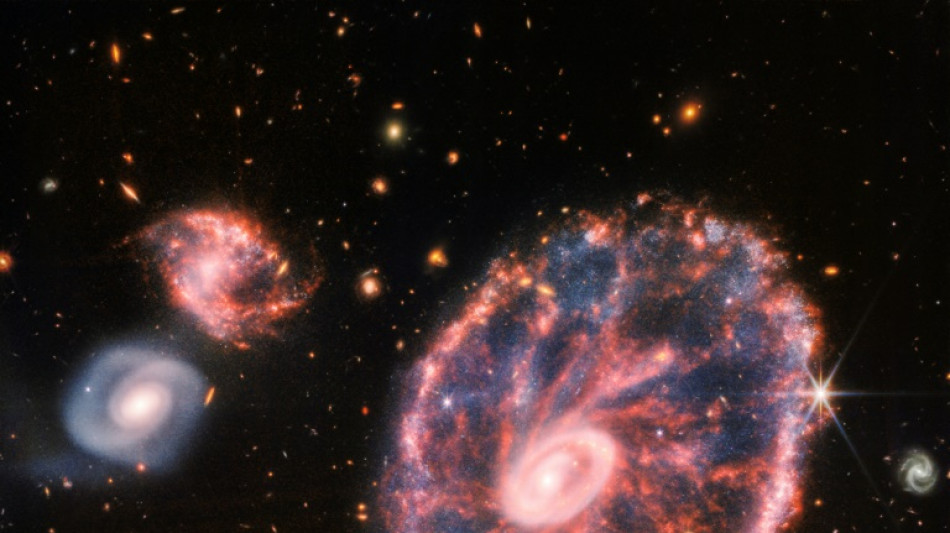
Webb telescope captures colourful Cartwheel Galaxy / Photo: © NASA/AFP

Webb telescope captures colourful Cartwheel Galaxy

The James Webb Space Telescope has peered through time and huge amounts of dust to capture a new image of the Cartwheel Galaxy, revealing the spinning ring of colour in unprecedented clarity, NASA and the European Space Agency said Tuesday.

Text size:

Located around 500 million light-years from Earth in the constellation Sculptor, the Cartwheel gained its shape during a spectacular head-on collision between two galaxies.

The impact sent two rings expanding from the galaxy's centre, "like ripples in a pond after a stone is tossed into it", NASA and the ESA said in a joint statement.

A smaller white ring remains closer to the galaxy's centre, while the outer ring, with its spokes of colour, has been expanding into the universe for around 440 million years, the statement added.

As the outer ring expands it runs into gas, sparking the formation of new stars.

The Hubble telescope had previously captured images of the rare ring galaxy, which is believed to have been a spiral galaxy like our own Milky Way before it was hit by a smaller intruder galaxy.

But the Webb telescope, which launched in December 2021 and revealed its first images to global fanfare last month, has a far greater reach.

Webb's ability to detect infrared light allowed it to see through the "tremendous amount of hot dust" obscuring the view of the Cartwheel Galaxy, NASA and the ESA said.

This revealed new details about star formation in the galaxy, as well as the behaviour of the supermassive black hole at its heart, they said.

It was also able to detect regions rich in hydrocarbons and other chemicals, as well as dust that is similar to dust on Earth.

Behind the Cartwheel, two smaller galaxies shine brightly, while even more galaxies can be seen behind them.

The observations show that the Cartwheel Galaxy is still in "very transitory stage", the space agencies said.

"While Webb gives us a snapshot of the current state of the Cartwheel, it also provides insight into what happened to this galaxy in the past and how it will evolve in the future."

W.Lane--TFWP