The Fort Worth Press - AI cracks Roman-era board game

USD -
AED 3.672501
AFN 63.999727
ALL 81.449748
AMD 370.780071
ANG 1.789884
AOA 918.000222
ARS 1392.916052
AUD 1.388889
AWG 1.8
AZN 1.698647
BAM 1.669697
BBD 2.01454
BDT 122.725158
BGN 1.668102
BHD 0.37765
BIF 2976
BMD 1
BND 1.275896
BOB 6.911331
BRL 4.953902
BSD 1.000226
BTN 94.881811
BWP 13.592996
BYN 2.822528
BYR 19600
BZD 2.011629
CAD 1.35855
CDF 2319.999821
CHF 0.781253
CLF 0.022842
CLP 898.999875
CNY 6.82825
CNH 6.831005
COP 3657.4
CRC 454.73562
CUC 1
CUP 26.5
CVE 94.450366
CZK 20.780066
DJF 177.719499
DKK 6.369402
DOP 59.501861
DZD 132.503944
EGP 53.639736
ERN 15
ETB 156.999718
EUR 0.85285
FJD 2.192102
FKP 0.736618
GBP 0.735159
GEL 2.68042
GGP 0.736618
GHS 11.203198
GIP 0.736618
GMD 72.99967
GNF 8775.000104
GTQ 7.641507
GYD 209.25239
HKD 7.832898
HNL 26.619971
HRK 6.428002
HTG 131.024649
HUF 311.14031
IDR 17334.35
ILS 2.943831
IMP 0.736618
INR 94.9105
IQD 1310
IRR 1314000.000024
ISK 122.68015
JEP 0.736618
JMD 156.725146
JOD 0.709019
JPY 156.574987
KES 129.149858
KGS 87.420498
KHR 4012.502143
KMF 419.999912
KPW 899.999976
KRW 1473.730014
KWD 0.30729
KYD 0.833543
KZT 463.288124
LAK 21979.999813
LBP 89549.999362
LKR 319.671116
LRD 183.874995
LSL 16.659827
LTL 2.95274
LVL 0.60489
LYD 6.349985
MAD 9.25125
MDL 17.233504
MGA 4150.000175
MKD 52.564485
MMK 2099.490131
MNT 3577.850535
MOP 8.070846
MRU 39.969937
MUR 47.029838
MVR 15.455017
MWK 1741.496063
MXN 17.458031
MYR 3.970417
MZN 63.899729
NAD 16.660156
NGN 1375.979992
NIO 36.710152
NOK 9.270802
NPR 151.803598
NZD 1.694485
OMR 0.384745
PAB 1.000201
PEN 3.507499
PGK 4.33875
PHP 61.274964
PKR 278.775023
PLN 3.627899
PYG 6151.626275
QAR 3.643501
RON 4.438103
RSD 100.106587
RUB 74.972586
RWF 1461.5
SAR 3.74998
SBD 8.04211
SCR 13.746323
SDG 600.49161
SEK 9.2504
SGD 1.274097
SHP 0.746601
SLE 24.603383
SLL 20969.496166
SOS 571.000014
SRD 37.458004
STD 20697.981008
STN 21.21
SVC 8.7523
SYP 110.524981
SZL 16.659758
THB 32.512977
TJS 9.381822
TMT 3.505
TND 2.88175
TOP 2.40776
TRY 45.142499
TTD 6.789386
TWD 31.629501
TZS 2605.000204
UAH 43.949336
UGX 3760.987334
UYU 39.889518
UZS 11949.999982
VES 488.942755
VND 26356
VUV 117.651389
WST 2.715189
XAF 560.041494
XAG 0.01327
XAU 0.000217
XCD 2.70255
XCG 1.80265
XDR 0.69563
XOF 559.999622
XPF 102.15026
YER 238.608254
ZAR 16.711303
ZMK 9001.201917
ZMW 18.67895
ZWL 321.999592
  • RBGPF

    0.5000

    63.1

    +0.79%

  • BCE

    0.1800

    23.96

    +0.75%

  • RELX

    -0.2400

    36.35

    -0.66%

  • GSK

    -0.7000

    51.61

    -1.36%

  • CMSC

    0.0600

    22.88

    +0.26%

  • CMSD

    0.1500

    23.28

    +0.64%

  • AZN

    -2.6300

    184.74

    -1.42%

  • RIO

    0.1000

    100.58

    +0.1%

  • RYCEF

    0.5500

    16.35

    +3.36%

  • NGG

    -1.0600

    88.48

    -1.2%

  • JRI

    -0.0100

    12.98

    -0.08%

  • BCC

    -1.1400

    78.13

    -1.46%

  • BP

    -0.9700

    46.41

    -2.09%

  • VOD

    0.3500

    16.15

    +2.17%

  • BTI

    -0.0900

    58.71

    -0.15%

AI cracks Roman-era board game
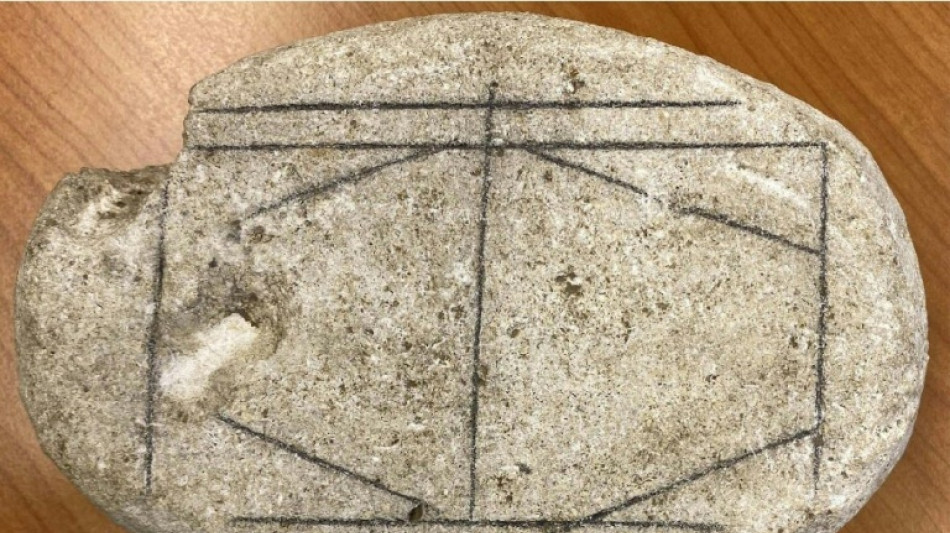
AI cracks Roman-era board game / Photo: © Antiquity/AFP

AI cracks Roman-era board game

A smooth, white stone dating from the Roman era and unearthed in the Netherlands has long baffled researchers.

Text size:

Now with the help of artificial intelligence, scientists believe they have cracked the mystery: the stone is an ancient board game and they have even guessed the rules.

The circular piece of limestone has diagonal and straight lines cut into it.

Using 3D imaging, scientists discovered some lines were deeper than others, suggesting pieces were moved along them, some more than others.

"We can see wear along the lines on the stone, exactly where you would slide a piece," said Walter Crist, an archaeologist at Leiden University who specialises in ancient games.

Other researchers at Maastricht University then used an artificial intelligence programme that can deduce the rules to ancient games.

They trained this AI, baptised Ludii, with the rules of about 100 ancient games from the same area as the Roman stone.

The computer "produced dozens of possible rule sets. It then played the game against itself and identified a few variants that are enjoyable for humans to play," said Dennis Soemers, from Maastricht University.

They then cross-checked the possible rules with the wear on the stone to uncover the most likely set of movements in the game.

However, Soemers also sounded a note of caution.

"If you present Ludii with a line pattern like the one on the stone, it will always find game rules. Therefore, we cannot be sure that the Romans played it in precisely that way," he said.

The aim of the "deceptively simple but thrilling strategy game" was to hunt and trap the opponent's pieces in as few moves as possible.

The research and the possible rules were published in the journal Antiquity.

X.Silva--TFWP