The Fort Worth Press - World's largest bacteria discovered in Guadeloupe

USD -
AED 3.672498
AFN 65.000053
ALL 79.569641
AMD 362.816706
ANG 1.790365
AOA 918.000007
ARS 1506.995597
AUD 1.4022
AWG 1.80125
AZN 1.6977
BAM 1.695609
BBD 2.01466
BDT 123.160418
BGN 1.683441
BHD 0.377118
BIF 2991.820156
BMD 1
BND 1.273738
BOB 10.998357
BRL 5.139103
BSD 1.000308
BTN 95.98391
BWP 13.567066
BYN 3.037656
BYR 19600
BZD 2.011747
CAD 1.393965
CDF 2312.498613
CHF 0.819025
CLF 0.024146
CLP 953.390392
CNY 6.71145
CNH 6.70801
COP 3127.97
CRC 447.438348
CUC 1
CUP 26.5
CVE 95.595821
CZK 21.07715
DJF 178.127262
DKK 6.48015
DOP 59.048684
DZD 133.802983
EGP 52.024303
ERN 15
ETB 163.385076
EUR 0.86684
FJD 2.21295
FKP 0.741937
GBP 0.743225
GEL 2.554668
GGP 0.741937
GHS 11.488194
GIP 0.741937
GMD 73.501592
GNF 8795.314945
GTQ 7.636255
GYD 209.277425
HKD 7.84495
HNL 26.847168
HRK 6.530797
HTG 130.738787
HUF 315.984007
IDR 17658
ILS 3.031403
IMP 0.741937
INR 95.88005
IQD 1310.410896
IRR 1374600.000125
ISK 121.197395
JEP 0.741937
JMD 157.856864
JOD 0.708978
JPY 155.061982
KES 129.559875
KGS 87.4499
KHR 4050.422208
KMF 427.000252
KPW 900.000318
KRW 1367.580244
KWD 0.30843
KYD 0.833583
KZT 444.773881
LAK 22392.336201
LBP 89575.662472
LKR 331.544497
LRD 173.548166
LSL 16.285389
LTL 2.95274
LVL 0.60489
LYD 6.353115
MAD 9.432659
MDL 17.439779
MGA 4325.19127
MKD 53.344315
MMK 2099.62457
MNT 3595.075141
MOP 8.082447
MRU 40.051151
MUR 47.219983
MVR 15.401643
MWK 1734.543043
MXN 17.139401
MYR 4.044801
MZN 63.910224
NAD 16.285247
NGN 1325.990033
NIO 36.811146
NOK 9.35275
NPR 153.579928
NZD 1.735375
OMR 0.384507
PAB 1.000282
PEN 3.355918
PGK 4.522953
PHP 62.724942
PKR 277.25311
PLN 3.76858
PYG 5918.765443
QAR 3.636395
RON 4.558397
RSD 101.741021
RUB 84.427175
RWF 1475.913668
SAR 3.753075
SBD 8.03625
SCR 13.656342
SDG 601.499446
SEK 9.785001
SGD 1.27333
SHP 0.742225
SLE 24.640201
SLL 20969.491881
SOS 571.673797
SRD 37.749718
STD 20697.981008
STN 21.240534
SVC 8.752834
SYP 13002.000254
SZL 16.283395
THB 33.2485
TJS 9.226022
TMT 3.51
TND 2.928519
TOP 2.40776
TRY 48.657597
TTD 6.782056
TWD 31.779202
TZS 2645.628037
UAH 44.609389
UGX 3916.077853
UYU 40.244484
UZS 11793.315705
VES 841.184017
VND 25998.5
VUV 118.157011
WST 2.736734
XAF 568.609718
XAG 0.015444
XAU 0.00023
XCD 2.70255
XCG 1.802758
XDR 0.707052
XOF 568.609718
XPF 103.393717
YER 236.496653
ZAR 16.26826
ZMK 9001.198788
ZMW 19.630588
ZWL 321.999592
SSP 5655.283496
MXV 1.943375
  • GSK

    0.0700

    50.08

    +0.14%

  • NGG

    1.1600

    76.09

    +1.52%

  • BCC

    0.6150

    76.545

    +0.8%

  • RBGPF

    0.0000

    69.99

    0%

  • RIO

    -0.1500

    97.11

    -0.15%

  • BP

    -0.8250

    46.135

    -1.79%

  • BTI

    -0.1200

    56.4

    -0.21%

  • BCE

    -0.2390

    22.661

    -1.05%

  • CMSC

    0.1700

    20.49

    +0.83%

  • RYCEF

    0.2600

    19.3

    +1.35%

  • AZN

    1.0700

    162.92

    +0.66%

  • JRI

    0.0900

    11.71

    +0.77%

  • CMSD

    -0.0240

    20.046

    -0.12%

  • VOD

    -0.2150

    17.465

    -1.23%

  • RELX

    0.0700

    34.29

    +0.2%

World's largest bacteria discovered in Guadeloupe
World's largest bacteria discovered in Guadeloupe / Photo: © Lawrence Berkeley National Laboratory/AFP

World's largest bacteria discovered in Guadeloupe

You can see it with the naked eye and pick it up with a pair of tweezers -- not bad for a single bacteria.

Text size:

Scientists say they have discovered the world's largest variety in the mangroves of Guadeloupe -- and it puts its peers to shame.

At up to two centimetres (three-quarters of an inch), "Thiomargarita magnifica" is not only around 5,000 times bigger than most bacteria -- it boasts a more complex structure, according to a study published in the journal Science on Thursday.

The discovery "shakes up a lot of knowledge" in microbiology, Olivier Gros, professor of biology at the University of the Antilles and co-author of the study, told AFP.

In his laboratory in the Caribbean island group city of Pointe-a-Pitre, he marvelled at a test tube containing strands that look like white eyelashes.

"At first I thought it was anything but a bacterium because something two centimetres (in size) just couldn't be one", he said.

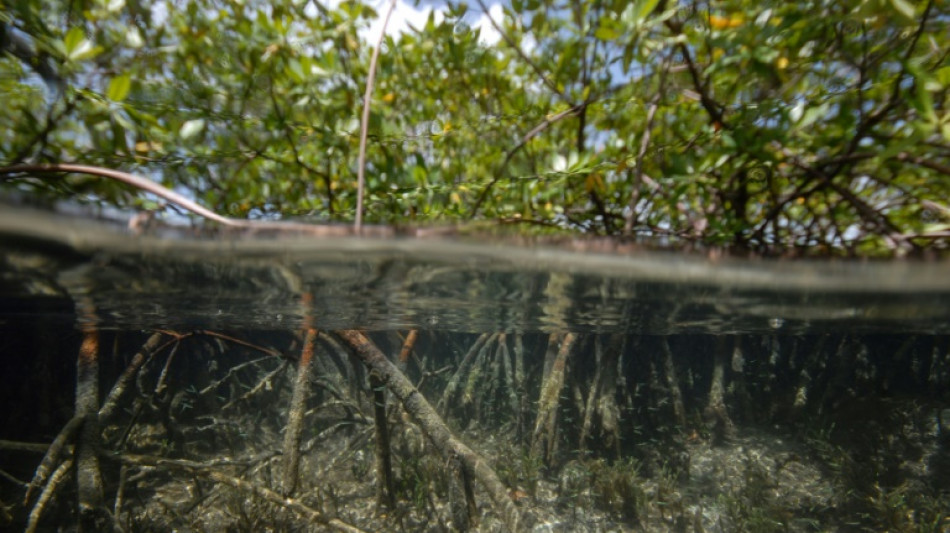
The researcher first spotted the strange filaments in a patch of sulphur-rich mangrove sediment in 2009.

Techniques including electronic microscopy revealed it was a bacterial organism, but there was no guarantee it was a single cell.

- 'As tall as Mount Everest' -

Molecular biologist Silvina Gonzalez-Rizzo, from the same laboratory, found it belonged to the Thiomargarita family, a bacterial genus known to use sulphides to grow. And a researcher in Paris suggested they were indeed dealing with just one cell.

But a first attempt at publication in a scientific journal a few years later was aborted.

"We were told: 'This is interesting, but we lack the information to believe you'," Gros said, adding that they needed stronger images to provide proof.

Then a young researcher, Jean-Marie Volland, managed to study the bacterium with the Lawrence Berkeley National Laboratory, run by the University of California.

With financial backing and access to some of the best tools in the field, Volland and his colleagues began building up a picture of the colossal bacteria.

It was clearly enormous by bacterial standards -- scaled up to human proportions, it would be like meeting someone "as tall as Mount Everest", Volland said.

Specialist 3D microscope images finally made it possible to prove that the entire filament was indeed a single cell.

But they also helped Volland make a "completely unexpected" discovery.

Normally, a bacterium's DNA floats freely in the cell. But in the giant species, it is compacted in small structures surrounded by a membrane, he explained.

This DNA compartmentalisation is "normally a feature of human, animal and plant cells, complex organisms... but not bacteria," Volland said.

Future research will have to determine if these characteristics are unique to Thiomargarita magnifica, or if they can be found in other species of bacteria, Gros said.

M.Delgado--TFWP