The Fort Worth Press - New T-Rex ancestor discovered in drawers of Mongolian institute

USD -
AED 3.67315
AFN 63.49594
ALL 81.989534
AMD 370.903715
ANG 1.789884
AOA 917.99983
ARS 1402.048197
AUD 1.395284
AWG 1.8025
AZN 1.698797
BAM 1.67146
BBD 2.014355
BDT 122.739548
BGN 1.668102
BHD 0.377399
BIF 2975
BMD 1
BND 1.275858
BOB 6.936925
BRL 4.984798
BSD 1.000128
BTN 95.070143
BWP 13.576443
BYN 2.828953
BYR 19600
BZD 2.011854
CAD 1.362389
CDF 2316.000194
CHF 0.784298
CLF 0.023178
CLP 912.220347
CNY 6.83025
CNH 6.830935
COP 3730.15
CRC 454.739685
CUC 1
CUP 26.5
CVE 94.649912
CZK 20.867705
DJF 177.719713
DKK 6.3919
DOP 59.602223
DZD 132.55103
EGP 53.529789
ERN 15
ETB 157.074992
EUR 0.85525
FJD 2.19835
FKP 0.736222
GBP 0.73885
GEL 2.684989
GGP 0.736222
GHS 11.195043
GIP 0.736222
GMD 73.499293
GNF 8777.498486
GTQ 7.643867
GYD 209.252937
HKD 7.83307
HNL 26.629682
HRK 6.444302
HTG 130.892468
HUF 312.330193
IDR 17389.95
ILS 2.943995
IMP 0.736222
INR 95.26255
IQD 1310
IRR 1315000.000217
ISK 122.610256
JEP 0.736222
JMD 157.565709
JOD 0.709016
JPY 157.195993
KES 129.180276
KGS 87.420501
KHR 4011.999928
KMF 420.498013
KPW 899.999998
KRW 1476.560203
KWD 0.30802
KYD 0.833593
KZT 463.980036
LAK 21962.495784
LBP 89401.229103
LKR 319.60688
LRD 183.624986
LSL 16.829672
LTL 2.95274
LVL 0.60489
LYD 6.334978
MAD 9.246973
MDL 17.22053
MGA 4155.000537
MKD 52.718674
MMK 2099.74975
MNT 3576.675528
MOP 8.070745
MRU 39.949934
MUR 46.759935
MVR 15.454983
MWK 1741.498844
MXN 17.519699
MYR 3.952987
MZN 63.909966
NAD 16.82972
NGN 1371.859584
NIO 36.720376
NOK 9.276301
NPR 152.110449
NZD 1.702345
OMR 0.3845
PAB 1.000329
PEN 3.506021
PGK 4.332497
PHP 61.755007
PKR 278.749726
PLN 3.64175
PYG 6218.192229
QAR 3.642981
RON 4.443596
RSD 100.458989
RUB 75.003336
RWF 1460.5
SAR 3.752195
SBD 8.025868
SCR 13.730136
SDG 600.49594
SEK 9.29262
SGD 1.27691
SHP 0.746601
SLE 24.649709
SLL 20969.496166
SOS 571.495216
SRD 37.455975
STD 20697.981008
STN 21.15
SVC 8.752948
SYP 110.524984
SZL 16.829938
THB 32.720082
TJS 9.363182
TMT 3.505
TND 2.885502
TOP 2.40776
TRY 45.185375
TTD 6.794204
TWD 31.677013
TZS 2594.999984
UAH 44.075497
UGX 3753.577989
UYU 40.286638
UZS 11998.000058
VES 488.94275
VND 26339.5
VUV 118.778782
WST 2.715188
XAF 560.591908
XAG 0.013756
XAU 0.000221
XCD 2.70255
XCG 1.8029
XDR 0.69563
XOF 558.498827
XPF 102.374977
YER 238.625012
ZAR 16.811398
ZMK 9001.199474
ZMW 18.731492
ZWL 321.999592
  • BCE

    -0.0300

    23.93

    -0.13%

  • CMSD

    -0.0300

    23.25

    -0.13%

  • AZN

    -1.2800

    183.46

    -0.7%

  • BP

    0.5300

    46.94

    +1.13%

  • RBGPF

    0.5000

    63.1

    +0.79%

  • BCC

    -3.8000

    74.33

    -5.11%

  • NGG

    -0.9800

    87.5

    -1.12%

  • GSK

    -0.7100

    50.9

    -1.39%

  • CMSC

    -0.0100

    22.87

    -0.04%

  • BTI

    -0.3600

    58.35

    -0.62%

  • JRI

    -0.0500

    12.93

    -0.39%

  • RIO

    -1.9500

    98.63

    -1.98%

  • RYCEF

    -0.3000

    16

    -1.88%

  • VOD

    -0.1000

    16.05

    -0.62%

  • RELX

    0.0100

    36.36

    +0.03%

New T-Rex ancestor discovered in drawers of Mongolian institute
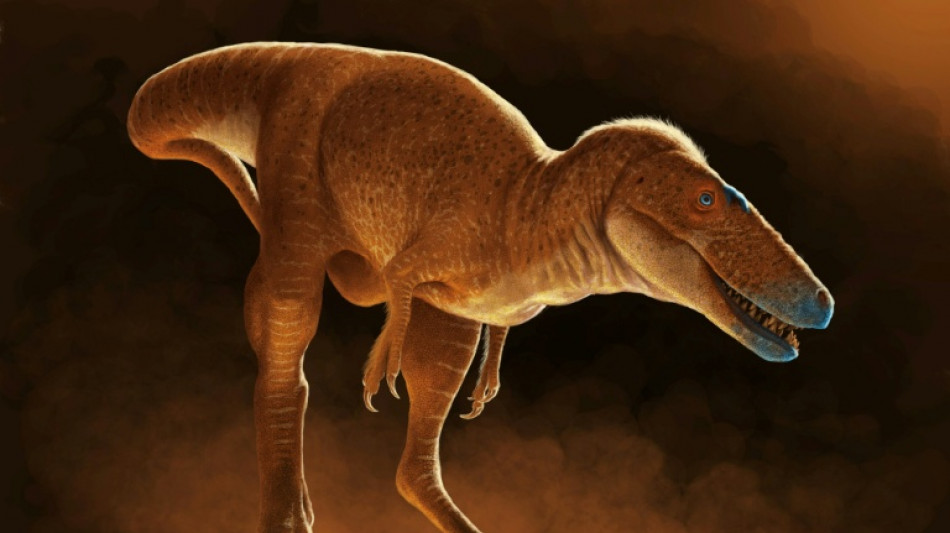
New T-Rex ancestor discovered in drawers of Mongolian institute / Photo: © University of Calgary/AFP

New T-Rex ancestor discovered in drawers of Mongolian institute

Misidentified bones that languished in the drawers of a Mongolian institute for 50 years belong to a new species of tyrannosaur that rewrites the family history of the mighty T-Rex, scientists said Wednesday.

Text size:

This slender ancestor of the massive Tyrannosaurus Rex was around four metres (13 feet) long and weighed three quarters of a tonne, according to a new study in the journal Nature.

"It would have been the size of a very large horse," study co-author Darla Zelenitsky of Canada's University of Calgary told AFP.

The fossils were first dug up in southeastern Mongolia in the early 1970s but at the time were identified as belonging to a different tyrannosaur, Alectrosaurus.

For half a century, the fossils sat in the drawers at the Institute of Paleontology of the Mongolian Academy of Sciences in the capital Ulaanbaatar.

Then PhD student Jared Voris, who was on a trip to Mongolia, started looking through the drawers and noticed something was wrong, Zelenitsky said.

It turned out the fossils were well-preserved, partial skeletons of two different individuals of a completely new species.

"It is quite possible that discoveries like this are sitting in other museums that just have not been recognised," Zelenitsky added.

- 'Messy' family history -

They named the new species Khankhuuluu mongoliensis, which roughly means the dragon prince of Mongolia because it is smaller than the "king" T-Rex.

Zelenitsky said the discovery "helped us clarify a lot about the family history of the tyrannosaur group because it was really messy previously".

The T-Rex represented the end of the family line.

It was the apex predator in North America until 66 million years ago, when an asteroid bigger than Mount Everest slammed into the Gulf of Mexico.

Three quarters of life on Earth was wiped out, including all the dinosaurs that did not evolve into birds.

Around 20 million years earlier, Khankhuuluu -- or another closely related family member -- is now believed to have migrated from Asia to North America using the land bridge that once connected Siberia and Alaska.

This led to tyrannosaurs evolving across North America.

Then one of these species is thought to have crossed back over to Asia, where two tyrannosaur subgroups emerged.

One was much smaller, weighing under a tonne, and was nicknamed Pinocchio rex for its long snout.

The other subgroup was huge and included behemoths like the Tarbosaurus, which was only a little smaller than the T-rex.

One of the gigantic dinosaurs then left Asia again for North America, eventually giving rise to the T-Rex, which dominated for just two million years -- until the asteroid struck.

C.M.Harper--TFWP