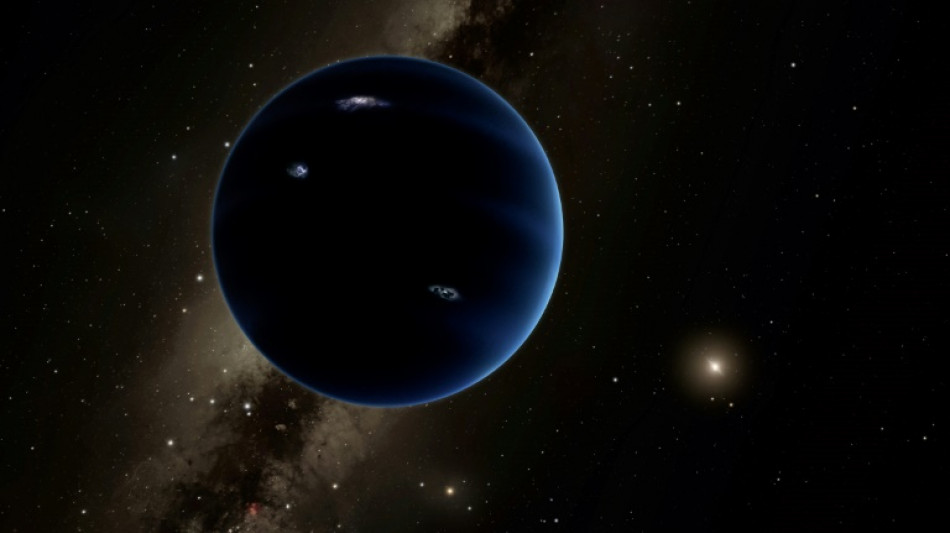
The hunt for mysterious 'Planet Nine' offers up a surprise
/ Photo: © CALTECH/AFP/File

It's an evocative idea that has long bedevilled scientists: a huge and mysterious planet is lurking in the darkness at the edge of our solar system, evading all our efforts to spot it.
Some astronomers say the strange, clustered orbits of icy rocks beyond Neptune indicate that something big is out there, which they have dubbed Planet Nine.
Now, a US-based trio hunting this elusive world has instead stumbled on what appears to be a new dwarf planet in the solar system's outer reaches.
And the existence of this new kid on the block could challenge the Planet Nine theory, the researchers have calculated.
Named 2017 OF201, the new object is roughly 700 kilometres (430 miles) across according to a preprint study, which has not been peer-reviewed, published online last week.
That makes it three times smaller than Pluto.
But that is still big enough to be considered a dwarf planet, lead study author Sihao Cheng of New Jersey's Institute for Advanced Study told AFP.
- Distant traveller -
The object is currently three times farther away from Earth than Neptune.
And its extremely elongated orbit swings out more than 1,600 times the distance between the Earth and the Sun, taking it into the ring of icy rocks around the solar system called the Oort cloud.
It goes so far out, it could have passed by stars other than our Sun in the past, Cheng said.
During its 25,000-year orbit, the object is only close enough to Earth to be observed around 0.5 percent of the time, which is roughly a century.
"It's already getting fainter and fainter," Cheng said.
The discovery suggests "there are many hundreds of similar things on similar orbits" in the Kuiper Belt beyond Neptune, Cheng said.
After taking a risk spending more than half a year sorting through a difficult dataset in search of Planet Nine, Cheng said he was "lucky" to have found anything at all.
The researchers are requesting time to point the James Webb, Hubble and ALMA telescopes at their discovery.
But Sam Deen, a 23-year-old amateur astronomer from California, has already been able to track the dwarf planet candidate through old datasets.
"OF201 is, in my opinion, probably one of the most interesting discoveries in the outer solar system in the last decade," Deen told AFP.
- What about Planet Nine? -
The icy rocks discovered in the Kuiper belt tend to have a clustered orbit going in a particular direction.
Two decades ago, astronomers proposed this was due to the gravitational pull of a world up to 10 times larger than Earth, naming it Planet Nine and kicking off a debate that has rumbled since.
It is also sometimes called Planet X, a name proposed for a hypothetical world beyond Neptune more than a century ago.
Back in 1930, astronomers were searching for Planet X when they discovered Pluto, which became our solar system's ninth planet.
But Pluto turned out to be too tiny -- it is smaller than the Moon -- and was demoted to dwarf planet status in 2006.
There are now four other officially recognised dwarf planets, and Cheng believes 2017 OF201 could join their ranks.
When the researchers modelled its orbit, they found it did not follow the clustered trend of similar objects.
This could pose a problem for the Planet Nine theory, but Cheng emphasised more data is needed.
Samantha Lawler of Canada's University of Regina told AFP that this "great discovery" and others like it mean that "the original argument for Planet Nine is getting weaker and weaker".
The Vera Rubin Observatory, which is scheduled to go online in Chile this year, is expected to shed light on this mystery, one way or another.
Deen said it was discouraging that no sign of Planet Nine has been found so far, but with Vera Rubin "on the horizon I don't think we'll have to wonder about its existence for much longer".
For Cheng, he still hopes that this huge planet is out there somewhere.
"We're in an era when big telescopes can see almost to the edge of the universe," he said.
But what is in our "backyard" still largely remains unknown, he added.
S.Weaver--TFWP