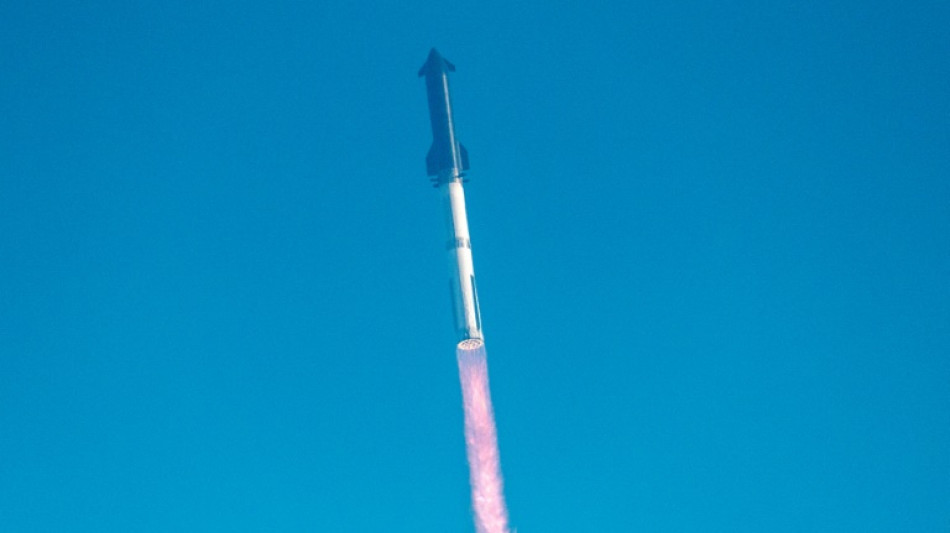
Starship megarocket blows up over Indian Ocean in latest bumpy test / Photo: © AFP

SpaceX's prototype Starship exploded over the Indian Ocean on Tuesday, capping another bumpy test flight for the rocket central to billionaire Elon Musk's dream of colonizing Mars.
The biggest and most powerful launch vehicle ever built lifted off around 6:36 pm (2336 GMT) from the company's Starbase facility, near a southern Texas village that earlier this month voted to become a city -- also named Starbase.
Excitement ran high among SpaceX engineers and spectators alike, after the last two outings ended with the upper stage disintegrating in fiery cascades over the Caribbean.
But signs of trouble emerged quickly: the first-stage Super Heavy booster blew up instead of executing its planned splashdown in the Gulf of Mexico.
A live feed then showed the upper-stage spaceship failing to open its doors to deploy a payload of Starlink satellite "simulators."
Though the ship flew farther than on its two previous attempts, it sprang leaks and began spinning out of control as it coasted through space.
Mission teams vented fuel to reduce the force of the expected explosion, and onboard cameras cut out roughly 45 minutes into what was meant to be a 66-minute flight -- falling short of its target splashdown zone off Australia's west coast.
"Starship experienced a rapid unscheduled disassembly," SpaceX posted on X -- a familiar euphemism for fiery failure -- while stressing it would learn from the setback.
Musk, meanwhile, vowed to pick up the pace: "Launch cadence for the next 3 flights will be faster — approximately one every 3 to 4 weeks," he said.
- Space fans -
Standing 403 feet (123 meters) tall, the black-and-white behemoth is designed to eventually be fully reusable and launch at low cost, carrying Musk's hopes of making humanity a multi-planetary species.
NASA is also counting on a variant of Starship to serve as the crew lander for Artemis 3, the mission to return Americans to the Moon.
Ahead of the launch, dozens of space fans gathered at Isla Blanca Park on nearby South Padre Island, hoping to catch a glimpse of history.
Several small tourist boats also dotted the lagoon, while a live feed showed Musk sitting at ground control in Starbase, wearing an "Occupy Mars" T-shirt.
Australian Piers Dawson, 50, told AFP he's "obsessed" with the rocket and built his family vacation around the launch -- his first trip to the United States, with his wife and teenage son whom he took out of school to be there.
"I know in science there's never a failure, you learn everything from every single test so that was still super exciting to see," said Joshua Wingate, a 33-year-old tech entrepreneur from Austin, after the launch.
- 'Fail fast, learn fast' -
Starship has now completed nine integrated test flights atop its Super Heavy booster. It was the first flight since test two that both vehicles were lost.
SpaceX is betting that its "fail fast, learn fast" ethos, which helped it dominate commercial spaceflight, will once again pay off.
One bright spot: the company has now caught the Super Heavy booster in the launch tower's giant robotic arms three times — a daring engineering feat it sees as key to rapid reusability and slashing costs.
This ninth flight marked the first time SpaceX reused a Super Heavy booster, though it opted not to attempt a catch -- instead pushing the envelope with a steeper descent angle and one engine intentionally disabled.
The FAA recently approved an increase in Starship launches from five to 25 annually, stating the expanded schedule wouldn't harm the environment -- a decision that overruled objections from conservation groups concerned about impacts to sea turtles and shorebirds.
L.Coleman--TFWP