The Fort Worth Press - Universe dying quicker than thought, says new research

USD -
AED 3.672498
AFN 66.135424
ALL 82.428003
AMD 381.697608
ANG 1.790403
AOA 917.000333
ARS 1440.719298
AUD 1.503556
AWG 1.8
AZN 1.698617
BAM 1.6671
BBD 2.013298
BDT 122.155689
BGN 1.666095
BHD 0.376959
BIF 2954.536737
BMD 1
BND 1.290974
BOB 6.906898
BRL 5.403152
BSD 0.999616
BTN 90.396959
BWP 13.244683
BYN 2.94679
BYR 19600
BZD 2.010374
CAD 1.37658
CDF 2240.000343
CHF 0.795735
CLF 0.023238
CLP 911.629427
CNY 7.054505
CNH 7.041445
COP 3801.6
CRC 500.023441
CUC 1
CUP 26.5
CVE 93.988535
CZK 20.66805
DJF 178.007927
DKK 6.35678
DOP 63.547132
DZD 129.654932
EGP 47.449851
ERN 15
ETB 156.189388
EUR 0.850931
FJD 2.253797
FKP 0.748248
GBP 0.74691
GEL 2.70203
GGP 0.748248
GHS 11.474844
GIP 0.748248
GMD 73.000007
GNF 8692.206077
GTQ 7.656114
GYD 209.124811
HKD 7.78223
HNL 26.31718
HRK 6.410897
HTG 131.023872
HUF 327.803501
IDR 16673.45
ILS 3.20699
IMP 0.748248
INR 90.72575
IQD 1309.438063
IRR 42122.494452
ISK 126.299846
JEP 0.748248
JMD 160.047735
JOD 0.708952
JPY 154.966501
KES 128.950385
KGS 87.449685
KHR 4002.062831
KMF 419.501996
KPW 899.999687
KRW 1464.35502
KWD 0.30682
KYD 0.833039
KZT 521.320349
LAK 21670.253798
LBP 89512.817781
LKR 308.871226
LRD 176.427969
LSL 16.864406
LTL 2.95274
LVL 0.60489
LYD 5.429826
MAD 9.19607
MDL 16.897807
MGA 4428.248732
MKD 52.4169
MMK 2099.265884
MNT 3545.865278
MOP 8.015428
MRU 40.004433
MUR 45.950131
MVR 15.398937
MWK 1733.36743
MXN 17.978805
MYR 4.0925
MZN 63.910031
NAD 16.864406
NGN 1451.530241
NIO 36.789996
NOK 10.13585
NPR 144.638557
NZD 1.725615
OMR 0.384498
PAB 0.999595
PEN 3.365397
PGK 4.308177
PHP 58.924995
PKR 280.140733
PLN 3.59277
PYG 6714.401398
QAR 3.643004
RON 4.335502
RSD 99.943984
RUB 79.121636
RWF 1454.886417
SAR 3.752081
SBD 8.176752
SCR 14.658273
SDG 601.499594
SEK 9.28439
SGD 1.288906
SHP 0.750259
SLE 24.125013
SLL 20969.503664
SOS 570.259558
SRD 38.547979
STD 20697.981008
STN 20.880385
SVC 8.746351
SYP 11056.681827
SZL 16.85874
THB 31.431503
TJS 9.186183
TMT 3.51
TND 2.922143
TOP 2.40776
TRY 42.701498
TTD 6.783302
TWD 31.318031
TZS 2482.490189
UAH 42.236116
UGX 3552.752147
UYU 39.226383
UZS 12042.534149
VES 267.43975
VND 26320
VUV 121.127634
WST 2.775483
XAF 559.141627
XAG 0.015656
XAU 0.00023
XCD 2.70255
XCG 1.801522
XDR 0.695393
XOF 559.141627
XPF 101.655763
YER 238.499715
ZAR 16.776101
ZMK 9001.197187
ZMW 23.065809
ZWL 321.999592
  • RIO

    -1.0800

    75.66

    -1.43%

  • CMSC

    -0.1300

    23.3

    -0.56%

  • SCS

    0.0200

    16.14

    +0.12%

  • RBGPF

    0.0000

    81.17

    0%

  • BCC

    0.2500

    76.51

    +0.33%

  • RYCEF

    -0.2500

    14.6

    -1.71%

  • BTI

    -1.2700

    57.1

    -2.22%

  • NGG

    0.2400

    74.93

    +0.32%

  • BCE

    0.3100

    23.71

    +1.31%

  • CMSD

    -0.1500

    23.25

    -0.65%

  • RELX

    0.1000

    40.38

    +0.25%

  • GSK

    -0.0700

    48.81

    -0.14%

  • JRI

    -0.0200

    13.7

    -0.15%

  • VOD

    0.0500

    12.59

    +0.4%

  • BP

    -0.2700

    35.26

    -0.77%

  • AZN

    -0.4600

    89.83

    -0.51%

Universe dying quicker than thought, says new research
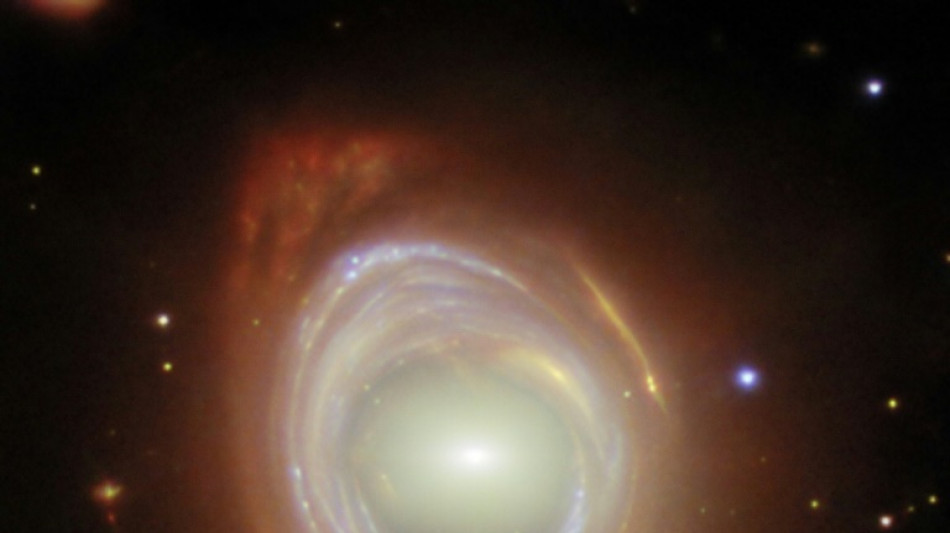
Universe dying quicker than thought, says new research / Photo: © ESA/Webb, NASA & CSA, G. Mahler/AFP

Universe dying quicker than thought, says new research

The universe is poised to die much faster than previously thought, according to new research by Dutch scientists.

Text size:

But there's no great need to panic. We still have 10 to the power of 78 years before it happens -- that's a one with 78 zeroes.

However, that is a major revision from the previous estimate of 10 to the power of 1,100 years, notes the research paper from Radboud University, published in the Journal of Cosmology and Astroparticle Physics.

"The final end of the universe is coming much sooner than expected but fortunately it still takes a very long time," said lead author Heino Falcke.

A trio of scientists at Radboud set out to calculate when the most "durable" celestial bodies -- white dwarf stars -- would eventually die out.

They based their calculations on Hawking radiation, named after celebrated British physicist Stephen Hawking.

Hawking postulated in the mid-1970s that black holes leak radiation, slowly dissolving like aspirin in a glass of water -- giving them a finite lifetime.

The Radboud scientists extended this to other objects in the universe, calculating that the "evaporation time" depends on density.

This enabled them to calculate the theoretical dissolution of the longest-lasting body, the white dwarf.

"By asking these kinds of questions and looking at extreme cases, we want to better understand the theory, and perhaps one day, we can unravel the mystery of Hawking radiation," said co-author Walter van Suijlekom.

Humankind needn't worry too much about the end of the universe. Unless we escape planet Earth, we'll be long gone.

Scientists think that our Sun will be too hot for life in about a billion years, boiling our oceans.

In about eight billion years, our star will eventually expand towards the Earth, finally gobbling up our by-then barren and lifeless planet and condemning it to a fiery death.

D.Johnson--TFWP