The Fort Worth Press - Study sheds light on origin of Australia's odd echidna

USD -
AED 3.673098
AFN 63.999807
ALL 83.315562
AMD 377.389656
ANG 1.790083
AOA 916.999992
ARS 1394.421201
AUD 1.423285
AWG 1.8
AZN 1.69886
BAM 1.696352
BBD 2.017025
BDT 122.885307
BGN 1.709309
BHD 0.377541
BIF 2970
BMD 1
BND 1.278723
BOB 6.920298
BRL 5.274396
BSD 1.001487
BTN 92.872847
BWP 13.580798
BYN 3.052406
BYR 19600
BZD 2.014155
CAD 1.37334
CDF 2270.00003
CHF 0.793255
CLF 0.023189
CLP 915.629725
CNY 6.87305
CNH 6.90112
COP 3704.7
CRC 467.742425
CUC 1
CUP 26.5
CVE 97.05002
CZK 21.383498
DJF 177.720131
DKK 6.523802
DOP 60.050166
DZD 132.663948
EGP 52.24302
ERN 15
ETB 156.999893
EUR 0.872903
FJD 2.24225
FKP 0.749449
GBP 0.754235
GEL 2.714978
GGP 0.749449
GHS 10.904995
GIP 0.749449
GMD 73.999696
GNF 8780.000119
GTQ 7.671558
GYD 209.520258
HKD 7.83865
HNL 26.570125
HRK 6.577798
HTG 131.24607
HUF 343.549944
IDR 17035.7
ILS 3.10005
IMP 0.749449
INR 93.40875
IQD 1310
IRR 1314999.999933
ISK 125.009719
JEP 0.749449
JMD 157.249479
JOD 0.708951
JPY 159.839855
KES 129.549694
KGS 87.450268
KHR 4009.999876
KMF 428.00016
KPW 899.9784
KRW 1511.869915
KWD 0.306695
KYD 0.834501
KZT 483.111229
LAK 21450.000341
LBP 89537.026148
LKR 311.844884
LRD 183.350276
LSL 16.820035
LTL 2.95274
LVL 0.60489
LYD 6.37991
MAD 9.37375
MDL 17.460159
MGA 4170.000124
MKD 53.814419
MMK 2100.10344
MNT 3571.101739
MOP 8.084959
MRU 40.119616
MUR 46.510091
MVR 15.46018
MWK 1735.999889
MXN 17.857603
MYR 3.915498
MZN 63.901624
NAD 16.819645
NGN 1355.99965
NIO 36.719956
NOK 9.610649
NPR 148.591748
NZD 1.724305
OMR 0.384495
PAB 1.001483
PEN 3.427503
PGK 4.30275
PHP 60.071971
PKR 279.302498
PLN 3.73735
PYG 6472.539624
QAR 3.644034
RON 4.445399
RSD 102.522958
RUB 83.870329
RWF 1459
SAR 3.754685
SBD 8.04524
SCR 14.436208
SDG 601.00003
SEK 9.421097
SGD 1.283599
SHP 0.750259
SLE 24.649774
SLL 20969.510825
SOS 571.49753
SRD 37.375052
STD 20697.981008
STN 21.5
SVC 8.762663
SYP 110.58576
SZL 16.82014
THB 32.780244
TJS 9.578717
TMT 3.5
TND 2.917502
TOP 2.40776
TRY 44.247018
TTD 6.788466
TWD 32.033199
TZS 2603.729794
UAH 44.042968
UGX 3767.67725
UYU 40.557008
UZS 12174.999989
VES 450.94284
VND 26310
VUV 119.592862
WST 2.733704
XAF 568.900934
XAG 0.013263
XAU 0.000208
XCD 2.70255
XCG 1.80488
XDR 0.70688
XOF 566.500406
XPF 103.896222
YER 238.574978
ZAR 16.987605
ZMK 9001.199588
ZMW 19.583865
ZWL 321.999592
  • RBGPF

    0.1000

    82.5

    +0.12%

  • BCC

    -1.0800

    71.84

    -1.5%

  • RYCEF

    -0.1800

    16.6

    -1.08%

  • CMSC

    -0.1200

    22.83

    -0.53%

  • NGG

    -3.0200

    87.4

    -3.46%

  • GSK

    -1.3500

    52.06

    -2.59%

  • BCE

    -0.2600

    25.75

    -1.01%

  • RELX

    -0.4300

    33.86

    -1.27%

  • CMSD

    0.0100

    22.89

    +0.04%

  • RIO

    -2.0800

    87.72

    -2.37%

  • BTI

    -2.4600

    58.09

    -4.23%

  • JRI

    -0.1370

    12.323

    -1.11%

  • VOD

    -0.3800

    14.37

    -2.64%

  • AZN

    -2.8700

    188.42

    -1.52%

  • BP

    0.7600

    44.61

    +1.7%

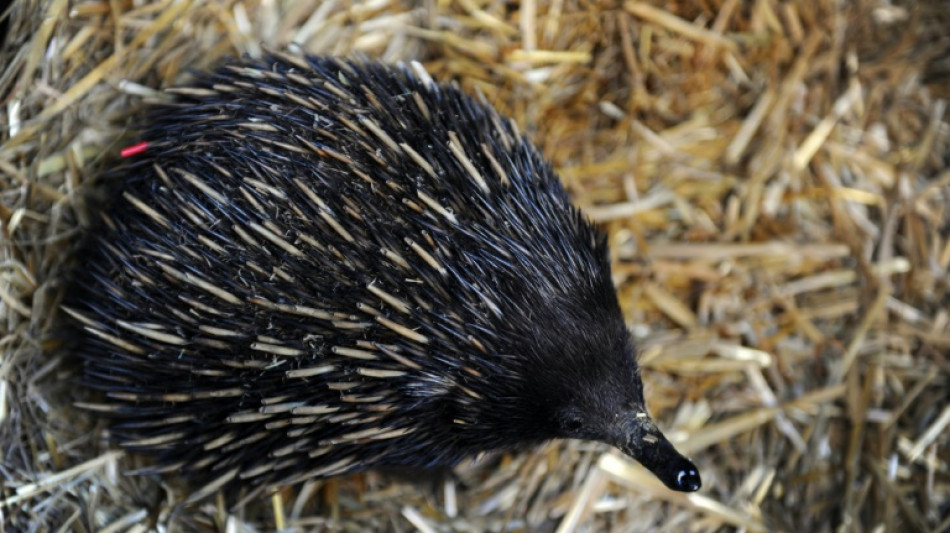
Study sheds light on origin of Australia's odd echidna
Study sheds light on origin of Australia's odd echidna / Photo: © AFP

Study sheds light on origin of Australia's odd echidna

Australia's burrowing echidna evolved from a water-dwelling ancestor in an "extremely rare" biological event, scientists said Tuesday in a new study of the peculiar egg-laying mammals.

Text size:

With powerful digging claws, protective spikes and highly sensitive beaks, echidnas are well suited to a life shuffling through the forest undergrowth.

But a team of Australian and international scientists believe many of the echidna's unusual traits were first developed millions of years ago when its ancestors splashed through the water.

"We're talking about a semiaquatic mammal that gave up the water for a terrestrial existence," said paleontologist Suzanne Hand, from the University of New South Wales.

"While that would be an extremely rare event, we think that's what happened with echidnas."

Echidnas and another Australian oddity, the semi-aquatic platypus, are believed to have evolved from a common ancestor called Kryoryctes cadburyi that lived in Australia more than 100 million years ago.

Researchers studied the single known bone fragment left by this ancestor, which was discovered among a trove of fossils at Dinosaur Cove in southern Australia some 30 years ago.

Platypus bones were similar to this ancient ancestor, Hand said, with a thick and heavy structure that provided ballast for diving.

Echidnas, in comparison, had very thin bone walls that made it easier to walk on land, Hand said.

This indicated echidnas were descended from a water-dwelling ancestor but had evolved to live on land, the research found.

It was far more common for prehistoric mammals to go from land to water, Hand said, pointing towards seals, whales, dolphins and dugongs.

The researchers said these findings appeared to be supported by other echidna traits.

Echidnas have backward-facing hind feet that help them shift mounds of soil when burrowing.

These feet may have first developed as rudders helping the echidna's ancestor navigate fast-moving waterways, Hand said.

Echidnas also have a "diving reflex" when submerged in water, which tells their body to conserve oxygen helping them hold their breath for longer.

Echidnas and platypus are monotremes, a rare group of mammals that lay eggs instead of live young.

"We're hoping we'll discover other ancestral monotremes that will help unravel the early history of this most fascinating group of mammals," said study co-author Michael Archer.

The research was published in peer-reviewed journal PNAS.

T.Mason--TFWP