Smart driving new front in China car wars despite fatal crash / Photo: © AFP

Intelligent driving features are the new battleground in China's merciless car market, with competition spurring brands to world-leading advances -- but a recent fatal crash has seen the government intervene to put the brakes on runaway enthusiasm.
Advanced driver-assistance systems (ADAS) help with tasks ranging from cruise control to parking and collision avoidance, with the ultimate aim being a fully self-driving car.
Automakers are pouring investment into their development, especially in the world's biggest car market China, which skews young and tech-savvy.
"Ten years ago, only 15 percent of customers said they would change car because of an intelligent cockpit -- today it's 54 percent," Giovanni Lanfranchi of EV firm Zeekr said.
Almost 60 percent of cars sold in China last year had level-two ADAS features -- where the driver is still in control but there is continuous assistance -- or above, according to an AlixPartners report released last week.
The features "are emerging as a key competitive tool", said the consultancy's Yvette Zhang.
Some firms use their own proprietary technology, like start-up Xpeng and consumer electronics-turned-car company Xiaomi, while others are cooperating with tech giants such as Huawei.
Such software is being developed in Europe and North America too.
But in a survey of hundreds of global auto executives surveyed by AlixPartners, two-thirds said they believed China led the world in the field.
"The collection and processing of data, and the availability of software and machine-learning talent" is difficult to replicate, the report said.
The technology is not immune from the price wars that are a key feature of the Chinese market.
In February, domestic EV giant BYD announced it would release its "God's Eye" driving system on nearly all its cars, including on some models priced below $10,000.
- Over-promising? -
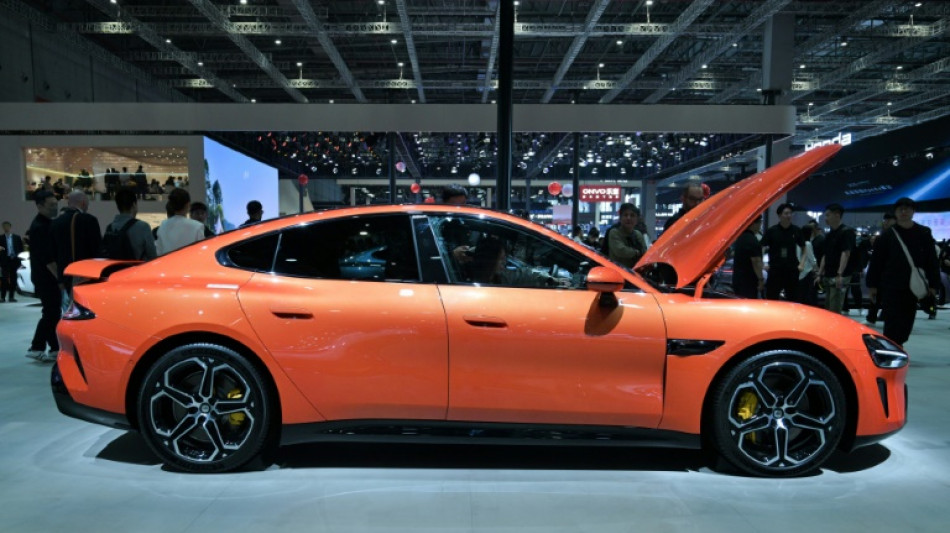
Then came a fatal accident in March involving a Xiaomi SU7 that had been in assisted driving mode just before it crashed.
The accident, in which three college students died, raised concerns over safety and the advertising of cars as being capable of "autonomous driving".
The issue is an industry-wide one -- Tesla's US-released "Full Self-Driving" capability, for example, is still meant to be used under driver supervision.
"The price war has just been so brutal, companies are desperate to find any way to set themselves apart," said Tom Nunlist, associate director for tech and data policy at Trivium China.
"So the question is have they been over-promising on features and releasing things as quickly as possible, for the purposes of fighting this commercial battle."
China's Ministry of Industry and Information Technology seems to share those concerns.
After the crash, it held a meeting with leading automakers and other key players in which it made clear that safety rules would be more tightly enforced.
It warned automakers to test systems rigorously, "define system functional boundaries... and refrain from exaggerated or false advertising".
Reports said it will also crack down on the practice of improving ADAS via remote software updates.
- 'Sharp U-turn' -
As the massive industry show Auto Shanghai kicked off last week, the shift in gear was obvious.
"In a sharp U-turn from just two months ago, carmakers have taken a low profile in terms of autonomous driving functions, but are emphasising safety instead," said UBS' Paul Gong in a note.
"Safety is the ultimate premium of new energy vehicles," a sign at BYD's booth read.
At the bustling Xiaomi booth, information boards touted the SU7's colour choices, chassis and hardware -- but AFP saw no mention of ADAS at all.
"The autonomous driving function marketing race seems to have halted, at least temporarily," wrote Gong.
Zhang Yu, managing director of Shanghai-based consultancy Automotive Foresight, told AFP that he thought the crash was "only a setback in marketing terms, which is helpful for a healthy development" of the area.
"This accident was not related to tech or the system itself, it more concerns the ignorance of ADAS and boundary of autonomous driving," he added.
The technology itself continues to progress.
"That's why this is becoming a pressing issue because car companies are going to be wanting to release these features," Trivium's Nunlist said.
However, a truly autonomous car -- level five on the scale -- is "certainly not imminent", he added, predicting "very hard last-mile problems".
C.M.Harper--TFWP