The Fort Worth Press - Over 14% of world has had Lyme disease: study

USD -
AED 3.67315
AFN 62.999538
ALL 83.598872
AMD 377.409853
ANG 1.790083
AOA 917.000251
ARS 1396.506103
AUD 1.415929
AWG 1.8025
AZN 1.70312
BAM 1.703362
BBD 2.013674
BDT 122.680044
BGN 1.709309
BHD 0.377516
BIF 2970
BMD 1
BND 1.278933
BOB 6.933521
BRL 5.251102
BSD 0.999826
BTN 92.219929
BWP 13.632761
BYN 2.978457
BYR 19600
BZD 2.010896
CAD 1.367651
CDF 2264.999986
CHF 0.787597
CLF 0.023049
CLP 910.109863
CNY 6.95625
CNH 6.89222
COP 3704.15
CRC 469.608688
CUC 1
CUP 26.5
CVE 96.624975
CZK 21.255996
DJF 177.719756
DKK 6.495215
DOP 61.349916
DZD 132.264618
EGP 52.364903
ERN 15
ETB 157.374978
EUR 0.869298
FJD 2.214897
FKP 0.754939
GBP 0.750985
GEL 2.720439
GGP 0.754939
GHS 10.88497
GIP 0.754939
GMD 73.483085
GNF 8774.999742
GTQ 7.663366
GYD 209.28592
HKD 7.83035
HNL 26.569989
HRK 6.555298
HTG 131.04103
HUF 339.912497
IDR 16968
ILS 3.122435
IMP 0.754939
INR 92.25415
IQD 1310
IRR 1321050.000025
ISK 124.479739
JEP 0.754939
JMD 157.272252
JOD 0.709047
JPY 159.169009
KES 129.403293
KGS 87.449745
KHR 4018.495892
KMF 429.000023
KPW 899.999993
KRW 1489.979568
KWD 0.30709
KYD 0.833137
KZT 482.803369
LAK 21474.999737
LBP 89550.000292
LKR 311.33349
LRD 183.250331
LSL 16.759823
LTL 2.95274
LVL 0.60489
LYD 6.409635
MAD 9.394968
MDL 17.396076
MGA 4155.000352
MKD 53.651234
MMK 2099.642329
MNT 3571.28497
MOP 8.0633
MRU 40.114977
MUR 46.779931
MVR 15.45998
MWK 1736.999759
MXN 17.708045
MYR 3.930504
MZN 63.90203
NAD 16.760234
NGN 1366.429505
NIO 36.719783
NOK 9.67741
NPR 147.558017
NZD 1.70793
OMR 0.384508
PAB 0.999835
PEN 3.428498
PGK 4.302502
PHP 59.643024
PKR 279.275029
PLN 3.713409
PYG 6489.287581
QAR 3.64325
RON 4.428206
RSD 102.065025
RUB 81.246127
RWF 1459
SAR 3.752877
SBD 8.05166
SCR 14.239797
SDG 601.000129
SEK 9.344702
SGD 1.278015
SHP 0.750259
SLE 24.601748
SLL 20969.510825
SOS 571.479477
SRD 37.571504
STD 20697.981008
STN 21.6
SVC 8.748552
SYP 110.524985
SZL 16.76031
THB 32.369473
TJS 9.597976
TMT 3.505
TND 2.921001
TOP 2.40776
TRY 44.169803
TTD 6.780237
TWD 31.992697
TZS 2605.000159
UAH 44.076764
UGX 3774.636602
UYU 40.646583
UZS 12105.000366
VES 446.24625
VND 26290
VUV 119.565255
WST 2.735215
XAF 571.296562
XAG 0.012419
XAU 0.0002
XCD 2.70255
XCG 1.801879
XDR 0.71253
XOF 575.494587
XPF 104.199517
YER 238.503834
ZAR 16.722535
ZMK 9001.209337
ZMW 19.470645
ZWL 321.999592
  • CMSD

    -0.0900

    22.9

    -0.39%

  • RBGPF

    0.1000

    82.5

    +0.12%

  • CMSC

    -0.0150

    22.975

    -0.07%

  • GSK

    0.3900

    53.78

    +0.73%

  • BP

    0.2400

    42.91

    +0.56%

  • RIO

    2.0400

    89.87

    +2.27%

  • BCC

    1.6900

    71.69

    +2.36%

  • BCE

    0.6421

    25.89

    +2.48%

  • BTI

    1.0150

    60.945

    +1.67%

  • RELX

    0.3500

    34.49

    +1.01%

  • RYCEF

    -0.1500

    16.4

    -0.91%

  • VOD

    0.1900

    14.6

    +1.3%

  • JRI

    -0.0450

    12.545

    -0.36%

  • NGG

    -0.0100

    90.89

    -0.01%

  • AZN

    2.1500

    192.05

    +1.12%

Over 14% of world has had Lyme disease: study
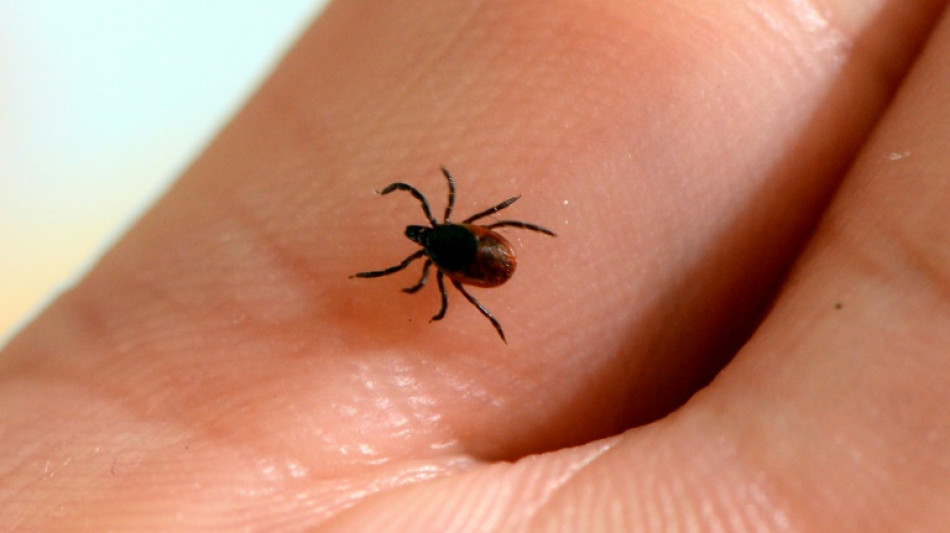
Over 14% of world has had Lyme disease: study / Photo: © AFP/File

Over 14% of world has had Lyme disease: study

More than 14 percent of the world's population has had Lyme disease, the most common tick-borne illness, according to a major review of the available research published on Tuesday.

Text size:

Central Europe had the highest rate of infection with 20 percent, while men over the age of 50 living in rural areas were most at risk, the study in the journal BMJ Global Health found.

The condition is rarely fatal, but people bitten by an infected tick often get a rash and suffer flu-like symptoms including muscle and joint ache, headache, nausea and vomiting.

To find out how common Lyme disease is across the world, the researchers pooled data from 89 studies.

The bacteria Borrelia burgdorferi (Bb), which causes the disease, was found in the blood of 14.5 percent of the nearly 160,000 total participants.

"This is the most comprehensive and up-to-date systematic review of the worldwide" prevalence of the disease, the researchers said.

After Central Europe, the regions with the highest antibody rates were Eastern Asia with 15.9 percent, Western Europe with 13.5 percent and Eastern Europe with 10.4 percent.

The Caribbean meanwhile had the lowest rate, with just two percent.

Previous research has shown that the prevalence of tick-borne diseases has doubled in the last 12 years.

Reasons for the rise included longer, drier summers due to climate change, animal migration, habitat loss and "increasingly frequent pet contact", the study said.

Farmers and workers who regularly interact with host animals like dogs and sheep were most at risk of getting bitten by an infected tick, the study found.

It warned that the data could be skewed in regions where Lyme disease is endemic, because health workers are more likely to carry out regular antibody tests there compared to regions where it is less common.

The study also said that research using an analytic technique called western blotting was more reliable and that its use "could significantly improve the accuracy" of future studies.

T.Gilbert--TFWP