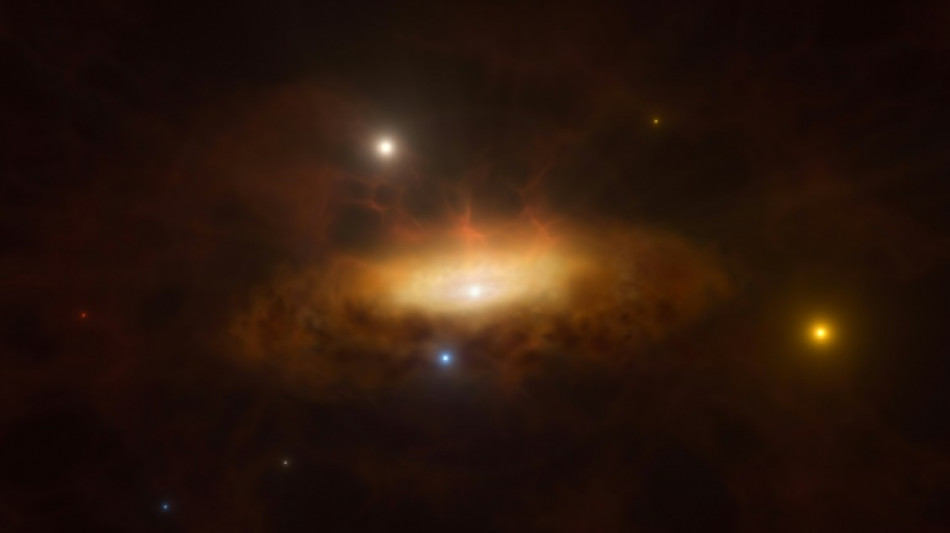
Massive black hole 'waking up' in Virgo constellation / Photo: © European Southern Observatory/AFP/File

A massive black hole at the heart of a galaxy in the Virgo constellation is waking up, shooting out intense X-ray flares at regular intervals that have puzzled scientists, a study said Friday.
Astronomers previously had little reason to pay any attention to galaxy SDSS1335+0728, which is 300 million light years from Earth.
But in 2019, the galaxy suddenly started shining with a brightness that turned some telescopes its way.
Then in February last year, Chilean astronomers started noticing regular bursts of X-rays coming from the galaxy.
This was a sign that the galaxy's sleeping black hole was waking from its slumber, according to the study published in the journal Nature Astronomy.
Most galaxies, including our home Milky Way, have a supermassive black hole squatting at their heart, like a spider in a web.
These invisible monsters gobble up everything that comes their way -- not even light can escape their almighty suck.
If an unlucky star swings too close, it gets torn apart.
The star's shattered material becomes a stream that spins rapidly around the black hole, forming what is called an accretion disc that is gradually swallowed.
But black holes can also go through long periods of inactivity when they do not attract matter.
And after a fairly uneventful period, the bright, compact region at the heart of galaxy SDSS1335+0728 has been classified as an "active galactic nucleus" -- and given the nickname "Ansky".
"This rare event provides an opportunity for astronomers to observe a black hole's behaviour in real time" using several X-ray telescopes, astronomer Lorena Hernandez-Garcia of Chile's Valparaiso University said in a statement.
- 'Pushes models to their limits' -
Ansky's short-lived X-ray flares are called quasiperiodic eruptions, or QPEs.
"This is the first time we have observed such an event in a black hole that seems to be waking up," Hernandez-Garcia said.
"We don't yet understand what causes them."
The current theory is that QPEs are linked to the accretion discs that form after black holes swallow stars.
But there is no sign that Ansky has recently feasted on a star.
And its flares are quite unusual.
"The bursts of X-rays from Ansky are 10 times longer and 10 times more luminous than what we see from a typical QPE," said Joheen Chakraborty, a PhD student at MIT and member of the research team.
"Each of these eruptions is releasing a hundred times more energy than we have seen elsewhere."
The intervals of 4.5 days between these blasts are also the longest ever observed, he added.
"This pushes our models to their limits and challenges our existing ideas about how these X-ray flashes are being generated," he said in the statement.
Astronomers have had to come up with some theories for what could be causing these strange bursts.
One was that the accretion disc was formed by gas getting sucked into the black hole, which only shoots out X-ray flares when a small celestial object such as a star crosses its path.
"Simply imagine a black hole and disc around it," Norbert Schartel, chief scientist of the European Space Agency's XMM-Newton telescope which has observed Ansky, told AFP.
Now imagine the star crossing the disc twice every time it orbits -- shooting out flares -- but at a particular angle which means "there is no real strong force to drag it in," he said.
X-ray astronomer Erwan Quintin told AFP that "for QPEs, we're still at the point where we have more models than data".
"We need more observations to understand what's happening."
J.M.Ellis--TFWP